
The constant urge to stay connected isn’t a personal failing; it’s a design problem in your environment.
- Your brain is wired with “psychological hooks,” like the unpredictable reward of a new email, that create compulsive checking habits.
- Creating clear sensory boundaries (using light, sound, and scent) is more effective than relying on willpower, especially in small spaces.
Recommendation: Stop trying harder and start designing smarter. Systematically re-engineer your physical and digital spaces to send clear “off-duty” signals to your brain.
The line between your living room couch and your office has blurred into non-existence. You close your laptop at 6 PM, but your work brain stays logged on, replaying conversations and checking for one last email. You know the common advice: set a schedule, have a dedicated workspace, turn off notifications. You’ve tried it all. Yet, the feeling of being “always on” persists, leaving you drained and wondering if this remote work freedom is actually a gilded cage. You’re not alone in this struggle; hyper-connectivity is the silent epidemic of the modern workforce.
The problem is that most advice treats this as an issue of time management or personal discipline. It assumes that if you just try harder, you’ll be able to switch off. But what if the root cause isn’t your lack of willpower? What if the real issue lies in the powerful psychological mechanisms and environmental cues you’re unknowingly subjected to? This isn’t about managing your calendar; it’s about re-engineering your entire work-life ecosystem.
This guide offers a different approach. We won’t just tell you “what” to do; we’ll explain “why” conventional methods fail and provide a strategic framework for dismantling the psychological hooks that keep you tethered to work. We’ll explore how to create firm boundaries even in a studio apartment, master your notifications, and implement physical routines that signal to your body and mind that the workday is truly over. It’s time to stop fighting a losing battle against your own brain and start redesigning your environment for true disconnection.
In this article, we will delve into the practical strategies and psychological shifts needed to reclaim your personal time. The following sections provide a clear roadmap to move from a state of constant connection to one of intentional rest and focus.
Summary: A Practical Guide to Reclaiming Your Off-Hours
- Why You Check Your Email at 10 PM Even When It Is Not Urgent?
- How to Create a “Tech-Free Zone” in a Studio Apartment?
- Cold Turkey vs. Gradual Reduction: Which Detox Method Lasts Longer?
- The Mistake That Ruins Relationships for 60% of Digital Nomads
- Regaining Focus: The Notification Setup That Doubles Productivity
- Why You Wake Up Tired Even After 8 Hours of Sleep?
- When to Stand Up: The 20-8-2 Rule for Metabolic Health
- How to Lead a Team Across 4 Time Zones Without working 24/7?
Why You Check Your Email at 10 PM Even When It Is Not Urgent?
That compulsive urge to check your inbox long after the workday has ended isn’t a simple bad habit; it’s a deeply ingrained psychological reflex. The culture of remote work has intensified this, with many employees feeling pressured to be constantly available. In fact, remote employees end up working an average of 9.4 unpaid hours of overtime every week, often because the boundary between work and home has completely dissolved. This “always on” expectation creates a state of low-grade, persistent anxiety.
The core of the issue is a powerful psychological mechanism known as a variable-ratio reinforcement schedule. It’s the same principle that makes slot machines addictive. You don’t know when the next “reward” (an important email, a piece of praise, a critical update) will arrive, so you keep pulling the lever—or in this case, refreshing your inbox. Research by The Harris Poll confirms the scale of this issue, finding that 60% of Americans struggle to disconnect from work during their time off. This unpredictable reward system trains your brain to seek the dopamine hit of a new message, turning your inbox into a source of both stress and compulsion.
Breaking this cycle requires more than just willpower. It requires actively dismantling the trigger-reward loop. Start by creating a “shutdown ritual” that clearly signals the end of your workday. This could involve closing your laptop, tidying your desk, and then immediately engaging in a non-work activity. The goal is to replace the email-checking routine with a new, healthier one that your brain can learn to associate with relaxation and disconnection. By understanding and addressing the underlying psychological hooks, you can begin to reclaim your evenings.
How to Create a “Tech-Free Zone” in a Studio Apartment?
When your bedroom is also your boardroom, creating a mental separation from work feels impossible. The common advice to “have a dedicated workspace” is unhelpful for those in a studio or small apartment. The solution isn’t necessarily physical separation, but sensory zoning. This is a form of environmental engineering where you use light, sound, and scent to create distinct “zones” for work and relaxation within the same physical space. Your brain is highly attuned to these cues, and you can leverage them to signal when it’s time to be productive versus when it’s time to rest.
For example, use a bright, blue-toned desk lamp during work hours to promote alertness. When you clock off, turn it off and switch to a warm, soft-glowing floor lamp in your “living” area. This simple change in lighting can have a profound effect on your mental state. As digital wellness coach Caroline Devine notes, sound is another powerful tool for sensory zoning:
I listen to lo-fi hip-hop on YouTube only when I’m working so that my brain associates that channel with work time.
– Caroline Devine, Clockwise Blog on Remote Work
This strategy of creating unique sensory associations helps your mind transition seamlessly between work mode and personal mode, even if your body hasn’t moved an inch.
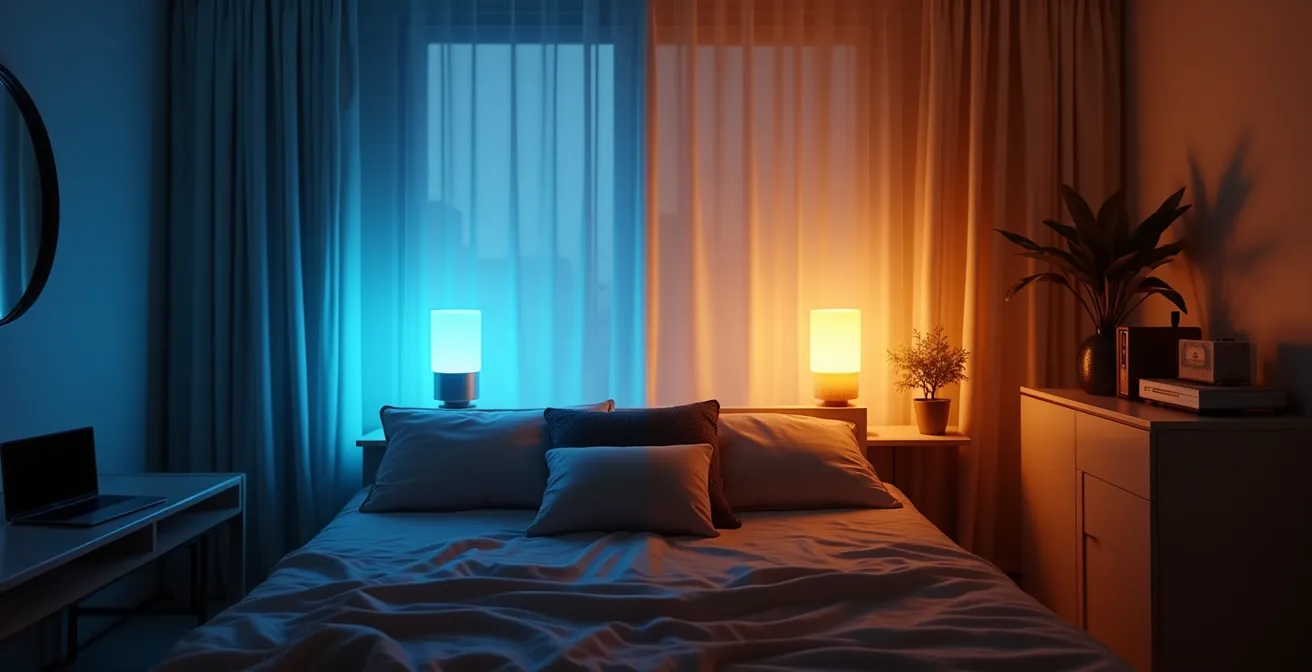
As the image above illustrates, contrasting light and ambiance can create a powerful psychological divide. To implement this effectively, consider different types of boundaries. A physical room divider might not be feasible, but a well-placed rug can define your “office” space, or an essential oil diffuser can be used to release an energizing scent during work hours and a calming one in the evening. The key is consistency.
The following table breaks down different approaches you can use, depending on your space and preferences.
| Boundary Type | Implementation | Best For | Example |
|---|---|---|---|
| Temporal | Time-based rules | Studios under 500 sq ft | Dining table = desk 9-5, dinner table after 6pm |
| Sensory | Light/scent changes | Open floor plans | Blue light for work, warm light for relaxation |
| Physical | Furniture arrangement | Spaces 500+ sq ft | Room divider or curtain separation |
Cold Turkey vs. Gradual Reduction: Which Detox Method Lasts Longer?
When you decide it’s time to reclaim your evenings from the creep of work tech, you’re faced with a choice: go “cold turkey” and abruptly cut off all access after hours, or opt for a “gradual reduction” by slowly decreasing your screen time. Both methods have their advocates. The cold turkey approach promises a clean, decisive break, forcing you to immediately find new ways to fill your time. However, it can also lead to feelings of anxiety or withdrawal, making it difficult to sustain.
On the other hand, a gradual reduction is less jarring. You might start by banning work email after 9 PM, then move it to 8 PM the following week. This method allows your nervous system to adjust slowly, reducing the shock of disconnection. The downside is that it requires more discipline and can easily lead to backsliding, as the boundaries are more flexible and easier to negotiate with yourself (“just one more email…”).
So, which one is more effective in the long run? Research suggests that the most sustainable approach is neither one nor the other, but a hybrid model. A powerful strategy is the “Reset and Rebuild” method. This involves a short, strict “cold turkey” period—like a completely unplugged weekend—to reset your baseline and remind yourself what true disconnection feels like. Following this reset, you implement a structured, gradual reduction plan during the weekdays. This combination gives you both the psychological breakthrough of a full detox and a realistic, sustainable framework for maintaining it. By scheduling regular digital detoxes, you build a resilient habit of disconnection that lasts far longer than an all-or-nothing approach.
The Mistake That Ruins Relationships for 60% of Digital Nomads
The digital nomad lifestyle is often romanticized as a solo adventure, but the reality is that many nomads are in committed relationships. The biggest threat to these relationships isn’t the travel or the instability; it’s the insidious phenomenon of being “present but absent.” This happens when you are physically in the same room with your partner, but your mind is still completely consumed by work. Your eyes are glazed over, you’re mentally rehearsing a presentation, and you’re only half-listening to the conversation. This emotional disconnection is far more damaging than physical distance.
This “present but absent” state is a direct consequence of failing to create firm mental boundaries. When your work is always a click away, it can occupy a disproportionate amount of your mindshare, even during personal time. Your partner might be talking about their day, but you’re silently stressing about a client’s email. This creates a subtle but profound rift, leaving your partner feeling unseen and unimportant. It’s a silent relationship killer that affects not just nomads, but anyone who works from home and struggles to switch off.

The solution is to practice visible disconnection. This means not only putting your devices away but also making a conscious, visible effort to be mentally present. When you finish work, announce it. Say, “Okay, I’m closing my laptop and I’m all yours now.” Then, actively engage in a shared activity that requires your full attention, like cooking a meal together, going for a walk without phones, or playing a board game. These rituals act as a powerful signal to both your brain and your partner that you have transitioned from work mode to relationship mode. It’s about quarantining your work not just physically, but mentally, to protect the time and emotional energy you dedicate to the people who matter most.
Regaining Focus: The Notification Setup That Doubles Productivity
The constant barrage of notifications is the single biggest enemy of deep work and peaceful evenings. Simply “turning them off” is too blunt an instrument; some alerts are genuinely urgent. The key to regaining control is not elimination, but strategic curation. It’s about designing a digital environment that serves your focus, not a system that constantly demands your attention. During the pandemic, the problem escalated dramatically; after-hours Teams chats increased by 69% per person, and weekend work surged, blurring lines completely.
A highly effective method is the “Concentric Circles Communication System.” This framework categorizes your communication channels based on urgency, allowing you to filter notifications with precision. Instead of a binary on/off switch, you create layers of accessibility. This gives you the peace of mind that true emergencies can still reach you, while non-urgent chatter is silenced until you’re ready for it. This conscious design of your notification landscape is a cornerstone of digital wellness and a prerequisite for productive deep work.
Action Plan: The Concentric Circles Communication System
- Inner Circle (Phone Calls): Reserve this channel for true, time-sensitive emergencies only. Go into your phone settings and disable notifications for all other apps and contacts, allowing calls only from a few select “VIP” numbers (e.g., your partner, your boss for critical issues).
- Middle Circle (Slack/Teams): This is for time-sensitive collaboration, not constant chatter. Turn off all banner and sound notifications. Instead, schedule 2-3 “check-in” blocks per day to process messages in batches. Use features like focus status to signal to colleagues when you’re unavailable.
- Outer Circle (Email): Treat email as asynchronous communication, not a to-do list. It’s for information that doesn’t require an immediate response. Turn off all notifications and check your inbox a maximum of 2-3 times per day at scheduled intervals.
- Device Segregation: Assign different roles to different devices. Your laptop is for deep work, your tablet for reading, and your phone for urgent communication. This prevents work from spilling onto every device you own.
- Communicate Your System: Briefly inform your team about your communication preferences. For example: “For urgent matters, please call. For everything else, I check Slack at 11 AM and 4 PM.” This sets clear expectations.
Complementing this system with a device segregation strategy can further amplify your focus. By assigning a specific purpose to each device, you create physical boundaries that reinforce your digital ones.
| Device | Purpose | Apps Allowed | Notification Settings |
|---|---|---|---|
| Laptop | Deep work & email | Work apps only | All notifications off during focus time |
| Tablet | Reading & research | Reference apps, no social media | Silent mode default |
| Phone | Urgent communication | Calls, emergency contacts | VIP contacts only |
Why You Wake Up Tired Even After 8 Hours of Sleep?
You get the recommended eight hours of sleep, yet you wake up feeling just as exhausted as when you went to bed. If this sounds familiar, the issue might not be the quantity of your sleep, but its quality. For remote workers, this pervasive fatigue is often a symptom of chronic stress and burnout, which prevent your brain from entering the deep, restorative stages of sleep. Microsoft’s Work Trend Index found that 31% of U.S. workers said the pandemic increased their feelings of burnout. When you’re mentally “on” all day, your nervous system remains in a state of high alert, making it difficult to fully power down at night.
Your brain continues to process work-related stressors even while you sleep, leading to fragmented, low-quality rest. You might not be consciously aware of it, but this background mental activity prevents the deep physical and psychological recovery that is supposed to happen during sleep. The result is waking up feeling unrefreshed, foggy, and with little energy for the day ahead, regardless of how long you were in bed.
The solution lies not in sleep hacks, but in addressing the daytime stress that sabotages your nights. One surprisingly effective strategy is incorporating nature into your day. A study by Dr. Qing Li on Tokyo office workers suffering from stress-related insomnia demonstrated the power of “forest bathing,” or meditative walks in nature. The research showed that subjects who took these walks not only slept longer and reported less anxiety, but the timing also mattered. Walks taken in the afternoon, after a stressful period of work, proved to be even more therapeutic for sleep quality than morning walks. This shows that actively discharging stress during the day is critical for achieving restorative sleep at night. It’s not about trying to sleep better; it’s about living better during your waking hours.
When to Stand Up: The 20-8-2 Rule for Metabolic Health
The sedentary nature of remote work is a well-known problem, but simply standing up isn’t enough. To combat the negative effects of prolonged sitting, you need a structured approach that aligns with your body’s natural rhythms. The 20-8-2 rule is a powerful framework for integrating movement into your workday to boost both your metabolic health and your mental focus. The rule is simple: for every 30-minute cycle, you spend 20 minutes sitting, 8 minutes standing, and 2 minutes moving or walking.
This approach is superior to simply switching between sitting and standing at random intervals. The regular, short bursts of standing and moving prevent your metabolism from slowing down, improve blood flow to the brain, and reduce the physical strain on your back and neck. It creates a consistent metabolic rhythm that keeps your energy levels stable throughout the day, preventing the afternoon slump that so often follows long periods of sitting. This isn’t just about avoiding the harm of being sedentary; it’s about actively using movement to enhance your cognitive performance.
You don’t need a fancy standing desk to implement this rule. You can stand to take phone calls, read documents on your phone, or do simple stretches at your desk. The 2-minute movement break is an opportunity for a quick walk around your apartment, a few jumping jacks, or even a short dance break. The key is to make it a non-negotiable part of your work cycle. Gamifying the process with a timer or a simple tally sheet can help build the habit. Remember, sustainable productivity is a marathon, not a sprint. Research has long shown that productivity levels plummet after 55 hours of work in a week. Integrating structured movement like the 20-8-2 rule is a strategy to work smarter, not longer, by keeping your body and mind in an optimal state.
Key takeaways
- True disconnection is an environmental design problem, not a willpower issue. Focus on engineering your space and digital tools.
- Use “sensory zoning” (light, sound, scent) to create clear mental boundaries between work and life, even in a small apartment.
- Adopt the “Concentric Circles” model for notifications to filter communication by urgency, protecting your focus without becoming unreachable.
How to Lead a Team Across 4 Time Zones Without working 24/7?
For leaders of remote teams, the pressure to be “always on” is magnified tenfold. When your team is spread across multiple time zones, it can feel like the workday never ends. The temptation is to stretch your own hours to accommodate everyone, leading directly to burnout. The most effective leaders, however, do the opposite. They don’t work more; they establish a culture of asynchronous-first communication and, most importantly, they model the behavior they want to see.
An asynchronous-first culture prioritizes clear, documented communication in shared spaces (like project management tools or wikis) over real-time meetings and instant messages. This allows team members to contribute at times that work best for them, reducing the pressure for immediate responses. As a leader, your role is to champion this shift. This means defining a small “overlap window” of 2-3 hours where real-time collaboration can happen if needed, but making asynchronous methods the default for everything else. It also means using tools like scheduled send for emails and messages to ensure they arrive during your colleagues’ work hours, respecting their time off.
However, the most powerful tool a leader has is their own behavior. You must practice visible disconnection. Time-box your work and be public about it. Set an out-of-office message that clearly states your working hours and who to contact in a true emergency. When you take a vacation, actually disconnect. By resisting the urge to have your work consume every waking hour, you give your team explicit permission to do the same. This isn’t about being less available; it’s about being more intentional. You build a more resilient, trusting, and ultimately more productive team when you prove that rest and boundaries are integral components of high performance, not obstacles to it.
By implementing these environmental, psychological, and procedural changes, you can transform your relationship with work. The goal is not just to survive remote work, but to thrive in it by consciously building a life where you are in control of your time and attention. Start today by choosing one strategy from this guide and applying it consistently.