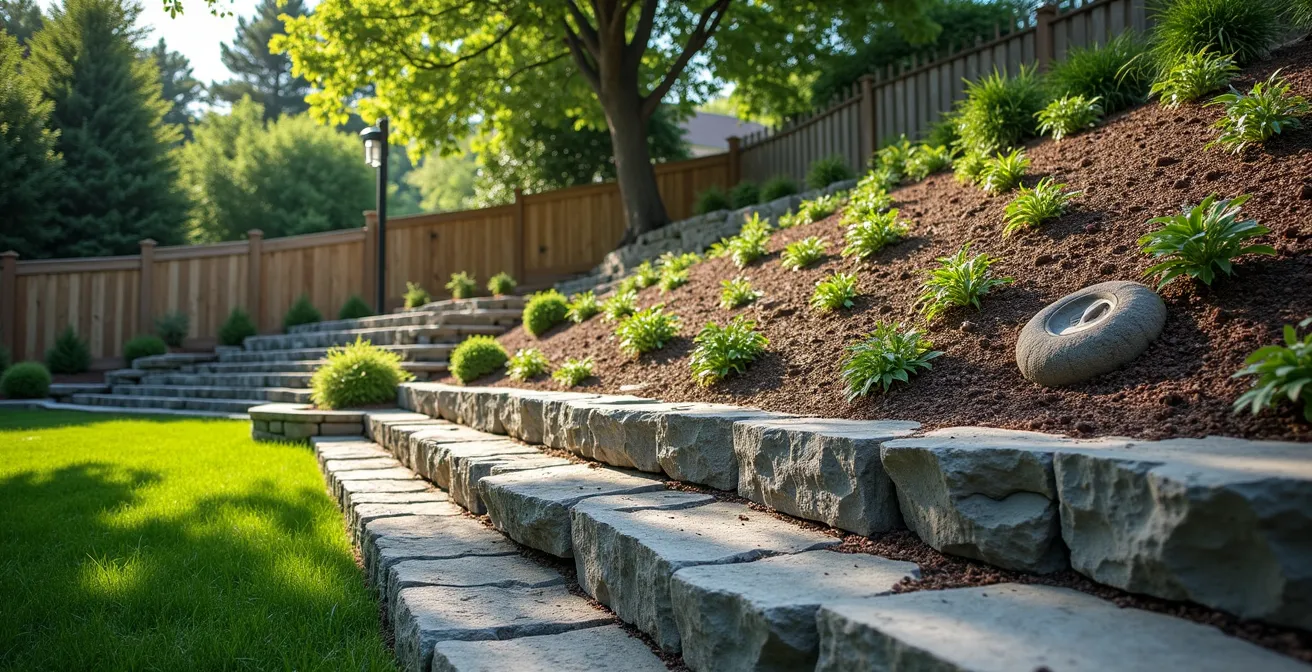
In summary:
- Conventional lawn grass has shallow roots and is ineffective for holding soil on steep slopes.
- Retaining walls fail from water pressure (hydrostatic pressure); proper drainage behind the wall is non-negotiable.
- Combining structural solutions like retaining walls with biological ones like deep-rooted plants creates a resilient, interlocking system.
- The goal is to slow and disperse water, not just redirect it, to prevent the creation of erosive gullies.
- Improving your soil’s health with compost is a foundational step that both reduces erosion and conserves water.
Watching your own backyard slide away after a heavy downpour is a deeply unsettling feeling. That rich topsoil, the foundation of your landscape, turns into a muddy river carving channels where there once was lawn. The common advice often feels inadequate: plant more grass, or maybe build a small wall. Homeowners try these fixes, only to see the grass wash out again or the new wall begin to bulge ominously after a few seasons. This frustrating cycle happens because these solutions treat the symptom—moving soil—without addressing the powerful geological and hydrological forces at play.
The problem of soil erosion is immense, a silent crisis that contributes to the nearly 500 million tons of topsoil lost in the U.S. each year. But what if the key wasn’t to build bigger, stronger barriers to fight the water, but to work with it? The secret to a stable slope lies in mimicking nature’s own strategies. It’s about understanding the physics of water pressure, the biology of root systems, and how to create an integrated system where soil, plants, and drainage work in concert to dissipate energy and hold the earth in place.
This guide moves beyond the temporary fixes. We will explore the science behind why simple lawns fail and how to engineer structures that manage water pressure correctly. We will compare stabilization techniques, uncover the critical drainage mistake that makes erosion worse, and detail how to plant a living, gripping matrix of vegetation. By adopting a permaculture designer’s perspective, you’ll learn to build a resilient landscape that not only stays put but also thrives.
Contents: How to Permanently Stabilize a Sloping Yard
- Why Grass Is Not Enough to Hold Soil on Steep Slopes?
- How to Build a Retaining Wall That Won’t Bulge With Water Pressure?
- Jute Netting or Coir Logs: Which Is Better for a 45-Degree Slope?
- The Drainage Mistake That Creates Gullies Instead of Solving Them
- Planting for Grip: How Densely to Plant Ground Cover for Maximum Hold?
- Why Adding Compost Reduces Your Watering Needs by 30%?
- Why Touching a Stalactite Stops Its Growth for Centuries?
- How to Maintain a Lush Garden During a Drought Without Breaking Bans?
Why Grass Is Not Enough to Hold Soil on Steep Slopes?
The image of a lush, green lawn is often equated with a healthy, stable landscape. However, on any slope steeper than a gentle 3:1 grade (three feet horizontal for every one foot vertical), standard turfgrass becomes a primary culprit in, rather than a solution for, soil erosion. The reason lies just beneath the surface in its root structure. Most lawn grasses, like Kentucky bluegrass or fescue, have a shallow, fibrous root system that extends only a few inches deep. This creates a dense mat on the surface but fails to anchor the deeper soil layers.
During heavy rain, water saturates the topsoil. Because the grass roots don’t create deep channels for infiltration, the water builds up in this shallow layer. The weight of the water combined with the force of gravity overwhelms the weak shear strength of the soil. The entire carpet of sod, along with the precious inches of topsoil it’s barely attached to, can slip and slide away in a miniature landslide. It’s a classic case of the right plant in the wrong place.
To truly understand your slope’s vulnerability, you need to think like a geologist and assess its specific conditions. A quick audit can reveal whether you are dealing with surface runoff, poor drainage, or other underlying issues that a simple lawn will never solve. Identifying the root cause of your erosion is the first step toward implementing a solution that will actually last.
Your 5-Point Slope Erosion Audit
- Check the Incline: Measure your slope’s angle. If it’s less than 33% (a 3:1 slope), mulching might be sufficient. Steeper slopes demand more robust, structural solutions.
- Test the Drainage: Dig a one-foot-deep hole and fill it with water. If water is still standing there after two days, you likely have dense clay or rock below, indicating poor drainage that will increase water pressure.
- Look for Bald Spots: Patches of bare earth can signal more than foot traffic. They may indicate shallow bedrock, poor irrigation coverage, or soil that’s been sterilized by over-fertilization, all of which are erosion hotspots.
- Assess Sun and Shade: Map out the sun exposure across the slope throughout the day. This is critical for selecting the right erosion-control plants that will thrive and establish a strong root network.
- Evaluate Water Access: Can you easily irrigate new plantings during their crucial establishment phase? Lack of water is a primary reason for the failure of erosion-control planting projects.
How to Build a Retaining Wall That Won’t Bulge With Water Pressure?
A bulging or cracked retaining wall is a common and dangerous sight in hilly neighborhoods. The failure is almost never due to the weight of the soil itself, but rather the immense, invisible force of water trapped behind it. This phenomenon, known as hydrostatic pressure, occurs when soil becomes saturated and the water has no escape route. This trapped water exerts tremendous force against the wall, a pressure so powerful it can push over structures built from concrete and stone. In fact, research shows unmanaged hydrostatic pressure can cause a 45% reduction in the structural factor of safety, turning a landscape feature into a liability.
The key to a permanent, safe retaining wall is to stop thinking of it as a dam and start thinking of it as a filter. Its primary job is to hold back soil, not water. A proper design must include a comprehensive drainage system that relieves this pressure before it can build. The illustration below shows the critical components of such a system.
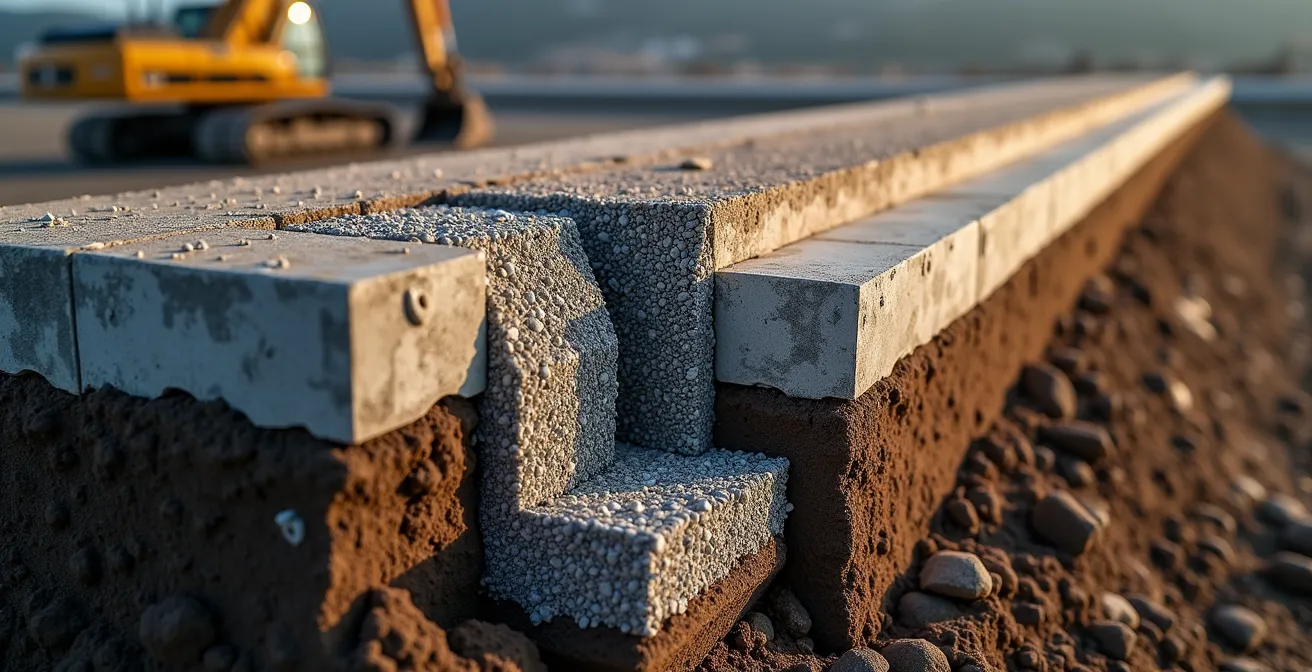
As you can see, the system works together to give water an easy path away from the wall. A column of coarse gravel or crushed stone behind the wall creates a vertical drainage channel. At the base, a perforated pipe collects this water and channels it away to a safe outlet. Finally, weep holes—small openings at the base of the wall—act as safety valves, allowing any accumulated water to escape. Without this system, failure is not a matter of if, but when.
Case Study: The Hilly Development That Got It Right
A residential development built on a steep, unstable hillside faced significant erosion challenges. Instead of taking shortcuts, the engineers performed a thorough geotechnical analysis. They designed reinforced concrete retaining walls that integrated a robust drainage system: weep holes were spaced at regular intervals, perforated drainage pipes were laid at the base in a bed of gravel, and the entire backfill zone was filled with free-draining gravel instead of compacted soil. Thanks to this strict adherence to pressure-relief principles, the walls have remained perfectly stable for years, ensuring the safety of the homes above and below.
Jute Netting or Coir Logs: Which Is Better for a 45-Degree Slope?
On steep slopes where planting alone isn’t enough, biodegradable erosion control products provide a critical temporary shield while vegetation establishes itself. These materials protect the soil surface from the impact of raindrops and slow down sheet flow, giving seeds and small plants a chance to take root. Two of the most effective and popular options are jute netting and coir logs. While both are made from natural fibers, they serve very different functions and are suited to different types of erosion problems.
Jute netting is a lightweight, open-weave blanket that is staked directly onto the soil surface. It’s excellent for protecting broadcast seeds or small plugs from being washed away by surface runoff (sheet flow). Coir logs, made from compressed coconut fiber, are dense, sausage-like tubes. They are installed in trenches along the contours of a slope to create mini check dams, excellent for slowing and intercepting concentrated water flow in small gullies or rills. The choice between them depends entirely on the type of water movement you need to manage and the timescale of your project.
The following table, based on an analysis of erosion control materials, breaks down their key differences to help you make the right choice for your 45-degree slope.
| Feature | Jute Netting | Coir Logs |
|---|---|---|
| Degradation Time | 1-2 years | 5+ years |
| Best Use | Protecting seeds and small plugs | Immediate structural support for larger plants |
| Flow Type Handled | Low-energy sheet flow across surface | High-energy concentrated flow in gullies |
| Installation | Requires stapling every 12-18 inches | Creates check dams in swales |
| Biodegradation Benefit | Quick organic matter pulse for seedlings | Long-term structural matrix for roots |
For a steep, 45-degree slope, a combination approach is often best. Use coir logs along the contours to break up the slope’s length and manage concentrated flow, then cover the areas between the logs with jute netting to protect your plantings. This creates a multi-layered defense that provides both immediate structural support and long-term surface protection.
The Drainage Mistake That Creates Gullies Instead of Solving Them
Installing a drainage system like a French drain seems like a definitive solution to a soggy, eroding slope. You collect the water, pipe it away, and the problem is solved. However, a single, critical mistake at the very end of the system can transform your solution into an even bigger problem. The mistake is this: concentrating all that collected water into a pipe and discharging it at full force onto an unprotected patch of ground. This high-velocity jet of water acts like a power washer, blasting away soil and carving a deep gully that grows with every storm.
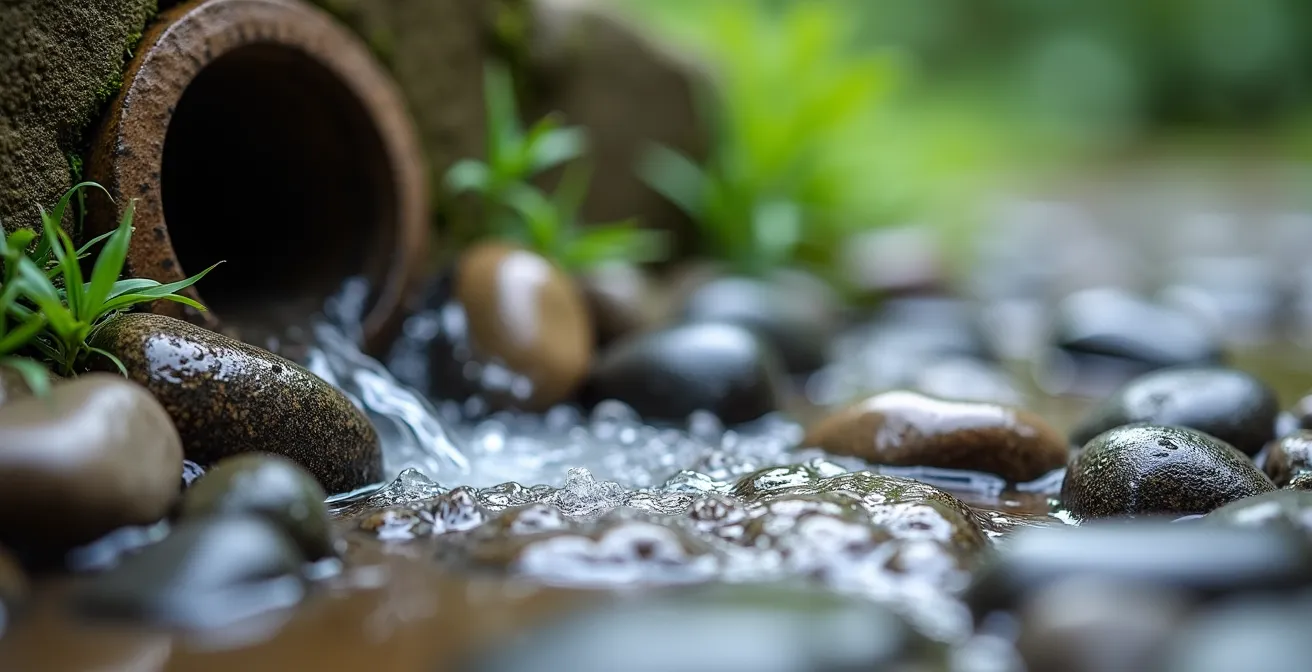
The principle you must follow is energy dissipation. You can’t just move water; you must release it gently. The water exiting a drainpipe has concentrated energy that needs to be spread out and slowed down. The most effective way to do this is by creating a riprap apron at the drain’s outlet. A riprap apron is a pad of carefully arranged stones that absorbs the water’s force. The water flows out of the pipe, hits the large stones, and is forced to spread out and trickle through the gaps, losing its erosive power before it reaches vulnerable soil.
This image of a properly constructed outlet demonstrates the principle perfectly. The water’s energy is harmlessly dissipated across the stones, protecting the soil downstream.
This same principle applies to all points of water concentration on your property, including downspouts from your roof. Never allow a downspout to discharge directly onto bare soil on a slope. Connect it to a buried pipe that leads to a riprap apron, a dry creek bed, or a rain garden that can safely handle and absorb the flow. A successful drainage strategy is an integrated system that manages water from the moment it hits your property until it leaves, gently and without causing damage.
Planting for Grip: How Densely to Plant Ground Cover for Maximum Hold?
While retaining walls and drainage systems are the skeleton of slope stabilization, plants are the living muscle and skin that lock everything together. The right planting strategy creates a dense, multi-layered root matrix that functions like natural rebar, binding soil particles together and dramatically increasing the soil’s resistance to erosion. But simply scattering a few plants won’t suffice. The key to effective biological stabilization is density.
Your goal is to achieve canopy closure as quickly as possible. The leaves and stems of the plants intercept raindrops, absorbing their impact before they can dislodge soil particles. This is the “90-Day Canopy Rule”: plant densely enough that the plant canopies will touch and cover the soil within three months. For low-growing ground covers like Vinca minor (Periwinkle), this might mean spacing them just 6 inches apart. For larger shrubs like spreading Junipers, 3 feet apart might achieve the same effect over a slightly longer period. In fact, for grasses, effective erosion control requires achieving what researchers call a minimum density of 10,000 stems/m².
Beyond surface coverage, diversity in root structure is crucial. A truly resilient slope combines plants with different root architectures to create an interlocking web at multiple depths. You should include:
- Deep taproot species: Plants like certain native grasses or shrubs that send a primary root deep into the ground, anchoring the deeper soil layers.
- Fibrous, spreading-root plants: These create a dense mat of fine roots in the top 6-12 inches of soil, which is excellent for preventing surface erosion.
- Rhizomatous plants: These spread via underground stems (rhizomes), continuously sending up new shoots and roots to form a thick, self-repairing colony.
On very steep slopes, digging individual holes can be difficult and destabilizing. Instead, consider creating small, level terraces or “planting pockets” to give new plants a stable foothold. This combination of dense planting and root diversity is what transforms a fragile slope into a living, self-sustaining retaining wall.
Why Adding Compost Reduces Your Watering Needs by 30%?
The connection between a healthy garden and erosion control is far more direct than most people realize, and it all comes down to one magic ingredient: compost. When you add compost to your soil, you are not just providing nutrients; you are fundamentally re-engineering the soil’s physical structure. This has a profound impact on how your land handles water, directly influencing both erosion and your watering bill.
Soil is composed of mineral particles (sand, silt, clay), air, water, and organic matter. Compost is a concentrated form of stable organic matter. When introduced to soil, it acts as a glue. Microorganisms feed on it and excrete sticky substances that bind tiny mineral particles together into larger clumps called aggregates. This process is called flocculation. The resulting soil structure is no longer dense and compacted, but crumbly, light, and full of pore spaces of all sizes.
This new structure transforms your soil into what is often called a “soil sponge.” During a heavy rain, water doesn’t just run off the surface. It quickly infiltrates into this network of pores, where it is held and stored for later use by plant roots. By absorbing more water, the soil sponge dramatically reduces the volume and velocity of surface runoff—the primary driver of erosion. A soil rich in organic matter can hold many times its weight in water. This increased water-holding capacity is why studies have shown that for every 1% increase in soil organic matter, the soil can hold tens of thousands of gallons more water per acre. This directly leads to the often-cited figure of a 30% reduction in irrigation needs, as the soil itself becomes a reservoir.
Why Touching a Stalactite Stops Its Growth for Centuries?
Deep within a cave, a stalactite forms with painstaking slowness. For millennia, a single drop of mineral-rich water at a time lands, deposits a microscopic layer of calcite, and builds the delicate stone icicle. The process relies on an unbroken chain of specific chemical and physical conditions. If a person reaches out and touches the tip of that growing stalactite, the almost imperceptible film of oil from their skin is enough to disrupt the water’s surface tension. The next drop no longer clings and deposits its minerals; it rolls off. The growth process halts, and it can take centuries for the natural conditions to re-establish themselves, if they ever do.
This is a powerful metaphor for the soil on your slope. A stable, erosion-resistant slope is not an inert pile of dirt; it is a living ecosystem, a complex community of bacteria, fungi, insects, and plant roots that has formed its own delicate balance over years. The fungal networks (mycelium) that bind soil particles together, the channels created by earthworms that aid infiltration, and the symbiotic relationship between roots and microbes—these are the soil’s equivalent of the stalactite’s mineral drip.
When a slope is improperly graded, tilled, or doused with chemicals, it is like touching the stalactite. These actions shatter the fragile soil structure, destroy the microbial life, and break the intricate web that holds the ecosystem together. The soil loses its ability to absorb water and resist gravity. Simply throwing grass seed at the problem afterward is like hoping the stalactite will magically start growing again. True restoration requires understanding that you are repairing a delicate, living system, a process that requires patience and a focus on rebuilding the biological infrastructure from the ground up.
Key Takeaways
- Manage Water, Not Just Soil: The primary force of erosion is water. Successful strategies focus on managing hydrostatic pressure, slowing flow, and promoting infiltration rather than just trying to hold dirt in place.
- Build a Living Structure: The most resilient slopes combine engineered elements (walls, drains) with a biological matrix. A dense, diverse planting of ground covers with varied root systems creates a self-repairing web that locks soil together.
- Soil Health is Stability: Improving soil structure with compost is a foundational step. It creates a “soil sponge” that absorbs massive amounts of water, drastically reducing erosive runoff while also making your landscape more drought-tolerant.
How to Maintain a Lush Garden During a Drought Without Breaking Bans?
The principles that create an erosion-proof slope are the very same principles that create a drought-resilient landscape. This is the elegant efficiency of working with natural systems. By focusing on slowing, spreading, and sinking water into the soil, you are not only preventing it from washing your yard away but also storing it for dry periods. This dual benefit is the cornerstone of a truly sustainable landscape that can remain lush even during summer heat and watering restrictions.
The soil sponge we discussed earlier is your primary tool. A soil rich in organic matter acts as a natural reservoir. Plants rooted in this soil can draw upon this stored moisture long after the surface has dried out, dramatically reducing their need for supplemental irrigation. This is your first and most powerful defense against drought.
Furthermore, many erosion control features can be designed to double as water-harvesting systems. A swale, for instance, is an erosion-control ditch dug on contour, but it’s also a premier permaculture technique for passively irrigating a landscape. During a storm, it intercepts runoff, holding the water and allowing it to slowly soak into the ground, hydrating the entire area downhill from it. Similarly, selecting the right plants is critical. Instead of thirsty ornamentals, choose deep-rooted, drought-tolerant native plants. Their deep roots not only anchor the soil effectively (as discussed in the section on planting for grip) but also allow them to access moisture far below the surface, where shallow-rooted plants would have long since withered.
By combining these strategies—building deep, spongy soil with compost, shaping the land with features like swales to capture rainfall, and choosing plants adapted to your climate—you create a self-sufficient ecosystem. Your garden will not only withstand the deluge of a storm but also thrive through the scarcity of a drought, all while demanding far less from you and the municipal water supply.
Start today by assessing your slope’s unique conditions using the audit checklist, and begin implementing these integrated strategies. By working with the natural forces of geology and biology, you can build a resilient, stable, and beautiful landscape that will last a lifetime.