
Contrary to popular belief, a high ‘soundproof’ (STC) rating does little to stop footstep noise, as it only measures airborne sound, not the structural vibrations you and your neighbors are concerned with.
- Effective solutions focus on improving the Impact Insulation Class (IIC) rating by decoupling the floor from the building’s structure.
- Properly installed underlayment and sealing flanking paths (like baseboard gaps) are far more effective than simply adding mass.
Recommendation: Shift your focus from blocking sound to isolating vibration. Start by auditing your floor’s weak points and implementing solutions that decouple and absorb impact energy.
That dreaded note on the door, the gentle-but-firm knock from downstairs, or the sound of a broomstick tapping on their ceiling—if you live in an apartment, you know the feeling. You feel like you’re walking on eggshells, constantly aware of every step, worrying that you’re disturbing the peace. You’ve probably tried the usual advice: wear slippers, walk softly, maybe even buy a rug. But often, the low, thudding sound of footsteps persists, creating tension and discomfort for everyone.
The frustration often stems from a fundamental misunderstanding of the problem. Most soundproofing advice focuses on blocking airborne noise like voices or music. However, footstep noise is an entirely different beast. It’s not just sound; it’s impact energy that travels through the solid structure of the building. This is why a floor with a high “soundproof” rating can still be a terrible transmitter of footstep noise, a fact that baffles many apartment dwellers.
But what if the solution wasn’t about trying to muffle the sound, but about interrupting its journey? The key lies in understanding that you’re not fighting sound waves in the air, but vibrations in the floor. This guide will act as your residential acoustics consultant, moving beyond generic tips. We will demystify the science of impact noise, show you how to choose and install materials that actually work, and reveal the common construction mistakes that turn your floor into a drum for your neighbors below.
By focusing on decoupling, absorption, and interrupting sound paths, you can take control of the situation, reduce noise transmission significantly, and restore a peaceful coexistence with your neighbors. This article breaks down the essential steps to achieve genuine acoustic comfort.
Summary: A Consultant’s Guide to Silencing Footsteps
- Why a High STC Rating Does Not Stop Footstep Noise?
- How to Install Underlayment to Maximize Sound Dampening?
- Carpet or Cork: Which Is the Better Hypoallergenic Sound Absorber?
- The Baseboard Mistake That Transmits Sound Through Your Walls
- Rug Placement: Covering the Traffic Paths That Generate the Most Noise
- Why Closet Offices Echo and How to Dampen the Sound?
- Fixing the Echo: Audio Setups That Include Remote Participants Equally
- How to Zone an Open-Plan Studio to Feel Like a One-Bedroom?
Why a High STC Rating Does Not Stop Footstep Noise?
A high STC (Sound Transmission Class) rating fails to stop footstep noise because it’s designed to measure the wrong type of sound. STC quantifies a material’s ability to block airborne noise, such as conversations, television sounds, or music. Think of it as a barrier to sound traveling through the air. However, the thud of a footstep is impact noise—a structural vibration that travels through the solid materials of the building itself, like a miniature earthquake wave.
To address footstep noise, you need to focus on a different metric: the Impact Insulation Class (IIC). This rating specifically measures how well a floor assembly reduces the transmission of impact energy to the room below. While STC focuses on blocking, IIC focuses on absorbing and isolating. Many building codes are now catching on to this crucial distinction. For example, according to building code requirements, multifamily residences must achieve an IIC 50 minimum, but for genuine quiet, higher values are needed.
Imagine your floor is the surface of a pond. Airborne sound is like a leaf floating on top, easily stopped by a simple barrier. Impact noise, however, is like dropping a stone into the water, sending ripples (vibrations) out in all directions. A high STC rating is like a net that stops the leaf but does nothing to stop the ripples. To stop the footstep “ripples,” you need materials that absorb the initial shock and decouple the floor from the rest of the building structure, which is the core principle of improving an IIC rating.
How to Install Underlayment to Maximize Sound Dampening?
Simply laying down an underlayment is not enough; its effectiveness hinges entirely on proper installation designed to decouple the finished floor from the subfloor. The goal is to create a “floating” floor assembly where the top layer has minimal direct contact with the building’s structure. This separation is what interrupts the path of impact vibration, dramatically improving your floor’s IIC rating.
The most crucial aspect is ensuring 100% coverage and isolation at the perimeter. The underlayment must not touch the walls or baseboards. A small gap, typically 1/8 inch, should be left around the entire room. This gap is then filled with a flexible acoustical sealant—not standard caulk—which prevents the creation of a “sound bridge” that would transfer vibrations directly into the wall framing. All seams in the underlayment must also be overlapped and sealed with acoustic tape to create a single, monolithic barrier.
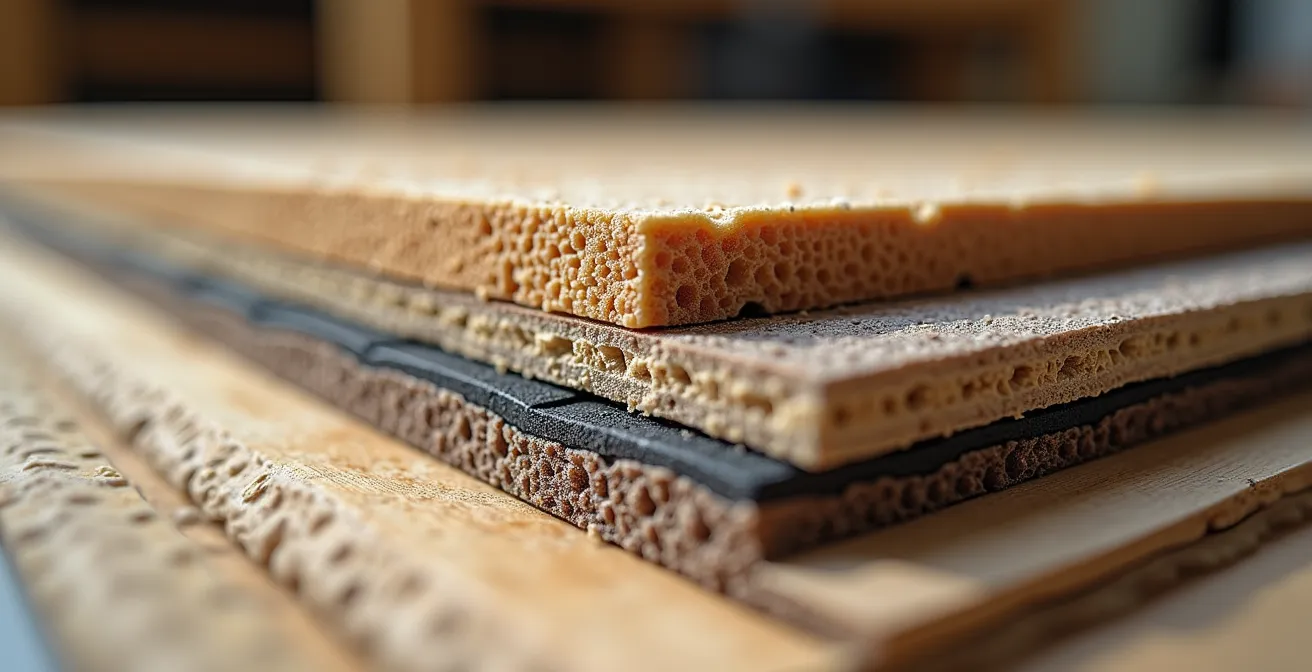
As the cross-section above illustrates, each layer serves a purpose. The underlayment acts as a shock absorber, while the sealed gaps prevent vibrations from flanking, or bypassing, the main floor assembly. Forgetting this perimeter isolation is the single most common installation mistake, rendering even the most expensive underlayment ineffective. The sound will simply find the path of least resistance and travel straight into the walls and down to your neighbor.
Action Plan: Installing Underlayment for Maximum Sound Dampening
- Ensure 100% coverage of the subfloor with the underlayment, leaving a deliberate 1/8 inch gap around the entire perimeter of the room.
- Meticulously seal all perimeter gaps with a high-quality acoustical caulk, which remains flexible and absorbs vibration unlike standard hardening caulk.
- Overlap all seams between underlayment sheets by at least 6 inches and seal them completely with a specialized acoustic tape to prevent any gaps.
- Guarantee that the finished flooring material (e.g., hardwood, laminate) makes no direct contact with the baseboards or wall plates.
- For ultimate performance, consider decoupling the floor from the structure using advanced isolation clips, though this is a more involved renovation.
Carpet or Cork: Which Is the Better Hypoallergenic Sound Absorber?
When choosing a surface to absorb impact noise, both carpet and cork are excellent options, but they serve different needs regarding performance and health. Carpet is an undisputed champion for acoustic performance. Its soft, porous fibers are exceptional at absorbing both impact noise and airborne sound within the room. A high-quality, dense carpet combined with a thick pad can dramatically improve an IIC rating to the point where most footstep noise becomes nearly inaudible. For context, studies show that when IIC ratings reach above 65, even sharp heel clicks can become imperceptible to the listener below.
However, for allergy sufferers, carpet can be a major drawback, trapping dust, pollen, and other allergens. This is where cork shines. As a naturally hypoallergenic and antimicrobial material, cork flooring provides good sound absorption without creating a reservoir for irritants. It has a cellular structure filled with air pockets that effectively dampens vibrations. While not quite as powerful as a plush carpet and pad, cork is a fantastic solution for bedrooms and living areas where both acoustic comfort and air quality are priorities.
When considering underlayment, the comparison between materials becomes even more critical, especially regarding moisture and longevity. The following table provides a clear overview of how different underlayment materials perform.
As an analysis of underlayment options shows, rubber often outperforms cork in key areas. Unlike cork, which is susceptible to moisture and can promote mold growth without a separate vapor barrier, rubber is naturally resistant to mold and mildew, making it a safer, more durable choice in a wider range of environments.
| Material | Sound Reduction | Thickness Required | Cost/sq ft | Water Resistance |
|---|---|---|---|---|
| Rubber | Excellent | 2-5mm | $2-4 | Excellent |
| Cork | Good | 30% thicker than rubber | $0.55-1.30 | Poor (needs barrier) |
| MLV | Best for airborne | 1/8 inch | Higher than rubber | Good |
| Foam | Fair | Varies | Lowest | Poor without barrier |
The Baseboard Mistake That Transmits Sound Through Your Walls
Even with the best underlayment and flooring, a significant amount of impact noise can still reach your neighbor through a process called flanking transmission. This occurs when sound bypasses the main floor assembly and travels through other parts of the building structure, most notably the walls. The single biggest culprit for this is the small, often-overlooked gap between your flooring and your baseboards, or between the baseboards and the drywall.
Sound acts like water: it will exploit any crack or opening. When a hard flooring surface is installed directly against a baseboard, every footstep sends a vibration directly into the baseboard, which then transmits it into the wall studs. From there, the vibration travels down the wall framing and radiates out as noise in the apartment below. You may have created an isolated “island” in the middle of your floor, but you’ve built a solid bridge for sound around the entire perimeter.
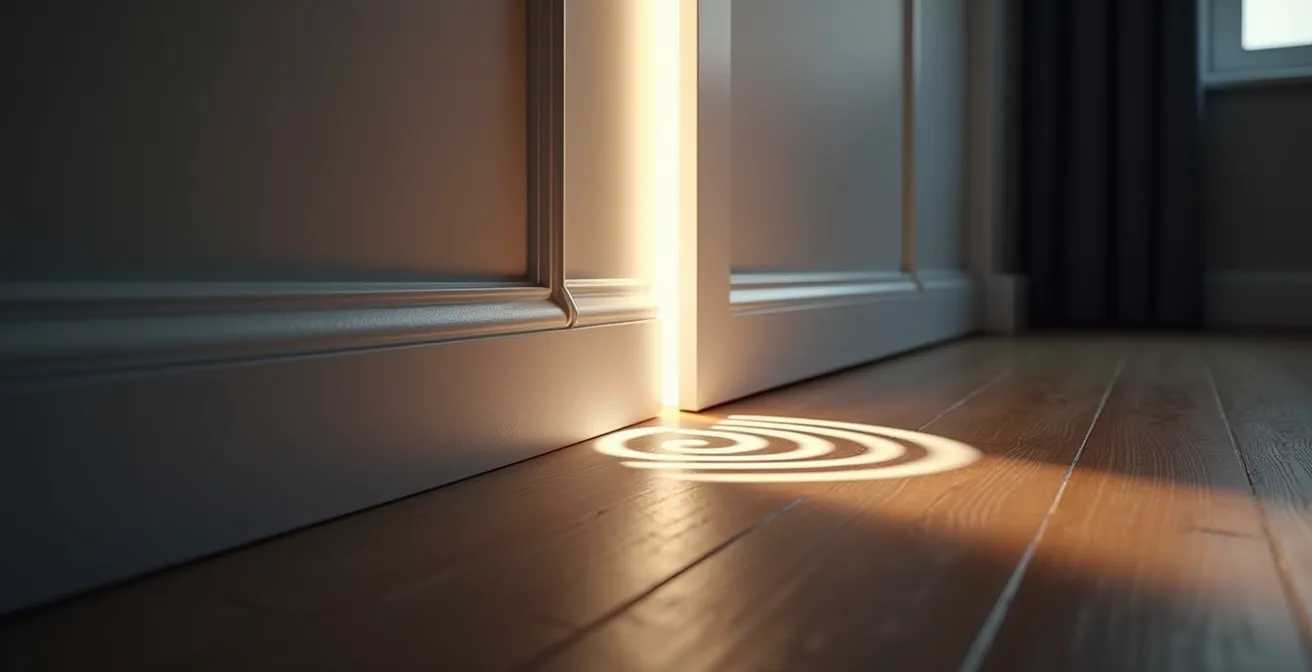
As this visualization shows, this gap is a direct highway for sound energy. The solution is simple but requires meticulous attention to detail: isolate and seal. There must be no direct, hard contact between the flooring and the baseboards. This gap should be filled with a flexible, non-hardening acoustical sealant (such as OSI Pro-Series SC-175). This specialized caulk is designed to absorb vibration, effectively creating an acoustic buffer. This same principle applies to other flanking paths, such as gaps around electrical outlets, HVAC vents, and recessed lighting cans, all of which must be sealed to create a truly isolated room.
Rug Placement: Covering the Traffic Paths That Generate the Most Noise
While a full flooring renovation offers the most comprehensive solution, it’s not always practical or affordable. Fortunately, the strategic use of area rugs and high-quality pads can provide a significant and immediate reduction in footstep noise. The key is not just to add a rug, but to place it with purpose, focusing on the acoustic hotspots in your home.
Start by mapping your daily walking routes. The paths you tread most frequently—from the bedroom to the bathroom, from the front door to the kitchen, the area in front of the sofa—are the primary generators of impact noise. Concentrating your efforts on these high-traffic zones will yield the greatest results. An 8×10 rug in the middle of a room may look nice, but if your main walkway is along its edge on the hard floor, you’ve solved very little. A runner in a hallway or a well-placed rug connecting two rooms will be far more effective.
The pad underneath the rug is just as important as the rug itself. Don’t cheap out on a thin, flimsy pad. For footstep noise, you need mass and density.
- Dense felt pads are excellent for absorbing the low-frequency thud of footfalls.
- Solid rubber pads offer maximum impact noise reduction and have the added benefit of durability.
- Memory foam pads provide a good balance of comfort and sound dampening.
Ensure the pad is the same size as the rug to provide complete, even coverage. A quality rug and pad combination can effectively create a small-scale “floating floor,” absorbing impact energy before it ever enters the building’s structure.
Why Closet Offices Echo and How to Dampen the Sound?
In the age of remote work, many people convert small spaces like closets into home offices, only to find they are echo chambers. You might be trying to solve this echo, but it’s crucial to correctly diagnose the acoustic problem you’re facing. Is it truly an echo, or is it related to the broader issue of transmitted noise? Often, what is perceived as a “boomy” or resonant quality in a small room is exacerbated by low-frequency impact noise from the floor above.
An echo is caused by airborne sound (like your voice) bouncing between hard, parallel surfaces—the walls, ceiling, and floor of your small office. This is solved with absorption: adding soft materials like acoustic panels, curtains, or a rug to stop the sound from reflecting within the room. If adding these materials solves your problem, then it was indeed an echo.
However, if the “boominess” persists, especially when your upstairs neighbor is home, you are likely misdiagnosing the problem. The issue isn’t echo within your room, but transmitted impact noise coming through the structure. The small, rigid dimensions of a closet office can act like a resonator box, amplifying these low-frequency vibrations from above. In this case, no amount of absorption inside your office will solve the core problem. The solution lies in addressing the noise at its source or along its path, using the decoupling and isolation strategies discussed throughout this guide.
Fixing the Echo: Audio Setups That Include Remote Participants Equally
In a professional context, creating good acoustics is about fairness. On a conference call, a poor audio setup that creates echo or fails to pick up voices clearly makes remote participants feel like second-class citizens. It creates an unequal experience that hinders communication and collaboration. This principle of acoustic fairness extends directly to our homes and our relationships with neighbors.
Unmanaged impact noise forces an unequal acoustic burden onto your downstairs neighbor. While you move freely in your own home, they are subjected to a constant barrage of noise that disrupts their peace and quiet. Their living space is acoustically compromised by activities in yours. Just as you would adjust a microphone or add sound panels to a conference room to ensure everyone can be heard equally, taking steps to mitigate footstep noise is an act of restoring acoustic balance in a shared building.
Viewing the problem through this lens transforms it from a mere technical challenge into an act of consideration and community living. The solutions—installing a high-IIC underlayment, sealing flanking paths, placing rugs strategically—are not just about dampening vibrations. They are about re-establishing an environment where all residents can enjoy their homes equally, without one person’s comfort coming at the direct expense of another’s. It’s the residential equivalent of ensuring everyone has an equal seat at the table.
Key Takeaways
- The most critical concept is the difference between airborne sound (measured by STC) and impact noise (measured by IIC); footstep solutions must focus on IIC.
- Effective solutions rely on decoupling the floor from the building’s structure using proper underlayment and sealing flanking paths at the perimeter.
- Strategic placement of area rugs with dense, high-quality pads over high-traffic “sound corridors” is a powerful and immediate first step.
How to Zone an Open-Plan Studio to Feel Like a One-Bedroom?
True home zoning is more than just a visual exercise; it’s about creating dedicated acoustic zones that enhance comfort and function. In an open-plan studio, you might use a bookshelf to visually separate a living area from a sleeping area. The same principle applies to managing footstep noise. By using flooring materials strategically, you can acoustically zone your apartment to minimize the creation and transmission of impact noise.
Think of your apartment in terms of its acoustic function. High-traffic areas like hallways and kitchens are “sound corridors.” Quieter areas like a reading nook or the space beside your bed are “quiet zones.” Your goal is to apply the most robust sound-dampening solutions to the sound corridors. This is where you should concentrate your use of large, dense area rugs and high-quality rubber pads. By doing so, you are creating an acoustically-dampened path for movement, absorbing impact energy at the source.
This approach synthesizes all the principles we’ve discussed. It’s a practical application of understanding traffic paths, using absorptive materials, and containing noise before it can become a structural problem. It allows you to enjoy the openness of your space without turning the entire floor into a single, resonant drumhead. You are essentially designing your own interior acoustic landscape, guiding movement over surfaces that are prepared to handle the impact and preserving the tranquility of your quiet zones. This is the ultimate expression of neighborly consideration and smart acoustic design.
By performing a thoughtful audit of your own floors and applying these principles, you can move from being the source of the problem to being the architect of the solution. The next logical step is to begin identifying your high-traffic zones and assessing your current flooring for the weaknesses we’ve discussed, creating a clear action plan to restore acoustic peace for you and your neighbors.