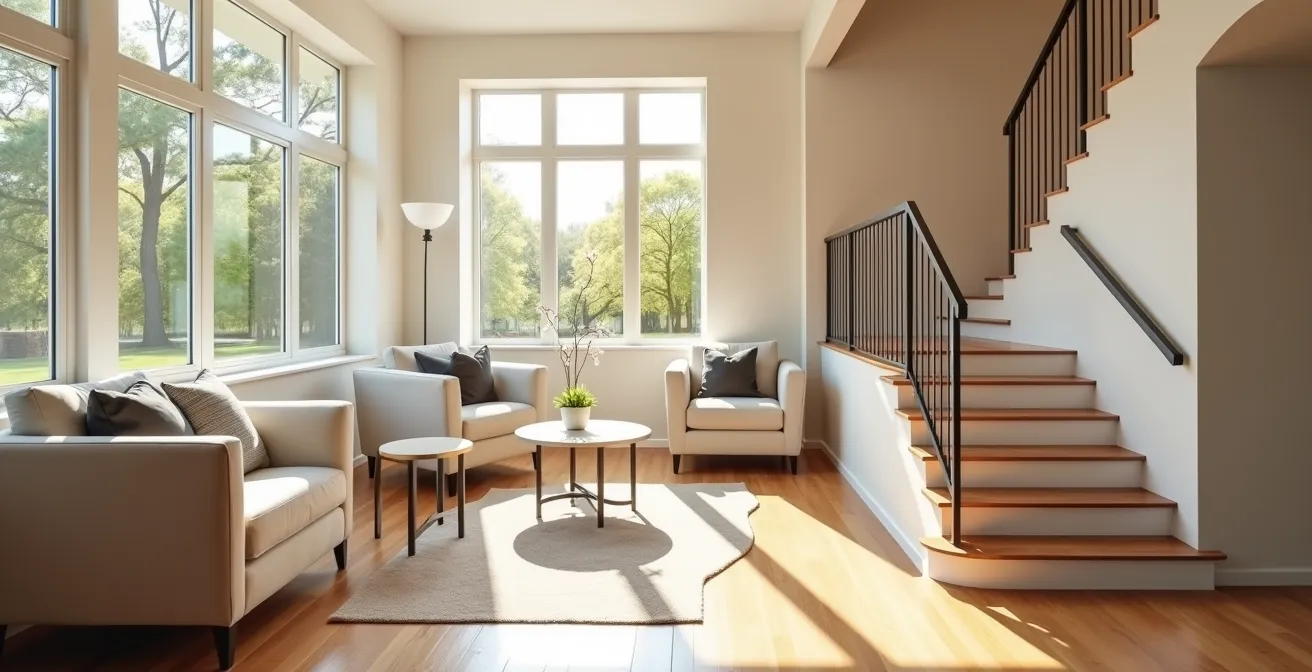
The secret to successful aging-in-place design is not adding medical fixtures, but seamlessly integrating safety into your home’s aesthetic.
- Proactive, design-led modifications prevent falls while enhancing your home’s value and comfort.
- Dual-function items like stylish grab bars and smart color contrasts offer invisible protection.
Recommendation: Prioritize modifications in high-risk areas like bathrooms and stairs, choosing elegant, universal design solutions before they become an urgent necessity.
The thought of modifying a home for a senior loved one—or for your own future—often conjures images of sterile, clinical environments. We picture cold metal grab bars, bulky plastic shower seats, and jarring warning signs that shout “an elderly person lives here.” This hospital-like aesthetic can feel like a surrender of personal style and the warmth of a cherished home. For many, the choice seems to be between safety and dignity, between function and beauty.
The common advice revolves around purely practical additions, but this approach misses a crucial emotional component. A home is a sanctuary, a reflection of a life lived. Turning it into a medical facility can negatively impact mental well-being and the very sense of independence it’s meant to preserve. The fear of this aesthetic transformation is a major reason why many families and seniors delay essential modifications until after a fall or a medical emergency, when choices are limited and rushed.
But what if this choice was a false one? The true key to effective aging-in-place is not about bolting on safety equipment; it’s about aesthetic forethought. It’s about weaving safety into the very fabric of the home’s design through smart, stylish, and often invisible solutions. This guide moves beyond the basics to show you how to implement elegant, dual-function features that enhance both safety and style. We will explore how to use color, retrofitting smarts, and ergonomic principles to create a space that is not only secure but also more beautiful and comfortable for everyone, regardless of age.
This article will walk you through the most impactful, design-conscious modifications you can make. From high-contrast visual cues on stairs to the one tub design mistake that causes the most falls, you’ll gain the knowledge to create a home that is a testament to both safety and sophisticated living.
Summary: A Guide to Stylish Senior Home Modifications
- Why Seniors Need High-Contrast Colors on Stairs and Doorways?
- How to Retrofit Doorways for Walkers Without Structural Demolition?
- Lever Handles or Round Knobs: Which Is Better for Arthritic Hands?
- The Tub Design Mistake That Causes the Most Falls in Seniors
- When to Renovate: Why You Should Install Grab Bars Before You Need Them?
- Stopping the Notebook Habit: Switching to a Password Manager Simply
- Kitchen or Bath: Where to Spend Your $10,000 Renovation Budget?
- How to Eliminate Lower Back Pain by Adjusting Your Existing Chair?
Why Seniors Need High-Contrast Colors on Stairs and Doorways?
As we age, changes in vision, including reduced depth perception and sensitivity to light, make navigating a home more challenging. What was once a familiar staircase can become a significant fall risk. The primary issue is the inability to clearly distinguish the edge of each step or the transition from one surface to another, like a hallway floor to a room’s threshold. This is where the strategic use of high-contrast colors becomes a powerful, yet subtle, safety tool. It’s not about painting bright yellow warning lines; it’s about creating elegant visual cues that guide the eye naturally.
Think of it as architectural wayfinding. A dark wood tread against a light-colored riser, or a stylish stair runner with a distinctly colored border, provides the brain with the crucial information needed to gauge distance and height accurately. This principle is backed by an understanding of household risks; for example, the CDC reports that among older adults, injury rates near household fixtures increase dramatically with age. By improving visibility in key transition areas like stairs and doorways, we can significantly mitigate this risk without compromising on design.
Integrating contrast can be an aesthetic upgrade. Consider these options:
- Stair Runners: Choose a runner with a contrasting border that complements your home’s decor.
- Paint: Paint stair risers a different, lighter shade than the treads to create natural visual separation.
- Materials: Use different materials, such as wood treads with elegant tiled risers, for both texture and color contrast.
- Lighting: Install discreet LED strips under the handrail to illuminate the treads, enhancing contrast in low-light conditions.
The goal is to make the environment inherently more intuitive. When a home’s design provides these subtle guides, it reduces the cognitive load required to navigate it safely, fostering greater confidence and independence.
How to Retrofit Doorways for Walkers Without Structural Demolition?
One of the most common barriers to mobility in a standard home is the width of its doorways. Interior doors, especially in older homes, are often too narrow to comfortably accommodate a walker or wheelchair, forcing a choice between difficult maneuvers or costly, disruptive renovations. The conventional solution—tearing down walls and reframing the opening—is expensive, messy, and can feel like a major, unwelcome overhaul. Fortunately, there’s a far more elegant and cost-effective solution that requires no demolition at all.
The answer lies in a simple piece of hardware: offset hinges, also known as swing-clear hinges. When a door is opened to 90 degrees, these specialized hinges swing the door completely clear of the doorway. This simple change can add up to two precious inches of usable clearance, often just enough to allow a walker or wheelchair to pass through without issue. This minor modification is a perfect example of a smart, non-invasive upgrade that delivers a major improvement in accessibility. It preserves the home’s structure while dramatically enhancing its function.
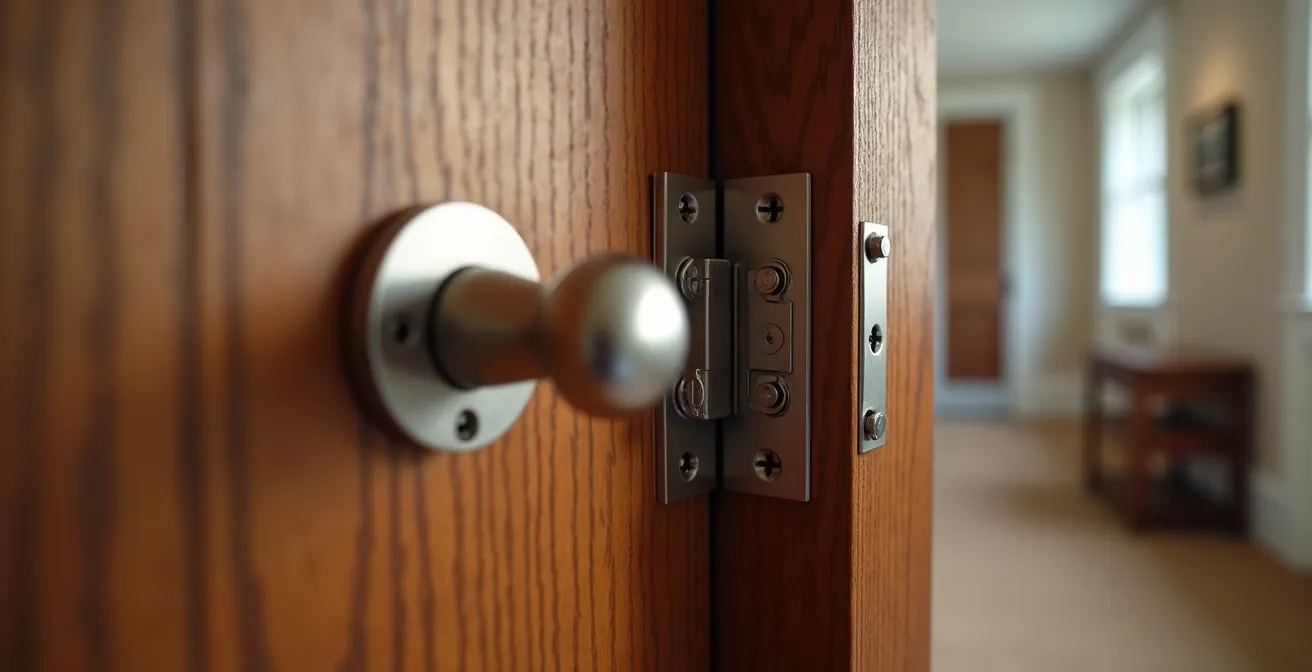
The impact of such thoughtful modifications is substantial. Proactive home updates not only improve quality of life but are also financially prudent. Research shows that home modifications may prevent up to 50% of all home accidents among seniors. Investing a few hundred dollars in offset hinges is a small price to pay to maintain access to every room in one’s home, avoiding the isolation that can result from inaccessible spaces.
Lever Handles or Round Knobs: Which Is Better for Arthritic Hands?
The simple act of opening a door can become a daily source of pain and frustration for someone with arthritis or reduced grip strength. The traditional round doorknob requires a firm grasp and a twisting motion—two actions that can be incredibly difficult and painful. This is where a small, stylish change can make a world of difference. Switching from knobs to lever handles is one of the most impactful and easy-to-implement principles of universal design.
Traditional knobs are difficult for people with arthritis to grasp firmly, and the twisting motion can sometimes be challenging.
– Mr. Handyman Home Modification Specialists, Mobility & Safety Modifications Guide
Unlike knobs, lever handles can be operated with a closed fist, an elbow, or the palm of the hand, requiring minimal grip strength and no wrist twisting. This benefits not only those with arthritis but anyone carrying groceries, a child, or laundry. It’s a classic example of universal design: a feature designed for accessibility that ultimately makes life easier for everyone. This shift in hardware is an aesthetic upgrade as well, with levers available in countless modern and traditional styles.
The advantages of lever handles over round knobs are clear and directly address the physical challenges associated with aging, as a detailed comparison of mobility-friendly hardware reveals. They are a mandated feature for ADA compliance for a reason.
| Feature | Lever Handles | Round Knobs |
|---|---|---|
| Grip Strength Required | Minimal – can operate with palm/elbow | Significant – requires firm grasp |
| Arthritis Compatibility | Excellent – no twisting motion needed | Poor – twisting causes pain |
| Style Options | Chrome (modern), Oil-rubbed bronze (traditional), Matte black (farmhouse) | Limited contemporary options |
| Universal Design | Benefits all users (carrying items, wet hands) | Single-purpose design |
| ADA Compliance | Meets accessibility standards | Does not meet standards |
The Tub Design Mistake That Causes the Most Falls in Seniors
The bathroom is, by far, the most dangerous room in the house for seniors. The combination of hard surfaces, water, and soap creates a high-risk environment. According to CDC data, over 80% of the nearly 235,000 annual bathroom injuries among those over 15 are due to falls. While many factors contribute, the single biggest design mistake that leads to these falls is the high threshold of a standard bathtub-shower combination. Requiring a person to lift their leg high over a slippery edge while balancing on one foot is a recipe for disaster, especially for those with limited mobility, balance issues, or leg weakness.
Simply adding a non-slip mat is a temporary fix that doesn’t address the fundamental architectural flaw. The most effective solution is to eliminate this barrier entirely. A zero-threshold or curbless shower removes the need to step up and over, allowing a user to walk or roll directly into the shower space. This not only dramatically reduces fall risk but also transforms the bathroom into a sleek, modern, spa-like environment. It’s a perfect fusion of high-end design and ultimate safety.
When designing a safe and stylish bathroom, replacing the tub with a curbless shower is the gold standard. This modification provides an immediate and profound safety benefit while also future-proofing the home and increasing its resale value. To take this a step further, consider a complete safety-oriented redesign.
Action Plan: The Ultimate Safe and Stylish Shower Checklist
- Go Curbless: Install a zero-threshold shower for seamless, spa-like entry and exit.
- Choose High-Grip Flooring: Select tiles with a DCOF (Dynamic Coefficient of Friction) rating above 0.42 for wet areas to prevent slips.
- Integrate Seating: Add a built-in tiled corner bench or a fold-down teak wall-mounted bench for a chic, secure seating option.
- Position Controls Smartly: Place shower controls near the entrance so water temperature can be adjusted before stepping inside.
- Install a Handheld Showerhead: Add a handheld showerhead on an adjustable-height bar to facilitate easy seated showering.
By removing the tub barrier and integrating these features, you address the root cause of most bathroom falls, creating a space that is both beautiful and fundamentally safe.
When to Renovate: Why You Should Install Grab Bars Before You Need Them?
Grab bars are the quintessential symbol of home safety modifications, but they are often installed reactively—after a fall has already occurred. This emergency approach often leads to hastily chosen, clinical-looking bars that disrupt the home’s aesthetic. The key to integrating them successfully is proactive installation. By planning ahead, you can choose designs that are not only functional but also beautiful, blending seamlessly into your bathroom’s decor as dual-function fixtures.
Today’s market offers a stunning array of designer grab bars that double as towel racks, toilet paper holders, or shower caddies. These pieces are crafted from high-end materials like brushed nickel or matte black steel, appearing as intentional design elements rather than medical necessities. The best time to install them is during any planned bathroom remodel, even years before they might be needed. At this stage, a contractor can easily add wood blocking between the wall studs for less than a hundred dollars. This crucial step provides a solid anchor point, ensuring the grab bars can support significant weight when they are eventually installed.
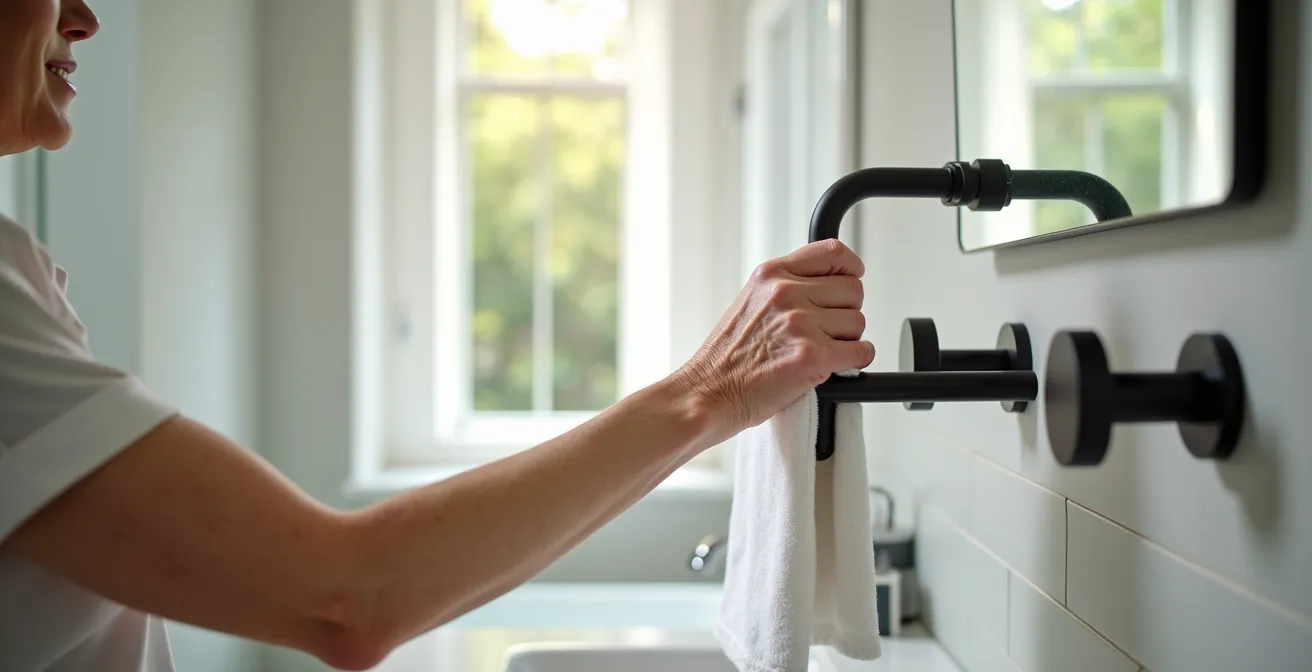
This foresight is not just about aesthetics; it’s a smart financial decision. With a staggering 77% of Americans over 50 preferring to age in place, proactive modifications are a wise investment. A planned installation of a stylish grab bar system can cost as little as $500, whereas emergency renovations after a fall can be far more extensive and costly. This simple, proactive step is one of the most effective ways to support long-term independence in a home that remains a source of pride.
Stopping the Notebook Habit: Switching to a Password Manager Simply
While securing the physical home is paramount, the modern safe home also has a digital layer that cannot be ignored. Smart home devices—from security cameras and smart locks to medical alert systems and telehealth portals—are increasingly vital for senior independence. However, each of these services requires a password, leading many to resort to the “notebook habit”: writing down credentials in a physical book that can be easily lost, stolen, or become illegible. This practice creates a significant security vulnerability in a supposedly “smart” home.
The simple, secure solution is to transition to a digital password manager. These applications act as an encrypted digital vault, storing all passwords, usernames, and other sensitive information under a single, strong master password. Instead of remembering dozens of complex passwords, a senior only needs to remember one. The manager can automatically generate and fill in unique, strong passwords for each online service, drastically improving digital security.
For children helping their parents, these tools offer peace of mind. Most reputable password managers include an emergency access feature. This allows a designated, trusted person (like an adult child) to gain access to the vault in case of an emergency, ensuring they can manage critical services like online pharmacy accounts or contact medical providers without having full access to the parent’s entire digital life. It’s a secure, organized, and modern alternative to the precarious notebook, extending the principles of safety and independence into the digital realm.
Kitchen or Bath: Where to Spend Your $10,000 Renovation Budget?
When faced with a limited renovation budget for aging-in-place modifications, a common and difficult question arises: which room should be the priority? Both the kitchen and the bathroom are central to daily independence, but they present different types of challenges. The bathroom is the site of the highest fall risk, making it a critical priority for immediate safety. The kitchen, on the other hand, is crucial for nutrition and daily routine, and modifications there can reduce strain and preserve energy over the long term.
Deciding where to allocate a budget of, for example, $10,000 depends on the individual’s most immediate needs and long-term goals. A full focus on the bathroom might involve installing a curbless shower—the single most effective fall prevention measure. A kitchen-centric budget could focus on creating an ergonomic workspace with pull-out shelving, accessible appliances, and better task lighting to prevent strain and fatigue. A third option, an 80/20 split, could address the most critical safety need in the bathroom (like a walk-in tub cutout) while also making small, high-impact upgrades in the kitchen.
The table below breaks down how a $10,000 budget could be allocated across these three strategies, highlighting the primary modifications and their impact on safety and independence. This framework can help you make a strategic decision that best supports a senior’s ability to live safely and comfortably at home.
| Budget Option | Bathroom Focus | Kitchen Focus | 80/20 Split |
|---|---|---|---|
| Primary Modifications | Curbless shower ($6,000), Grab bars ($500), Non-slip flooring ($3,500) | Pull-out shelving ($4,000), Counter-height microwave ($2,000), Task lighting ($4,000) | Walk-in tub cutout ($1,500), Designer grab bars ($1,500), Pull-down shelving ($1,500), Lever faucet ($500) |
| Safety Impact | High – addresses #1 fall risk area | Medium – reduces strain and fatigue | Balanced – addresses both immediate and long-term needs |
| Independence Factor | Critical for daily hygiene | Essential for meal preparation | Maintains both capabilities |
| Future-Proofing Value | Immediate fall prevention | Long-term energy preservation | Comprehensive coverage |
Key Takeaways
- The best senior safety modifications are invisible, blending aesthetic design with function.
- Prioritize high-risk areas: eliminate tub thresholds in bathrooms and add visual contrast on stairs.
- Proactive planning, like adding wall blocking for future grab bars, is more effective and stylish than reactive fixes.
How to Eliminate Lower Back Pain by Adjusting Your Existing Chair?
While major renovations are crucial, sometimes the most significant improvements to daily comfort and safety come from optimizing the furniture we already own. For many seniors, lower back pain and the difficulty of getting up from a seated position are constant challenges. An existing chair that is too low, too soft, or lacks proper support can exacerbate these problems and even increase the risk of a fall. Before investing in an expensive new lift chair, it’s worth assessing and adjusting your current seating.
The ideal chair for a senior should pass the “Sit-to-Stand” test. The seat height should be between 17 and 19 inches from the floor, a height that allows most people to stand up without using their hands for leverage. If a favorite chair is too low, simple and inexpensive furniture risers can be placed under the legs to elevate it to the correct height. Furthermore, the chair should have firm cushions that provide support rather than enveloping the user, and sturdy armrests that can be used for push-off leverage. A simple lumbar pillow can also be added to provide essential lower back support and improve posture.
Beyond the chair itself, its placement is a key part of home safety. Furniture should be arranged to create clear pathways of at least 36 inches wide, allowing easy navigation for walkers or wheelchairs. Well-placed, stable end tables or console tables can also serve as discreet balance support points as a person moves through a room. Brandon Landgraf, a home modification expert, notes that “chairs with a higher seat height (17-19 inches) make standing and sitting easier.” By applying these simple ergonomic principles to existing furniture, you can significantly enhance both comfort and safety without a single contractor.
Frequently Asked Questions on Home Modification and Safety
How do password managers help with smart home devices for seniors?
Password managers securely store credentials for smart locks, security cameras, medical alert systems, and smart lighting, eliminating the need to remember multiple complex passwords for home safety devices.
Can family members access emergency information through password managers?
Yes, most password managers offer emergency access features that allow trusted family members to access specific credentials like medical alert services or smart doorbell apps without compromising the entire digital vault.
What’s the advantage over writing passwords in a notebook?
Digital password managers are encrypted and secure, can generate strong unique passwords, sync across devices, and can’t be lost or stolen like physical notebooks. They also enable quick access to telehealth portals and online pharmacy services.