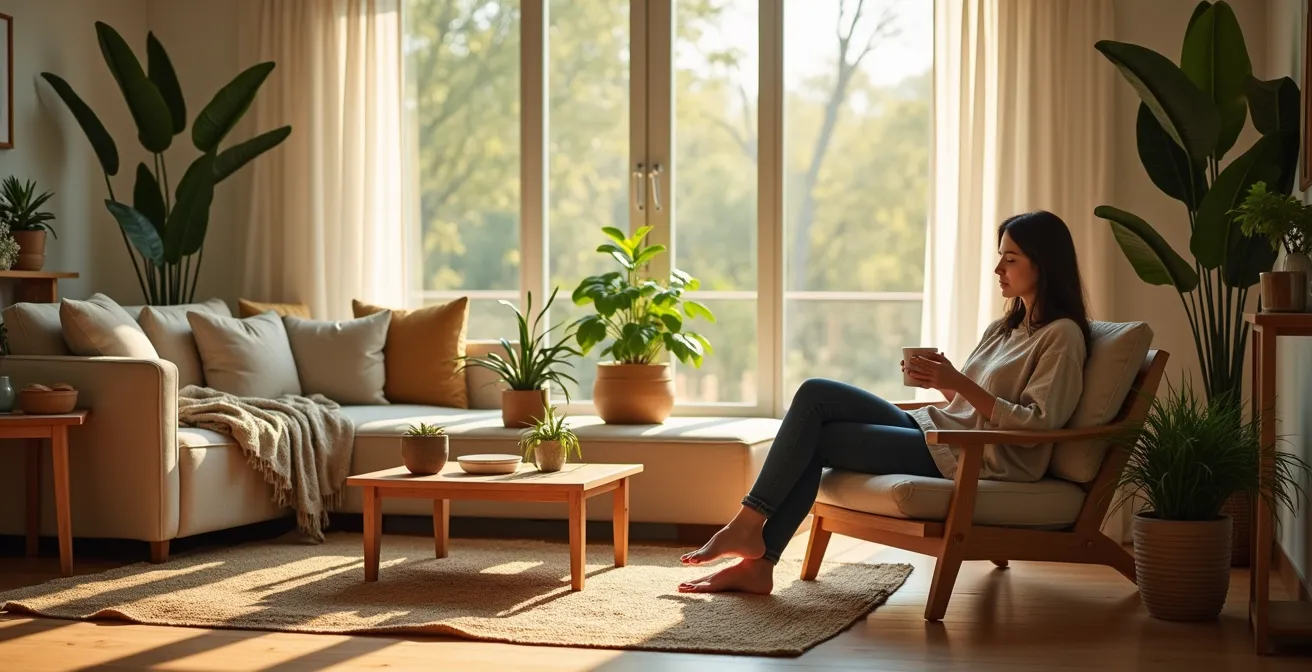
Lowering cortisol with home design is less about collecting plants and more about sending specific, calming sensory signals to your primal brain.
- Fractal patterns found in nature (and replicated in decor) can measurably reduce physiological stress.
- Dynamic artificial light that mimics the sun’s daily cycle is more critical for regulating your body clock than static brightness.
Recommendation: Focus on intentionally curating a multi-sensory experience of nature—sight, sound, and touch—rather than simply accumulating greenery.
For the urban dweller, the background hum of life is often one of low-grade stress. The endless scroll on a bright screen, the distant wail of a siren, the sheer lack of natural vistas—it all contributes to elevated cortisol levels, leaving you feeling “wired but tired.” You feel a deep-seated need for nature, a quiet craving for green that seems just out of reach amidst the concrete and glass.
The conventional advice is well-meaning but often falls short. You’ve been told to “get a desk plant” or “open a window for some sun.” While these actions are steps in the right direction, they often fail to address the root of the issue. They are small gestures in a sensory environment that remains overwhelmingly artificial and demanding. This approach treats nature as a decorative accessory rather than a fundamental human need.
But what if the key to truly lowering stress at home wasn’t just about the *objects* of nature, but about deeply understanding and recreating the specific *sensory cues* they provide? This is the core of biophilic design: a science-backed method for creating habitats that speak directly to our evolutionary wiring. It’s not about turning your apartment into a jungle; it’s about intentionally weaving in the patterns, light, sounds, and textures that signal safety and calm to our nervous system.
This guide will move beyond the superficial and explore the psychological mechanisms at play. We will decode the science behind nature’s calming influence, from the mathematical beauty of a leaf’s veins to the profound impact of mimicking a natural sunset with smart lighting. You will learn how to transform your home into a genuine sanctuary that actively works to lower your cortisol, one sensory cue at a time.
To help you navigate this transformative approach, we’ve structured this guide to address the most critical aspects of biophilic design. The following sections will delve into the science and practical application of nature’s most potent stress-reducing elements.
Summary: A Scientific Approach to a Nature-Infused Home
- Why Patterns Found in Leaves Calm the Human Brain Instantly?
- How to Choose Plants That Actually Clean the Air in Low-Light Rooms?
- Sunlight or Smart Bulbs: Can Artificial Light Truly Mimic Nature?
- The “Jungle” Mistake: When Too Many Plants Create Anxiety Instead of Calm
- Masking City Noise: Placing Indoor Fountains for Maximum Acoustic Relief
- Why Adding Compost Reduces Your Watering Needs by 30%?
- How to Create a “Neural Sundown” Routine to Switch Off Your Brain?
- How to Prevent Burnout Before It Starts Using Micro-Habits?
Why Patterns Found in Leaves Calm the Human Brain Instantly?
The profound sense of calm we feel when gazing at a fern or a forest canopy is not mere poetry; it is a neurological response to a specific mathematical language. Our brains are hardwired for “fractal fluency”—an effortless ability to process the repeating, self-similar patterns that are the building blocks of the natural world. From the branching of a tree to the veins of a leaf, these patterns are everywhere, and our visual system finds them deeply satisfying and non-threatening.
This isn’t just a feeling; it’s a measurable physiological phenomenon. In fact, research has shown that viewing mid-range fractal patterns, like those found abundantly in nature, can trigger a wakefully relaxed state, reducing stress by as much as 60%. When our eyes scan these patterns, it activates the parahippocampal gyrus, an area of the brain associated with regulating emotions and processing spatial environments, signaling to our amygdala that we are in a safe, predictable space. This is the opposite of the effect created by the blank, uniform walls of a typical urban interior, which can feel sterile and unstimulating.
Incorporating these patterns into your home is a powerful way to reduce cortisol without adding a single living thing. Think beyond just plants. Consider an area rug with a repeating leaf motif, throw pillows with branching embroidery, or even art prints that feature natural fractal geometry. The key is to introduce visual complexity that is ordered and self-similar, providing your brain with the soothing, intricate information it has evolved to appreciate. Even the way you arrange books on a shelf can mimic the non-linear, organic forms of nature.
Ultimately, by understanding fractal fluency, you shift from seeing nature as decoration to utilizing its fundamental patterns as a tool for nervous system regulation.
How to Choose Plants That Actually Clean the Air in Low-Light Rooms?
The idea that a few houseplants can scrub the air of toxins is one of the most persistent and appealing claims in the wellness world. While there is a kernel of truth to it, the reality is far more nuanced. To make effective choices, especially for low-light urban apartments, you must understand the science and its limitations. The ability of plants to purify air is real, but the scale of the effect is often misunderstood.
Case Study: The NASA Clean Air Study Reality Check
The famous 1989 NASA study is the origin of the “air-purifying plant” boom. It conclusively showed that certain plants could remove up to 90% of volatile organic compounds (VOCs) like benzene and formaldehyde from a sealed chamber within 24 hours. Plants like the Parlour Palm and Lady Palm were particularly effective. However, the crucial context often missed is that this occurred in a small, airtight container. To achieve a similar air-cleaning effect in a typical home with normal ventilation, you would need a dense, impractical jungle of hundreds of plants. The primary benefit of plants in a home setting is psychological, not atmospheric.
This does not mean choosing plants is futile; it simply reframes the goal. Instead of aiming for significant air purification, focus on selecting resilient, beautiful plants that thrive in low light and provide the vital psychological and biophilic benefits of greenery. For typical indoor conditions, your best choices are hardy species that tolerate shade and infrequent watering. Excellent options include:
- Snake Plant (Sansevieria trifasciata): Nearly indestructible and requires very little light.
- ZZ Plant (Zamioculcas zamiifolia): Has deep green, waxy leaves and is highly drought-tolerant.
- Kentia Palm (Howea forsteriana): An elegant palm that brings a tropical feel and handles lower light levels well.
- Calathea varieties: Known for their stunning fractal-patterned leaves, they are a perfect example of a plant chosen for its visual biophilic impact.
This image showcases the textural beauty of plants that can succeed in less-than-ideal lighting.

Notice the intricate patterns on the Calathea leaf, a direct source of the stress-reducing fractal geometry we discussed. Choosing a plant is less about its air-cleaning capacity and more about its ability to bring these essential, calming visual cues of nature into your daily life.
Prioritize plants that will not only survive but flourish, providing you with a consistent and reliable connection to nature’s visual language.
Sunlight or Smart Bulbs: Can Artificial Light Truly Mimic Nature?
Light is arguably the most powerful driver of our internal biological clock. The quality, color, and intensity of the light we are exposed to directly signals our brain to either be alert and active (raising cortisol) or wind down and prepare for rest (producing melatonin). In our natural state, the sun would provide this dynamic signal flawlessly. For the modern urbanite, however, we must rely on technology to replicate this life-sustaining rhythm.
While nothing can perfectly replace the full-spectrum, dynamic nature of real sunlight, modern smart bulbs have become remarkably sophisticated. The key is to move beyond thinking of light as simple illumination and see it as a programmable, biological tool. High-quality smart bulbs with a high Color Rendering Index (CRI) can now mimic the sun’s journey across the sky with surprising accuracy. This is not about brightness alone, but about the temperature of the light—from the cool, blue-white of morning to the warm, amber glow of sunset.
A comparative look shows just how close technology can get to nature’s standard when used correctly. As outlined in a recent analysis of biophilic design elements, the differences are becoming less about capability and more about implementation.
| Feature | Natural Sunlight | High-CRI Smart Bulbs (95+) |
|---|---|---|
| Color Rendering Index | 100 (perfect) | 95-98 |
| Dynamic Changes | Natural sun path variation | Programmable schedules |
| Stress Impact | Maximum cortisol reduction | Significant reduction with proper programming |
| Flicker | None | Varies – choose flicker-free models |
The true power lies in creating a dynamic schedule that supports your circadian rhythm. Blasting your home with static, cool-white LED light in the evening is the equivalent of staring into a high-noon sun at 10 PM—it’s a recipe for disrupted sleep and elevated stress. A well-designed lighting program can actively help your brain and body transition through the day.
Your Action Plan: Dynamic Lighting for Stress Reduction
- Morning (6 AM): Program bulbs to a cool blue-white (around 5000K) to suppress melatonin and stimulate alertness.
- Midday (12 PM): Shift to a bright, neutral white (around 4000K) at maximum comfortable intensity to mimic the overhead sun.
- Evening (6 PM): Begin the transition to a warmer white (3000K) and reduce the overall intensity by at least 30%.
- Night (9 PM): Drastically shift to a very warm, amber or firelight tone (1800K-2200K) at a low 20% intensity to encourage melatonin production.
- Flicker-Free First: Ensure any bulb you purchase is explicitly labeled “flicker-free” to avoid subconscious visual stress.
By taking active control of your home’s lighting, you are providing one of the most fundamental and powerful cues your body needs to regulate its stress and sleep cycles.
The “Jungle” Mistake: When Too Many Plants Create Anxiety Instead of Calm
The “urban jungle” aesthetic, popularized on social media, champions the idea that more is always better when it comes to houseplants. While born from a genuine love of nature, this approach can inadvertently create a space that feels chaotic and overwhelming, triggering a low-grade sense of anxiety rather than calm. This happens when we ignore two fundamental, evolved human preferences: prospect and refuge. We instinctively seek spaces where we have clear lines of sight (prospect) while feeling safely enclosed (refuge). An overabundance of cluttered plants can block sightlines, obscure pathways, and create a visually jumbled environment that our primal brain reads as unsafe or chaotic.
The calming effect of nature isn’t about the sheer quantity of green, but the quality and complexity of the patterns it presents. An environment that is too simple is boring, but one that is too complex is stressful. The sweet spot, as biophilic design expert R.P. Taylor notes, lies in a specific level of ordered complexity.
The third iteration of a fractal is more likely to engender a positive health response than less complex designs. Simplified or superficial applications of complexity can result in an arguably dull and an inadequately nurturing form that fails to stimulate the mind or engender physiological stress reduction.
– R.P. Taylor, Reduction of Physiological Stress Using Fractal Art and Architecture
This means a single, beautifully patterned Calathea can be more psychologically beneficial than a dozen mismatched, poorly placed pots. The goal is curation over accumulation. Instead of scattering plants randomly, create intentional “vignettes.” Group plants in odd numbers like 1, 3, or 5, which is more visually harmonious than even numbers. Vary their heights and leaf textures to create interest, but maintain a consistent element, such as the color or material of the pots, to provide a sense of order. Most importantly, preserve negative space—allow for clear paths and views across the room. This intentional arrangement respects our innate need for prospect while still providing the rich, fractal details that calm our minds.
A truly biophilic space is not a dense jungle, but a thoughtfully composed landscape that feels both engaging and secure, stimulating the mind just enough to foster a state of peaceful alertness.
Masking City Noise: Placing Indoor Fountains for Maximum Acoustic Relief
For many urban dwellers, the most invasive source of chronic stress isn’t visual—it’s auditory. The unpredictable cacophony of traffic, sirens, construction, and loud neighbors keeps our nervous system in a constant state of low-level alert. Our brain is wired to interpret sharp, sudden, or mechanical sounds as potential threats. The key to creating an acoustic sanctuary is not silence, which is often impossible, but the introduction of a positive, non-threatening sound to mask the negative ones.
This is where the sound of flowing water becomes a powerful biophilic tool. Unlike a sudden car horn, the gentle, consistent sound of a fountain or stream is a form of “pink noise.” It contains a mix of frequencies that is consistent and predictable, which our brain interprets as safe. In fact, studies show that simply hearing the sound of water can have a direct impact on our physiology, helping to lower cortisol levels and promote relaxation. It works by providing a pleasant, constant auditory signal for our brain to focus on, effectively pushing the stressful, unpredictable city noises into the background.
The placement of an indoor water feature is critical for maximizing this effect. The goal is acoustic triangulation: position the fountain between you and the primary source of noise, such as a window facing a busy street. This allows the sound of water to physically intercept and mask the intrusive sounds before they reach you. Consider a tabletop fountain in your living room or home office—the spaces where you need to de-stress or concentrate most.
This image captures the essence of creating an acoustic and visual refuge from the city.
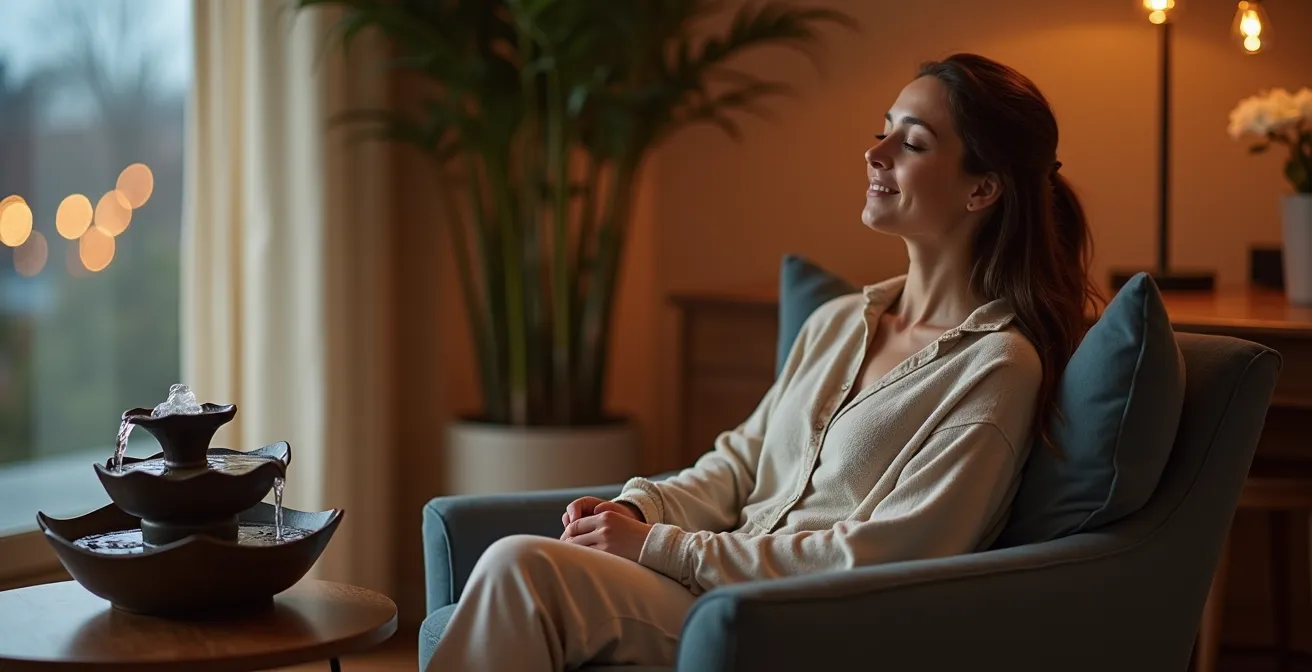
As seen here, combining the fountain with other sound-dampening materials like thick curtains, rugs, or cork wall panels can amplify the effect, creating a multi-layered cocoon of tranquility. The goal is to build an acoustic refuge that feels as safe and peaceful as it sounds.
By consciously curating your home’s soundscape, you are directly signaling to your nervous system that it is safe to relax and let its guard down.
Why Adding Compost Reduces Your Watering Needs by 30%?
While the title points to an outdoor gardening benefit, the underlying principle holds a profound lesson for the indoor biophilic environment: direct contact with soil and its microbiology has a powerful, often overlooked, effect on our mental health. The act of repotting a houseplant is not just a chore; it is an opportunity for a direct, tactile connection with a living system that can measurably improve your mood. This connection goes deeper than the psychological satisfaction of nurturing a plant; it’s biochemical.
Soil contains a vast ecosystem of microorganisms, including a specific bacterium called Mycobacterium vaccae. Scientific research has revealed this microbe to be a natural antidepressant. When we handle soil, we inhale or absorb this bacterium, which triggers the production of serotonin in the brain—the same neurotransmitter targeted by many antidepressant medications. This “feel-good” chemical enhances feelings of well-being and reduces anxiety. A study at the University of Colorado Boulder found that injections of M. vaccae could even prevent a PTSD-like syndrome in mice, highlighting its potent stress-resilience effects.
This isn’t a fleeting high; the mood-boosting effects are surprisingly durable. Further research has shown that the natural effects of the soil bacteria antidepressant can be felt for up to three weeks after exposure. This suggests that even a monthly ritual of repotting a plant or tending to an indoor herb garden can provide a sustained boost to your mental well-being. It introduces a vital tactile element to your biophilic practice, grounding you in a way that purely visual elements cannot.
Instead of viewing compost and soil merely as plant food, reframe it as a source of beneficial microbiology for your own mind. The 30% reduction in watering needs from compost’s water-retention properties is a practical benefit for the plant, but the serotonin boost from soil contact is the direct biophilic benefit for you. It’s a reminder that our connection to nature is not just visual but also tactile, chemical, and deeply symbiotic.
So, the next time you repot a plant, do it mindfully and without gloves. You are not just giving your plant a new home; you are engaging in a science-backed mental health practice.
How to Create a “Neural Sundown” Routine to Switch Off Your Brain?
In the natural world, the setting of the sun provides a slow, unmistakable transition from day to night. For our ancestors, this gradual shift in light and temperature was a clear environmental cue to wind down, seek refuge, and prepare for sleep. In the modern world, we override this signal with artificial lights, glowing screens, and late-night activity, leaving our brains in a perpetual state of “daytime” alertness. A “neural sundown” is a deliberate, multi-sensory routine designed to recreate this natural transition and signal to your brain that it is time to switch off.
The goal is to replace the abrupt, stimulating cues of modern evening life with the gentle, calming cues of a natural twilight. This is not about simply turning off the lights at a set time; it’s about creating a gradual, multi-sensory sequence that eases your nervous system out of its fight-or-flight mode and into a rest-and-digest state. It’s a conscious act of environmental communication with your own body.
An effective neural sundown sequence engages multiple senses to reinforce the message of safety and rest. It begins about 90 minutes before your desired bedtime. First, engage your sense of sight by shifting all smart lights in your home to a very warm, 1800K amber temperature, mimicking the last embers of a fire. Next, engage your sense of smell by diffusing a calming essential oil like lavender or cedarwood, which are known to have relaxing properties. Then, engage your sense of hearing by turning off all screens and notifications, allowing the masking sounds of your indoor fountain or a nature soundscape to become the dominant auditory input.
Finally, and most importantly, engage your sense of touch with a tactile grounding practice. Place your phone on its charger in another room for the night. As you do, deliberately pick up a “grounding object”—a smooth stone, a piece of driftwood, or even a pinecone you’ve collected. Hold it in your hands. Feel its weight, its texture, its temperature. This simple, screen-free act of tactile focus is a powerful final signal to your brain, pulling it away from the digital world and anchoring it firmly in the physical, present moment.
By consistently providing these calming, biophilic cues, you are retraining your body and mind to align with the restorative rhythms of nature, even in the heart of the city.
Key Takeaways
- Focus on nature’s patterns (fractals), not just its presence, to directly calm your brain.
- Mimic the sun’s daily light cycle with programmable smart bulbs to manage your body clock and cortisol levels.
- Use curated nature sounds, tactile objects, and even contact with soil to create a multi-sensory refuge from urban stress.
How to Prevent Burnout Before It Starts Using Micro-Habits?
Preventing burnout is not about grand, sweeping gestures or week-long vacations; it is about the small, consistent, and sustainable habits that are woven into the fabric of your daily life. The principles of biophilic design offer a uniquely effective framework for creating these “micro-habits.” Instead of adding more tasks to your to-do list, this approach focuses on modifying your existing environment to provide a steady stream of restorative sensory input. It’s about building a home that passively and actively works to regulate your nervous system.
The key is to think in terms of “sensory deposits” into your resilience bank. Each small, positive biophilic interaction is a micro-deposit that counteracts the countless “sensory withdrawals” of urban life. These habits should require minimal effort and be linked to existing routines. For example, place a plant with clear fractal patterns, like a Calathea, in your line of sight from your desk. Your micro-habit is simply to take a one-minute “fractal gaze” between tasks, allowing your eyes to trace its patterns instead of checking your phone. This leverages a powerful stress-reduction mechanism with almost zero willpower.
Another powerful micro-habit is to link your lighting to your schedule. Create a “Work End” scene on your smart lighting app that automatically shifts your lights from cool, focus-oriented white to a warm, relaxing glow at 6 PM. The environmental shift acts as a non-negotiable cue to your brain that the workday is over. Similarly, keep your tactile grounding object—the smooth stone or piece of wood—on your desk. Make it a habit to pick it up and feel its texture for 30 seconds before starting a stressful meeting or after finishing a difficult task. It’s a physical anchor in a sea of digital demands.
Even the monthly task of watering and tending to your plants can be reframed as a scheduled micro-habit for mental health. This is your dedicated time for tactile soil contact, ensuring you get a regular dose of the mood-boosting M. vaccae. By embedding these tiny, science-backed rituals into your environment and routines, you are not just decorating your space; you are building an automated, anti-burnout system that supports your well-being long before you ever feel close to the edge.
Your journey to a lower-cortisol home begins not with a trip to the nursery, but with a simple observation. Start today by identifying one source of fractal patterns, one shift in your lighting, and one moment of intentional sensory calm in your own space.