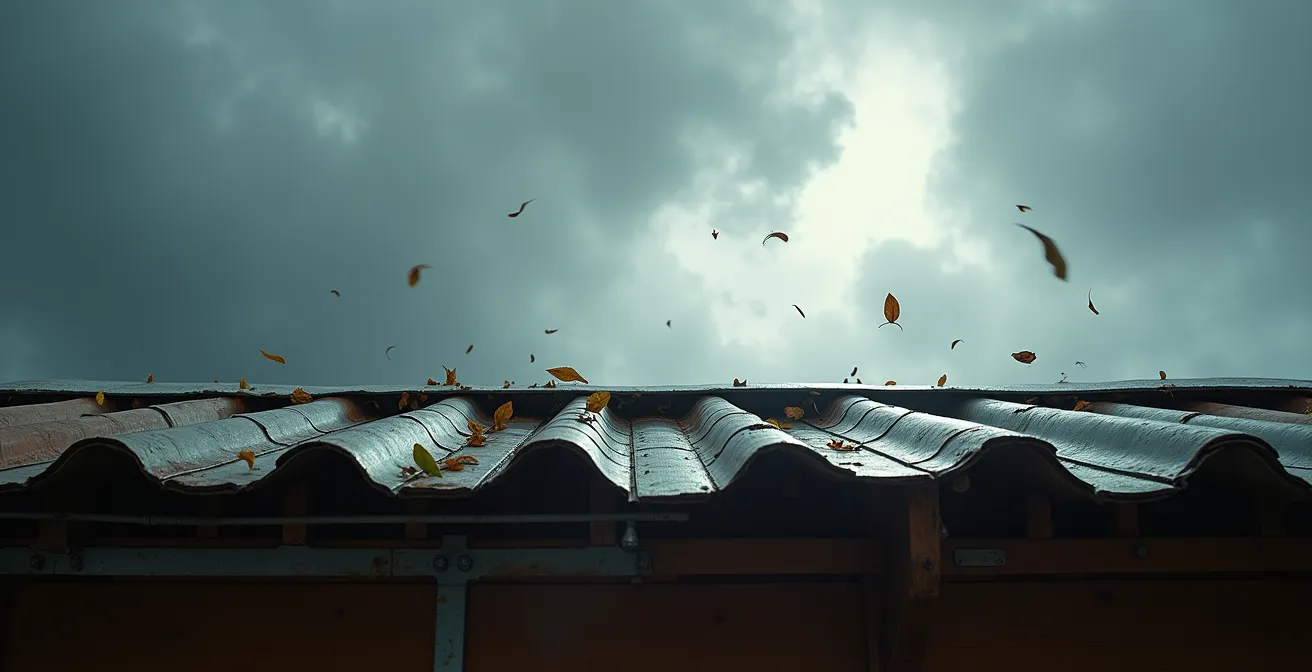
The survival of your home in a hurricane is not about individual strong components, but about creating a continuous, unbroken structural system from the roof to the foundation.
- A breached garage door is the most common failure point, creating internal pressure that can lift the entire roof system.
- Hurricane straps are non-negotiable; they are the critical link that ties your roof structure to the walls, resisting aerodynamic uplift.
Recommendation: Stop thinking about isolated upgrades. Instead, audit your home for the weakest link in its “continuous load path” and address that vulnerability first.
For a coastal homeowner, the approach of hurricane season brings a familiar anxiety. The typical advice involves a checklist of actions: board up windows, trim trees, secure loose objects. While these steps are necessary, they often miss the fundamental principle of structural resilience. Homeowners diligently follow these steps, yet catastrophic failures still occur. The common perception is that extreme wind force is an unstoppable brute force, and survival is a matter of luck.
This perception is dangerously incomplete. From a structural engineering perspective, a house is not a collection of independent parts; it is an interconnected system designed to manage loads. Failure rarely happens because the entire house is weak, but because one critical connection fails, causing a cascade of destruction. The wind doesn’t just push on your house; it pries it apart, seeking out the weakest point of entry to create internal pressure and lift your roof like a wing.
But what if the key to survival wasn’t just adding stronger materials, but understanding the physics of how your home fails? This guide abandons the simple checklist approach. Instead, it provides a structural engineer’s framework for viewing your home as a complete system. We will dissect the most critical failure points—from the ground to the peak of your roof—and explain the engineering principles required to fortify them. This is not about just surviving a Category 1 storm; it’s about understanding the forces at play to build true resilience against them.
This article will guide you through the essential structural concepts and tactical reinforcements necessary to protect your home. We will examine each critical component, from roof connections to facade integrity, to ensure you are building a cohesive shield against the storm.
Summary: A Structural Engineer’s Framework for Hurricane Resilience
- Why Your Roof Needs Hurricane Straps Even If It Is Heavy?
- How to Install Storm Shutters on Second-Story Windows Safely?
- Plywood or Metal Shutters: Which Will Survive Debris Impact?
- The Garage Door Weakness That Blows the Roof Off Whole Houses
- When to Trim Trees: The Pruning Schedule to Prevent Storm Damage
- Sizing Your Cistern: How to Calculate Roof Runoff Potential?
- The Purchasing Mistake That Leaves You With 5 Incompatible Apps
- How to Waterproof Your Facade Without Trapping Moisture Inside?
Why Your Roof Needs Hurricane Straps Even If It Is Heavy?
One of the most dangerous misconceptions in storm preparation is that a heavy roof is an inherently safe roof. The primary threat from hurricane winds is not the wind pushing down on your roof, but the powerful aerodynamic uplift it creates. As high-speed wind flows over the shape of your roof, it creates a low-pressure zone above, similar to how an airplane wing generates lift. This pressure difference can generate thousands of pounds of upward force, attempting to suck the roof structure directly off your walls.
This is where hurricane straps, or truss tie-downs, are mission-critical. These galvanized steel connectors are not merely accessories; they are the essential link in your home’s continuous load path. This engineering concept refers to an unbroken chain of structural connections that transfers the loads from the highest point of the structure (the roof) safely down through the walls and into the foundation. Without straps, your roof trusses or rafters are often just resting on top of the wall’s top plate, held in place by little more than gravity and a few toenails—no match for aerodynamic uplift.
By mechanically fastening the roof trusses to the wall studs, hurricane straps ensure the roof and walls act as a single, unified box that can resist being pulled apart. The investment is not only in structural safety but also financial. As research shows, installing hurricane straps can reduce insurance costs, as insurers recognize this as a primary mitigation measure against catastrophic loss.
Action Plan: 5-Point Hurricane Strap Installation Audit
- Verify structural rating: Confirm the straps are rated to resist forces up to several thousand pounds, ensuring they can maintain roof-to-wall adhesion under extreme load.
- Trace the load path: Ensure the installation plan creates a continuous structural load path from roof to foundation using corrosion-resistant metal connectors.
- Check connection density: Straps must be installed at every rafter-to-wall connection point, not just at corners, to distribute uplift forces evenly.
- Select appropriate material: Choose between galvanized steel for a balance of strength and affordability, or stainless steel for superior corrosion resistance in harsh coastal environments.
- Ensure code compliance: The installation must meet or exceed International Residential Code (IRC) requirements and any specific local wind-load regulations.
Ultimately, a roof without straps is an untethered lid on a box, waiting for a strong wind to lift it off. Securing this connection is the first and most fundamental step in true hurricane fortification.
How to Install Storm Shutters on Second-Story Windows Safely?
Protecting second-story windows presents a significant logistical and safety challenge. The act of installing heavy, unwieldy shutter panels at height introduces risks that can lead to serious injury if not managed with an engineering mindset. Safety is paramount, and it begins with selecting the correct equipment. A stable, properly-sized extension ladder for straight access or an A-frame ladder for a wider stability base is non-negotiable. The ladder must be placed on firm, level ground at the correct angle (approximately 75 degrees).
The installation itself must be treated as a structural task. Simple nails are never acceptable for securing storm shutters. The forces exerted by wind and debris impact are immense. Use hanger bolts or barrel bolts that are long enough to penetrate the window trim and anchor securely into the home’s structural framing. Whenever possible, panels should be mounted inside the window frame. If they must be mounted to the exterior facade, ensure the screws are driven into studs, not just the sheathing.
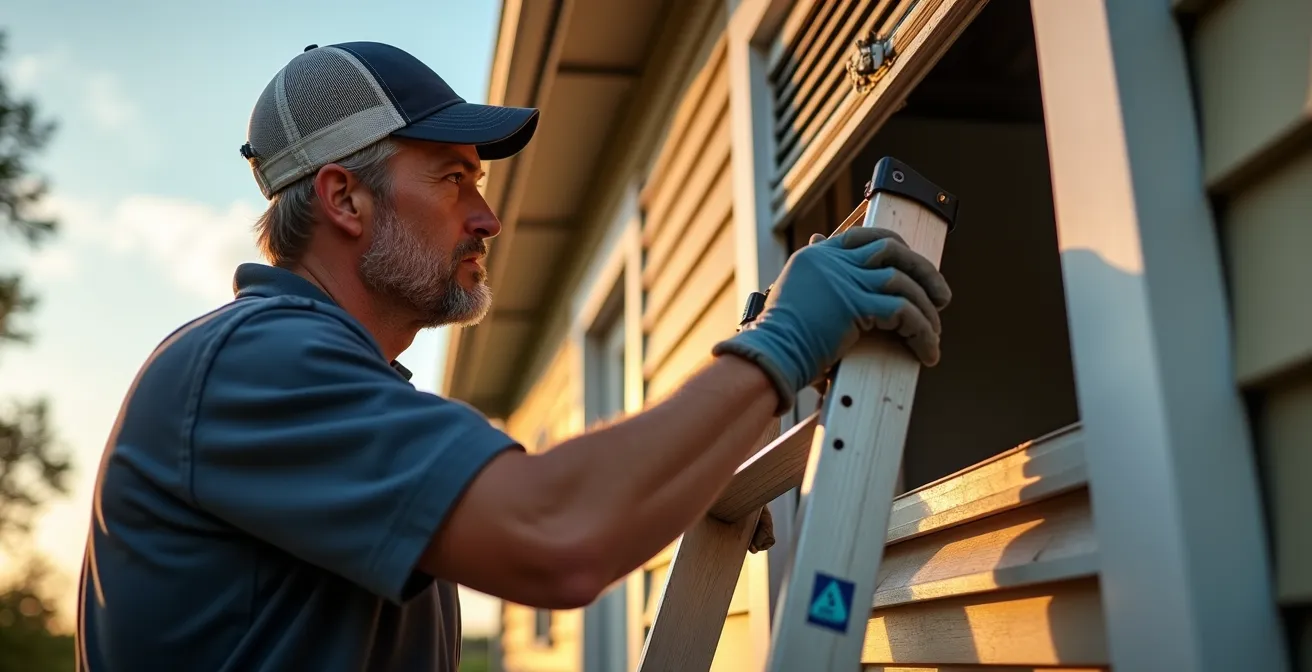
As seen in the professional approach illustrated above, this is never a one-person job. A team approach is mandatory for safety and effectiveness. One person’s sole responsibility should be to stabilize the base of the ladder, acting as a ground anchor, while the other person positions and fastens the heavy panels. Given the recurring risk and labor, homeowners should also consider permanent solutions like accordion or roll-down shutters. While the initial cost is higher, they eliminate the annual danger of ladder work and provide instant protection.
Ultimately, a shutter that is not installed safely or securely offers a false sense of security. It becomes a hazard itself, both to the installer and as a potential projectile in the storm.
Plywood or Metal Shutters: Which Will Survive Debris Impact?
The choice of shutter material is a critical decision that balances cost against performance. While plywood is a common, low-cost option, its protective capabilities have significant structural limitations. From an engineering standpoint, the key performance indicator is not just wind resistance, but impact resistance against wind-borne debris. A sheet of plywood may block wind, but it can be easily punctured or shattered by a projectile, rendering it useless.
Testing data reveals that standard plywood’s performance degrades sharply in more powerful storms. It is generally accepted that plywood shutters are strong enough for Category 1 and 2 hurricanes, but they consistently fail tests simulating impacts in Category 3 or higher storms. Furthermore, plywood is essentially a single-use solution; once exposed to the torrential rain of a hurricane, it warps, delaminates, and loses its structural integrity, making it unreliable for future seasons.
Aluminum and polycarbonate panels offer vastly superior performance. These materials are engineered specifically for impact resistance and durability, designed for multiple years of deployment. While their upfront cost is higher, they represent a more sound long-term investment in safety and property protection, often qualifying for insurance premium discounts that plywood does not.
The following table, based on a comparative analysis of storm panel materials, breaks down the key structural and financial differences.
| Material | Impact Resistance | Cost per Sq Ft | Lifespan | Insurance Discount |
|---|---|---|---|---|
| Plywood (5/8″) | Fails at 27 mph missile impact | $2-$6 | Single use (warps from moisture) | No discount |
| Aluminum Panels | 25% stronger than plywood | $15-$30 | Multiple years (corrosion resistant) | Potential discount |
| Polycarbonate | 200x stronger than plywood | $10-$25 | Long-term reusable | Potential discount |
For true peace of mind, especially in areas prone to stronger hurricanes, investing in a reusable, impact-rated system like aluminum or polycarbonate is the only structurally sound decision.
The Garage Door Weakness That Blows the Roof Off Whole Houses
The large, unbraced surface of a standard garage door makes it the single most vulnerable point in a home’s structural envelope during a hurricane. Its failure is not an isolated event; it is the trigger for catastrophic, system-wide failure. When the garage door is breached by high winds, the garage acts like a massive scoop, funneling air into the house. This leads to a sudden and dramatic internal pressurization of the entire structure.
This internal pressure, combined with the aerodynamic lift on the roof, creates an unstoppable force pushing upwards. The roof structure, even one with hurricane straps, can be overwhelmed, leading to it being lifted and peeled off the walls. This “empty soda can” effect is the mechanism responsible for some of the most devastating structural damage seen after hurricanes. The data is clear: structural analysis confirms that 90% of homes whose garage door survived a storm had no structural damage to the roof, proving the direct correlation between the door’s integrity and the survival of the entire house.
FEMA Analysis: The Domino Effect of Garage Door Failure
A post-hurricane analysis by the Federal Emergency Management Agency (FEMA) identified a clear pattern of destruction. According to their findings, garage door failure is a leading cause of catastrophic structural damage. FEMA notes that about 80% of residential hurricane wind damage starts with wind entry through the garage door. Once the door is compromised, the rapid pressurization inside the home can generate enough force to blow out walls and lift the roof structure completely off the building, leading to total structural collapse.
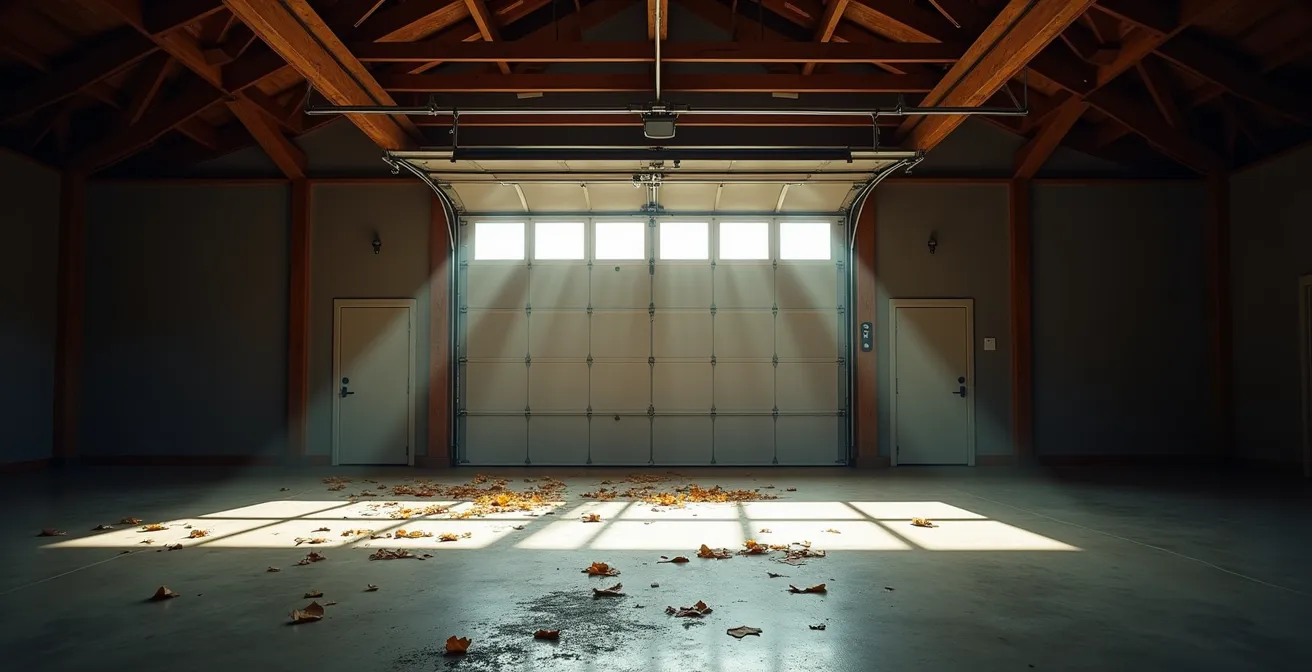
The visual above illustrates precisely how wind entering the garage creates upward pressure on the roof’s structural members. Reinforcing your garage door with a hurricane-rated model or an approved bracing kit is not just about protecting your car; it’s about preventing the explosive depressurization that destroys entire homes.
Ignoring the vulnerability of your garage door is akin to locking your front door but leaving a massive, unsecured bay window open to the storm.
When to Trim Trees: The Pruning Schedule to Prevent Storm Damage
From a structural perspective, trees adjacent to a home are not just landscaping; they are potential projectiles and sources of direct impact loads. The goal of tree trimming for hurricane preparedness is not merely aesthetic but is a strategic exercise in risk mitigation. The most crucial element is timing. Proactive pruning must be completed months before hurricane season begins, during the tree’s dormant season (typically late fall or winter). Last-minute trimming as a storm approaches is extremely dangerous, as it creates a supply of loose branches that become deadly missiles in high winds.
The methodology of pruning is also critical. An engineer’s approach focuses on strengthening the tree’s own structure. This involves “thinning cuts” to allow wind to pass through the canopy, rather than “topping cuts” which create weak, fast-growing shoots that are prone to snapping off. The primary goal is to remove any branches that are dead, dying, or diseased, as these are guaranteed to fail. Secondly, it is imperative to create a safety clearance by removing any limbs that are within 6 to 10 feet of your roofline, as these can puncture the roof decking during the storm.
A “danger zone” map should be created for your property, identifying any trees whose fall path could intersect with your house, power lines, or other structures. This strategic assessment helps prioritize which trees require professional attention or potential removal.
The preparation of your trees takes place months before any storm is even named. Attempting to prune and trim branches as the storm is coming can turn the branches into hazards when the winds hit and cause even more damage.
– Big D Roofing Hurricane Experts, Hurricane-Proof Roofing Guide
Managing the trees on your property is not a last-minute chore; it is an integral part of maintaining the structural integrity of your home’s defensive envelope.
Sizing Your Cistern: How to Calculate Roof Runoff Potential?
While the title suggests water collection, a structural engineer’s primary concern with “roof runoff potential” is not volume, but weight and uncontrolled force. During a hurricane, a roof must manage a deluge of water, and its failure to do so can lead to structural damage that is then exploited by high winds. Calculating the runoff potential, in this context, means assessing the potential for water to become a destructive load on your roof system.
One of the most common failure points is the roof’s edge, encompassing the fascia and soffit boards. These components are often not designed to handle the immense weight of a gutter system completely filled with water and debris. If your gutters are clogged, a single 10-foot section can hold several hundred pounds of water. This static load can be enough to rip the fascia and gutters away from the house, exposing the ends of your roof rafters. This creates a new, vulnerable entry point for wind and wind-driven rain, compromising the entire roof structure.
Therefore, the most critical “sizing” calculation is ensuring your drainage capacity exceeds the storm’s input. This involves:
- Regularly cleaning all gutters and downspouts to ensure an unobstructed flow path.
- Inspecting and reinforcing the hangers and attachments that secure the gutters to the fascia.
- Ensuring downspouts direct water several feet away from the foundation to prevent soil erosion and hydrostatic pressure on the foundation walls.
Routine maintenance is a form of structural protection. A clean, secure gutter system effectively sheds a massive, potentially destructive water load away from your home, preserving the integrity of the roof edge, which is a frequent target for wind damage.
In a hurricane, water and wind work in concert. A failure in your water management system creates a new weakness for the wind to attack.
The Purchasing Mistake That Leaves You With 5 Incompatible Apps
In the world of technology, purchasing five separate apps that don’t communicate with each other leads to inefficiency and frustration. In the world of structural fortification, the equivalent mistake is far more costly: investing in high-quality, disconnected components that fail to form a cohesive defensive system. This is the “incompatible apps” error of hurricane preparedness—a piecemeal approach that creates a false sense of security.
Consider these scenarios:
- You install a state-of-the-art, impact-rated hurricane shutter (the “premium app”) but secure it with cheap, short screws that only bite into wood trim instead of the structural frame. The shutter is strong, but its connection is weak. The system fails.
- You install a wind-rated garage door but neglect to check if the surrounding door frame and wall connections are equally robust. The door holds, but the frame splinters, and the entire unit is pushed in. The system fails.
- You have hurricane straps on your roof trusses but have not addressed a rotting soffit or fascia board. Wind-driven rain penetrates the rotten wood, saturating the wall cavity and compromising the very wall studs the straps are anchored to. The connection point is weakened from within. The system fails.
The fundamental mistake is focusing on the “features” of an individual product rather than its role within the continuous load path. Every connection point is a potential vulnerability. True resilience comes from ensuring that each component is as strong as the next in the chain, from the shutter bolt to the wall stud, from the truss strap to the foundation anchor. A single weak link, or “incompatible app,” renders the entire investment useless when put under extreme load.
The most important step is a holistic audit of your home’s existing structural connections before you invest in any single-point upgrade. Identify and fix the weakest link first.
Key Takeaways
- Your home’s survival depends on a “continuous load path” that transfers wind forces from the roof, through the walls, and into the foundation.
- The garage door is the most common point of failure. Its collapse leads to internal pressurization that can lift the entire roof.
- Fortification is a system. High-quality individual components (like shutters or doors) will fail if their connections to the main structure are weak.
How to Waterproof Your Facade Without Trapping Moisture Inside?
Protecting a home’s facade from wind-driven rain is a critical part of hurricane preparedness. However, a common but dangerous mistake is to apply a non-permeable “waterproof” coating that effectively seals the wall. While this may block rain from the outside, it also traps any moisture that finds its way inside the wall system, leading to a catastrophic loss of structural integrity from within.
Moisture can enter a wall cavity from multiple sources: a small leak around a window, condensation from interior air, or even minor absorption through the materials themselves. If the exterior facade cannot “breathe”—that is, allow this trapped moisture vapor to escape—it creates a perfect environment for mold, mildew, and, most destructively, wood rot. Over time, this trapped moisture can silently decay wooden studs, sheathing, and structural headers. The wall may look perfectly fine from the outside, but its load-bearing capacity is being compromised.
The structurally sound approach is to use a weather-resistant barrier (WRB) or “house wrap” that is designed to be water-resistant but vapor-permeable. These advanced materials block liquid water from penetrating from the outside but allow moisture vapor that is trapped inside to dry to the exterior. This ensures the structural framing remains dry and sound. For brick or stone facades, ensuring that weep holes at the base of the wall are clear and functional is essential to allow the air gap behind the masonry to drain and dry.
Applying an impermeable sealant to a wall is like putting a plastic bag over it. You may keep the rain out, but you are creating a terrarium for rot. The goal is not to create an airtight seal, but a managed, breathable system that keeps liquid out while allowing vapor to escape.
For your home to withstand the force of a hurricane, it must be strong. For it to remain strong for years to come, it must also be kept dry, both inside and out.