In summary:
- Your touch, even a light one, transfers oils and acids that cause irreversible chemical damage to ancient surfaces over time.
- Ethical photography in dark interiors requires using camera settings like high ISO and exposure bracketing, not destructive flash.
- Distinguish authentic cultural ceremonies from tourist shows by observing schedules, audiences, and the absence of fixed ticket prices.
- Support preservation by buying certified replicas or artisan crafts, as purchasing real artifacts fuels an illegal and destructive black market.
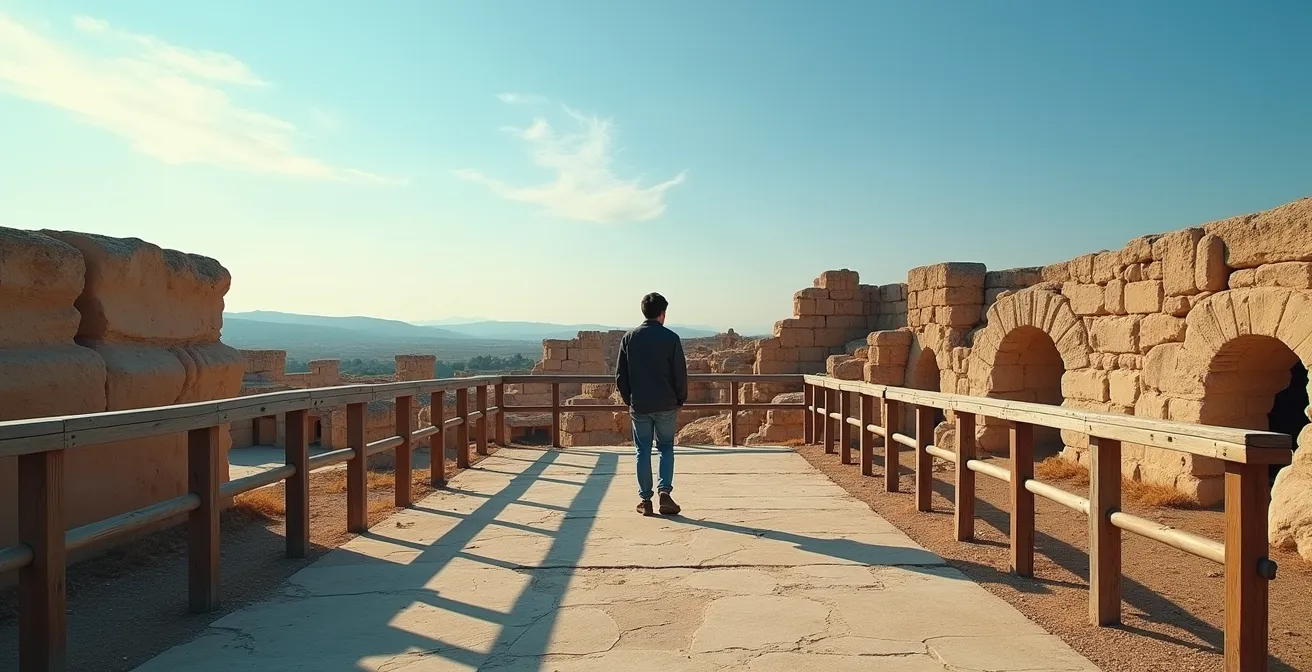
Standing before a 2,000-year-old wall, the impulse is almost irresistible: to reach out and touch history. This desire to connect is universal, born from a place of awe and reverence. As a conscientious traveler, you already know the basic rules—don’t litter, stay on the path, be quiet and respectful. You’ve heard the simple refrains of “don’t touch the art” and “take only pictures, leave only footprints.”
While well-intentioned, this advice barely scratches the surface. It treats priceless world heritage sites as if they were simple museums, failing to explain the profound, often invisible, damage that millions of visitors can cause. The most significant threats to our shared history aren’t from malicious vandals, but from the cumulative impact of well-meaning tourists who simply don’t understand the science of decay they unwittingly accelerate.
But what if the key to preservation wasn’t just following a list of prohibitions, but actively understanding *why* those rules exist? What if you could shift your perspective from a passive visitor to an active guardian? This guide is built on that principle. It will not just tell you what not to do; it will explain the hidden mechanics of destruction and equip you with the knowledge to make choices that truly protect these fragile wonders for generations to come.
This article will guide you through the crucial, often overlooked, aspects of responsible heritage tourism. By understanding the science behind the decay, the ethics of cultural interaction, and the strategies for minimizing your physical and economic footprint, you will be empowered to visit the world’s most incredible places in a way that honors and preserves them.
Summary: The Guardian’s Guide to Responsible Heritage Tourism
- Why Touching Ancient Walls Destroys Them With Oil and Acid?
- How to Photograph Dark Interiors Without Using Flash?
- Certified Guide or Local Elder: Who Gives the Truer History?
- The Souvenir Mistake: Buying Artifacts That Fuel the Black Market
- When to Visit the Louvre: Avoiding the Peak Hours That Threaten Art Safety
- The Red Flag That Reveals a “Traditional” Ceremony Is Staged for Tourists
- Why Touching a Stalactite Stops Its Growth for Centuries?
- How to Experience Authentic Local Culture in Popular Cities Without the Crowds?
Why Touching Ancient Walls Destroys Them With Oil and Acid?
The gentle brush of a fingertip against an ancient stone carving feels harmless, a momentary connection across millennia. Yet, this simple act is a primary driver of deterioration at heritage sites worldwide. Your skin, no matter how clean, is constantly coated in a mixture of natural oils, sweat, and acids. When transferred to a porous surface like sandstone, marble, or ancient plaster, these substances begin a slow, insidious process of chemical and biological decay.
The acids subtly etch the surface, breaking down mineral bonds that have been stable for centuries. The oils penetrate the pores of the stone, creating dark, permanent stains that are impossible to remove without causing further damage. Worse, these organic deposits become a food source for bacteria and fungi. These microorganisms colonize the surface, leading to discoloration, flaking, and the eventual crumbling of the material. What one touch begins, a million touches accelerate into a catastrophic failure of the material.
The tragic reality of this cumulative impact is visible at countless sites. A clear example is seen in the preservation challenges at Pompeii, where the cumulative effect of millions of visitors touching walls has led to significant and irreversible degradation of 2,000-year-old frescoes and structures. Each individual touch seems insignificant, but multiplied over decades, it amounts to a constant assault that conservationists are powerless to reverse.
Your Guardian’s Checklist: Protecting Ancient Surfaces
- Adopt a “zero contact” policy: Consciously maintain a distance of at least one meter from all ancient walls, carvings, or painted surfaces.
- Mind your equipment: If using hiking poles, ensure they have rubber tips to avoid scratching ancient floors and rock surfaces.
- Prevent chemical transfer: Avoid applying sunscreen or insect repellent immediately before entering a site, as these chemicals can react with ancient materials.
- Practice mindful hygiene: Keep hands clean, but refrain from using alcohol-based hand sanitizers near historic surfaces, as the alcohol can be damaging.
- Report accidental contact: If you or someone else accidentally touches a surface, inform site staff. This allows them to monitor the area and is an act of stewardship, not shame.
Understanding this process transforms the rule “don’t touch” from a simple prohibition into a conscious act of guardianship. By keeping your hands to yourself, you are not just obeying a sign; you are actively starving the forces of decay and protecting history for the future.
How to Photograph Dark Interiors Without Using Flash?
Entering the quiet dark of a pharaoh’s tomb or a medieval crypt, your first instinct as a photographer is to use a flash to illuminate the intricate details hidden in the shadows. However, the use of flash is strictly forbidden in almost all sensitive historical sites, and for good reason. The intense, repetitive bursts of light cause photochemical degradation, a form of invisible damage that has a devastating cumulative effect on ancient pigments and fragile materials.
Each flash is a high-energy blast that causes pigments to fade, much like a poster left in the sun for a week. Over thousands of flashes from thousands of visitors, vibrant colors on a fresco or delicate manuscript turn to muted, faded ghosts of their former glory. This damage is irreversible. As a guardian of heritage, your challenge is to capture the beauty of these spaces without contributing to their demise.
This is where understanding your camera becomes a tool of preservation. The photograph below illustrates the power of using natural light—a technique that respects the artifact while still achieving a stunning result.
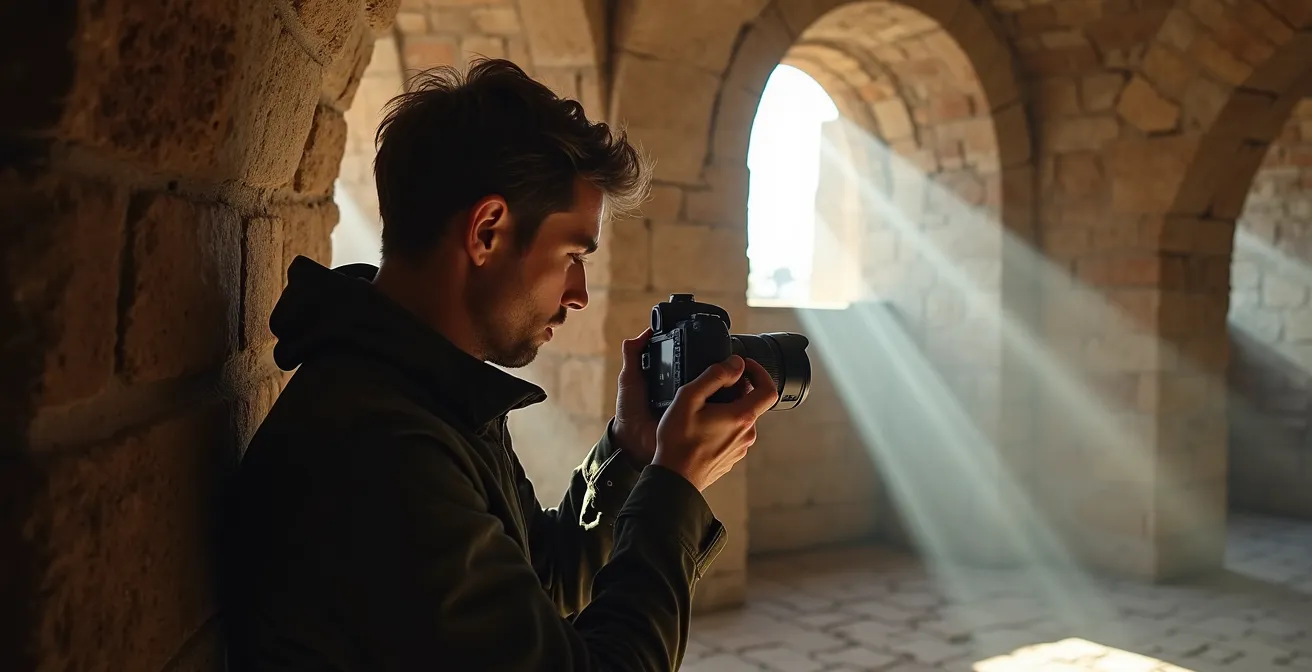
As you can see, by using available light and proper technique, it’s possible to create dramatic, well-exposed images. Instead of using a flash, a responsible photographer learns to “gather” the existing light. This involves a few key techniques that any traveler can learn:
- Use a higher ISO: Modern cameras can handle high ISO settings (3200-6400) with minimal noise. This is always preferable to using a flash.
- Open your aperture: Use the widest aperture your lens allows (e.g., f/1.8, f/2.8) to let in the maximum amount of light.
- Brace yourself: Instead of a tripod, which is often banned, find a stable surface like a doorway or a modern railing to brace your camera against. Press your elbows into your body to form a human tripod. This allows for slower shutter speeds without motion blur.
- Shoot in RAW: This file format captures far more information than a JPEG, giving you the flexibility to recover shadow detail during post-processing without degrading the image quality.
By choosing these methods over the convenience of a flash, you are making a conscious decision to protect the very thing you are trying to capture. Your beautiful, naturally-lit photograph becomes a testament not only to your skill but also to your respect for history.
Certified Guide or Local Elder: Who Gives the Truer History?
Upon arriving at a major heritage site, you are often faced with a choice: Do you hire the officially licensed guide with a laminated ID and a degree in archaeology, or the local elder from a nearby village who offers to share the stories of their ancestors? The common advice to “hire a local guide” is too simplistic, as it overlooks a fundamental question: What kind of “truth” are you seeking?
This isn’t a question of one being right and the other wrong. Rather, it’s about understanding that they offer two different, equally valuable, and complementary types of knowledge. The certified guide provides the “what”—the historical facts, the archaeological data, the timelines of construction and collapse. The local elder provides the “why”—the cultural context, the spiritual significance, and the stories that transform a pile of stones into a living heritage site. The UN World Tourism Organization frames this perfectly, stating that our approach should be holistic. As they note in their guidelines on tourism and culture:
Tourism policies and activities should be conducted with respect for the artistic, archaeological and cultural heritage, which they should protect and pass on to future generations
– UN World Tourism Organization, Tourism and Culture Guidelines
A truly respectful visit acknowledges that both the scientific and the spiritual narratives are part of the site’s complete story. Choosing one over the other means you’re only getting half the picture. The ideal approach, if time and budget permit, is to experience both. To make an informed decision based on your goals, consider the different strengths of each.
This table can help you decide which perspective aligns best with your interests for a particular visit, or how to best combine them for a comprehensive understanding.
| Aspect | Certified Guide | Local Elder | Combined Approach |
|---|---|---|---|
| Knowledge Type | Archaeological facts, dates, scientific data | Cultural stories, spiritual significance, oral traditions | Complete narrative combining both perspectives |
| Verification | Official credentials, licensed by authorities | Community endorsement, cultural center connection | Dual verification through both channels |
| Best For | Understanding construction, timeline, historical context | Grasping cultural meaning, local traditions, living heritage | Comprehensive understanding of site significance |
| Typical Cost | Fixed hourly/daily rates | Donation or gift-based compensation | Combined budget for both perspectives |
The most conscientious traveler recognizes that a site’s “truest” history is a blend of scientific fact and cultural memory. By seeking out both, you honor the complete identity of the place and enrich your own understanding immeasurably.
The Souvenir Mistake: Buying Artifacts That Fuel the Black Market
The desire to bring home a tangible piece of your journey is natural. A small, beautifully shaped rock or a fragment of ancient-looking pottery seems like the perfect memento. However, this seemingly innocent act of collecting or purchasing is one of the most destructive things a tourist can do. It directly fuels the black market for antiquities, an illegal trade that incentivizes the looting and destruction of heritage sites worldwide.
Every “authentic” artifact sold in a market, no matter how small or inexpensive, has likely been illegally excavated. Looters, in their rush to find sellable items, destroy invaluable archaeological context. A simple pottery shard, when found in situ by an archaeologist, can reveal volumes about trade routes, diet, and daily life. When ripped from the ground and sold to a tourist, it becomes a mute, meaningless object. Your purchase encourages this cycle of destruction. It is a fundamental principle of preservation that it is 100% illegal to remove any artifact, from pottery pieces to stone tools, from protected archaeological areas.
A heritage guardian understands that their economic footprint is a powerful tool for either good or ill. The answer is not to stop buying souvenirs, but to channel that economic power toward supporting preservation, not destruction. Instead of hunting for “real” artifacts, you can make choices that empower local communities and help fund the conservation of the sites you love. True souvenirs are not taken; they are created and exchanged ethically.
Here are several ethical alternatives that provide a meaningful connection to the place you visited while actively contributing to its future:
- Purchase certified replicas: Official museum shops often sell high-quality, certified replicas. The profits from these sales are frequently channeled directly back into conservation and research for the site.
- Support local artisans: Seek out and purchase contemporary crafts from local artists who are inspired by ancient traditions. This supports living culture and ensures skills are passed down through generations.
- Book a workshop: Instead of buying a pot, learn how to make one. Participating in a workshop with a local artisan creates a much more profound memory and directly supports their livelihood.
- Make a direct donation: The most impactful way to contribute is to donate directly to the site’s official preservation fund. This is the purest form of giving back.
By shifting your spending, you transform from a passive consumer into an active patron of cultural heritage. Your “souvenir” is no longer an object, but the knowledge that your visit helped ensure the site’s survival.
When to Visit the Louvre: Avoiding the Peak Hours That Threaten Art Safety
The title’s mention of the Louvre is a placeholder for a universal problem: overtourism. The phenomenon of being in a massive crowd, shuffling shoulder-to-shoulder past a masterpiece you can barely see, is not just an unpleasant experience; it’s a direct threat to the safety of the site itself. Overtourism creates a host of invisible damages, from increased humidity and CO2 levels from breathing, which accelerate the decay of delicate artifacts, to the simple wear and tear of millions of feet on ancient floors.
The goal of a heritage guardian is to enjoy these incredible places while minimizing their own contribution to this cumulative strain. This requires a strategic approach to timing, moving against the primary flow of tourist traffic. While many sites are implementing top-down controls, individual travelers can make a significant difference by planning their visits for off-peak times, effectively spreading the load and reducing stress on the infrastructure.
Case Study: Visitor Management in Venice
The UNESCO World Heritage site of Venice provides a stark example of the battle against overtourism. For years, the city struggled to balance the economic benefits of tourism with the urgent need to protect its fragile architecture and lagoon ecosystem from the sheer volume of visitors. In response, Venice has implemented strategies such as timed entry systems and visitor caps during peak seasons. These measures, while controversial, are designed to mitigate the cumulative damage caused by overcrowding and have shown success in reducing strain on the city’s most vulnerable areas, improving both site preservation and the quality of life for residents.
You can apply a similar logic to your own travels, no matter the destination. By consciously choosing when and where you go within a site, you can have a richer, more authentic experience while reducing your impact. Here are some smart strategies for avoiding the crowds:
- Embrace the early morning: The hours between 6 AM and 8 AM are golden. Most tourists are still asleep, but the city is alive with locals going to work, shopping at markets, and enjoying their daily routines.
- Use technology: Google Maps’ “Popular Times” feature is a powerful tool for identifying the least crowded hours for almost any major attraction. Plan your visit for the dips in the graph.
- Travel in the shoulder season: Visiting in late autumn or early spring, rather than the height of summer, means fewer crowds, lower prices, and often more pleasant weather.
- Book the first or last slot: If a site uses a timed-entry system, always book the very first or very last slot of the day. You’ll enjoy a much less crowded experience.
- Explore the periphery: At large sites like the Roman Forum or Angkor Wat, the main attractions will be packed. Spend your time exploring the lesser-known, but often equally fascinating, outlying areas.
By planning thoughtfully, you not only improve the quality of your own visit but also become part of the solution to one of the greatest threats facing our world’s heritage.
The Red Flag That Reveals a “Traditional” Ceremony Is Staged for Tourists
One of the most profound travel experiences is witnessing a local cultural or religious ceremony. It’s a window into the soul of a place, a moment of authentic connection. However, the popularity of tourism has led to the rise of the “staged ceremony”—a performance designed to look traditional but created solely for a paying audience. While entertaining, these shows can be a form of cultural exploitation, reducing sacred or meaningful traditions to a caricature for profit.
A heritage guardian seeks authentic connection, not just entertainment. The key is to develop a discerning eye, learning to distinguish between a community event that you are privileged to observe, and a theatrical show in which you are simply a customer. There is nothing inherently wrong with a cultural performance, but it’s crucial to understand the difference and manage your expectations. An authentic ceremony is performed for the community’s own reasons, on its own schedule; a tourist show is performed for you.
Spotting the difference isn’t always easy, as performers are often very skilled. However, there are several key indicators you can look for that help separate a living heritage event from a rehearsed performance. Paying attention to context, scheduling, and the behavior of the audience (both local and tourist) will almost always reveal the true nature of the event.
This guide can help you assess the situation and understand what you are likely witnessing. There are no hard and fast rules, but a combination of these factors can provide a very clear picture.
| Indicator | Authentic Ceremony | Tourist Performance |
|---|---|---|
| Schedule | Follows lunar/religious calendar, irregular timing | Daily shows at fixed times (2PM, 4PM) |
| Audience | Mostly locals actively participating | 99% tourists with cameras |
| Atmosphere | Unscripted reality, children running, casual conversation | Stage-like separation, rehearsed movements |
| Photography | May have restrictions or require permission | Photo opportunities emphasized, poses held |
| Payment | Donations or no charge | Ticket booth with fixed prices |
By making this distinction, you can choose to support genuinely local initiatives and engage with culture in a way that is respectful and non-exploitative. You can appreciate a tourist performance for the skill and artistry it involves, while knowing that the deeper, more authentic experiences lie elsewhere, waiting to be discovered with patience and respect.
Why Touching a Stalactite Stops Its Growth for Centuries?
The otherworldly beauty of a wild cave, with its glittering stalactites and stalagmites, is the result of a process that unfolds on a geological timescale. These delicate formations are built, drip by single drop of mineral-rich water, over thousands of years. Yet, a single touch from a human hand can halt this ancient process in an instant, and the damage can be permanent.
Like ancient ruins, the surface of a cave formation is far more complex and delicate than it appears. The primary mechanism of destruction here is biological and chemical contamination. The constant dripping that forms a stalactite creates a very specific, stable environment. The surface is home to a unique ecosystem of extremophile bacteria, microorganisms that are perfectly adapted to that exact environment and play a crucial role in the mineral deposition process. As scientific studies have shown, tourism in heritage caves introduces foreign microbes that can disrupt this delicate balance with system-wide, often permanent, impacts.
When you touch a stalactite, the oils and microbes from your skin are deposited onto its surface. Your “foreign” microbes, now in a new environment with no competitors, can rapidly out-compete and destroy the native cave bacteria. This disruption effectively sterilizes the surface, breaking the chain of mineral deposition. The water may continue to drip, but the stalactite will no longer grow where it was touched. A dark, oily patch is left behind, a permanent scar marking the spot where thousands of years of natural creation were halted in a second. This is the ultimate example of invisible damage with a long-lasting, visible consequence.
The rule in any cave environment is absolute: look, but never, ever touch. Your brief moment of tactile curiosity is not worth erasing centuries of future growth. By treating the entire cave as a pristine, untouchable museum exhibit, you act as a true guardian, ensuring that these slow-growing wonders can continue their silent, beautiful work for millennia to come.
Key Takeaways
- Embrace the Guardian Mindset: Shift your perspective from a consumer of experiences to a protector of heritage. Your primary goal is to leave a place as good as, or better than, you found it.
- Understand Cumulative Impact: A single footstep, touch, or flash seems harmless, but multiplied by millions, it is the primary force of destruction. Your individual choices matter.
- Seek the “Why”: Don’t just follow the rules. Understand the scientific and cultural reasons behind them. This knowledge transforms simple prohibitions into acts of conscious preservation.
How to Experience Authentic Local Culture in Popular Cities Without the Crowds?
You have now grasped the core principles of being a heritage guardian: understanding your invisible impact, making ethical choices, and minimizing your physical footprint. The final piece of the puzzle is to apply this mindset to proactively seek out authentic cultural experiences, even in the most popular and crowded destinations. The goal is to move beyond the tourist bubble and connect with the real rhythm of a place.
The secret is to think like a local, not a tourist. A tourist’s itinerary is often dictated by a Top 10 list, leading them to the same crowded places at the same crowded times. A local’s life follows a daily and weekly rhythm. By learning to observe and gently intersect with that rhythm, you can discover a side of the city that most visitors completely miss. This often means rejecting the most obvious choices and exploring the periphery, both in terms of geography and time.
This strategy isn’t about shunning famous landmarks entirely, but about contextualizing them within a broader, more genuine experience of a city. It’s about finding the balance between seeing the “must-see” sights and discovering the “must-feel” soul of a place. The following “Dawn & Dusk Strategy” provides a framework for doing just that.
- Visit markets at dawn: Don’t go to the main food market at 11 AM with other tourists. Go at 6 AM. You’ll be there with local chefs and residents doing their daily shopping. The energy is completely different, and the experience is real.
- Walk historic centers at sunrise: The golden hour of sunrise is not just for photographers. It’s when locals are out exercising, commuting, and starting their day. A famous plaza that is a chaotic tourist trap at noon can be a place of serene, local beauty at 6:30 AM.
- Find local public events: Use local social media or community boards to find public gatherings. This could be a neighborhood chess club in the park, a free tango gathering in a square, or a public poetry reading. These are the lifeblood of a community.
- Explore two blocks away: Walk two or three blocks away from any major tourist street. You’ll find the tourist-focused shops give way to authentic local businesses, bakeries, and cafes where residents actually go.
- Follow the reverse itinerary: Look up the top 5 tourist attractions in a city and make a conscious choice to explore the neighborhoods *around* them, rather than joining the queue.
By adopting these strategies, you are not just avoiding crowds; you are stepping into a more meaningful and respectful mode of travel. Your journey becomes less about ticking boxes and more about genuine discovery, leaving both you and the place you visit enriched by the encounter.