
Shifting from product sales to leasing isn’t just about recurring revenue; it’s about fundamentally re-engineering your business to capture up to 3x more value from every single asset.
- True profitability comes from designing products for serviceability and mastering reverse logistics, not just collecting monthly fees.
- This model transforms Corporate Social Responsibility (CSR) from a cost center into a self-funding, market-expanding profit engine.
Recommendation: Begin by analyzing your product’s entire lifecycle to identify untapped value, starting with design for repair instead of replacement.
For decades, the manufacturer’s playbook has been simple: build a product, sell it, and hope the customer returns for the next model. This linear “sell-and-forget” approach creates volatile cash flow and leaves immense value on the table. Many business leaders believe the answer lies in a subscription model to secure more stable revenue. While true, this view is dangerously incomplete. Simply putting a lease on a product designed for a single sale is like putting a jet engine on a horse-drawn cart—it misses the fundamental engineering shift required for flight.
The real transformation, the one that generates exponential returns, is not a sales strategy. It’s a comprehensive pivot to a circular business model. This involves rethinking everything from the initial design of your product to how you manage its end-of-life. The common advice to “focus on customer relationships” or “sell outcomes” only scratches the surface. The genuine opportunity lies in a deep, operational commitment to the entire asset lifecycle value, a concept that turns maintenance, returns, and refurbishment from cost centers into powerful revenue streams.
This transition challenges the very core of what it means to be a manufacturer. It demands a shift from measuring success by units sold to maximizing the lifetime value of every asset you produce. It requires mastering disciplines like Design for Service (DfS) and reverse logistics. This guide provides a strategic blueprint for this evolution. We will dissect how a leasing model triples revenue potential, how to design products built for a circular economy, and how this shift can become a self-funding CSR strategy that actually boosts your bottom line.
This article provides a comprehensive roadmap for manufacturers ready to move beyond the limitations of the traditional sales model. Explore the key pillars of a successful product-to-service transition in the sections below.
Summary: From Products to Services: The Blueprint for Unlocking Recurring Revenue
- Why Leasing Your Product Generates 3x More Revenue Over Its Lifecycle?
- How to Design Products That Take 5 Minutes to Repair Instead of Replace?
- Recycling or Upcycling: Which Process Recovers More Value From Waste?
- The “Used Goods” Stigma That Stops Customers From Buying Refurbished
- Mastering Returns: How to Collect Used Products Without Killing Margins?
- Rent or Buy: Which Is More Ethical for a Wedding Guest Outfit?
- Why Green Businesses Have a 20% Higher Employee Retention Rate?
- How to Implement a CSR Strategy in a Small Business With Zero Extra Budget?
Why Leasing Your Product Generates 3x More Revenue Over Its Lifecycle?
The transition from a single transaction to a recurring revenue model fundamentally alters a product’s economic potential. A traditional sale captures value once. A leasing model, however, creates multiple touchpoints for revenue generation throughout the asset’s life, effectively tripling its earning power. This isn’t just theory; it’s a proven strategy that is gaining significant traction, with forecasts predicting 7% annual growth for the leasing market through 2026.
The automotive industry provides a classic blueprint. A car manufacturer generates revenue from the initial lease, profits from the built-in financing, and then captures a third wave of revenue by refurbishing and reselling the “Certified Pre-Owned” vehicle at the end of the lease term. This “triple-dip” transforms a single asset into three distinct profit events.
Case Study: The Auto Industry’s Triple Revenue Strategy
The auto lease model perfectly demonstrates the 3x revenue principle. Automakers benefit from an initial stream of cash flow with built-in profits, they establish long-term customer relationships that encourage repeat leases, and they generate a significant final revenue stream by reselling well-maintained, mildly used vehicles at the lease’s conclusion. This creates three distinct and profitable revenue touchpoints from a single manufactured asset, maximizing its lifecycle value far beyond a one-time sale.
This model is not exclusive to cars. It can be applied to industrial machinery, electronics, or even high-end furniture. The key is to expand your definition of revenue beyond the basic monthly fee. Your strategy should include diversified streams such as initial setup fees for installation, ongoing sales of proprietary consumables, premium support tiers with service level agreements (SLAs), and even monetizing the anonymized usage data your products generate to provide valuable performance insights to your clients. Each addition builds upon the base lease, compounding the asset’s total earnings.
How to Design Products That Take 5 Minutes to Repair Instead of Replace?
A profitable leasing model is impossible if your products are designed for the landfill. In a “sell-and-forget” world, complex, unrepairable products drive new sales. In a service-based world, they destroy your margins with every service call and replacement. The solution is a strategic shift to Design for Service (DfS)—a philosophy where ease of maintenance, repair, and disassembly is engineered into the product from day one.
This means moving away from proprietary screws, glued-in components, and sealed units. Instead, the focus is on modularity. Imagine a product where the most common points of failure—batteries, screens, motors—are designed as Customer-Replaceable Units (CRUs). These modules can be quickly swapped out by a technician, or even the customer, with minimal downtime. Using standardized fasteners and color-coding internal components further simplifies the process, making repairs intuitive and fast.

As the image above illustrates, a modular architecture makes a product’s internals look less like a tangled mess and more like a set of well-organized building blocks. This approach not only slashes service costs but also dramatically increases asset uptime, a critical metric for customer satisfaction in a leasing model. The goal is to make repairs so simple they take minutes, not hours or days, ensuring the asset is out in the field generating revenue, not sitting on a repair bench costing you money.
Action Plan: Implementing a Design for Service (DfS) Strategy
- Standardize fasteners: Audit all assemblies and migrate to non-proprietary, common-head screws to simplify tooling.
- Identify CRUs: Analyze failure data to identify the top 3-5 components that fail most often and redesign them as customer-replaceable units.
- Develop a visual system: Implement a color-coding scheme for internal components and connections to make repair instructions intuitive.
- Rethink packaging: Design product packaging that can be repurposed as a permanent storage or shipping case for returns and repairs.
- Include basic tools: Empower customers by including the simple, necessary tools for basic repairs and module swaps directly within the product packaging.
Recycling or Upcycling: Which Process Recovers More Value From Waste?
At the end of a product’s first life, manufacturers face a critical choice that directly impacts profitability: what to do with the returned asset? Many companies default to material recycling, believing it to be the most environmentally responsible option. However, from a value-recovery standpoint, recycling is often the last and least profitable resort. It involves breaking a product down to its raw materials, an energy-intensive process that destroys the vast majority of the value embedded in its design, engineering, and components.
A far more profitable approach is to move up the value recovery hierarchy. This framework prioritizes strategies that preserve the product’s existing form and function for as long as possible. The highest value is retained through simple redeployment—inspecting a returned product and leasing it out again “as is.” The next best option is refurbishment, where the product is cosmetically and functionally restored to a “like-new” condition and sold as a Certified Pre-Owned (CPO) item. Even component harvesting, where functional parts are salvaged from non-repairable units to support the service network, recovers significantly more value than melting everything down.
The table below, based on the principles of the circular economy, outlines this hierarchy. It clearly shows that methods retaining the product’s integrity require less energy and yield far greater revenue potential, a core tenet for a successful service model.
| Recovery Method | Value Retained | Energy Required | Revenue Potential |
|---|---|---|---|
| Redeployment (re-lease as is) | 95-100% | Minimal | Highest |
| Refurbishment (CPO) | 75-90% | Low | High |
| Component Harvesting | 40-60% | Moderate | Medium |
| Material Recycling | 10-25% | High | Lowest |
By focusing on redeployment and refurbishment, a manufacturer not only creates new revenue streams from a single asset but also significantly reduces the need for new production, cutting down on material and energy costs. This strategic view of “waste” as a resource is fundamental to the economic success of a leasing business.
The “Used Goods” Stigma That Stops Customers From Buying Refurbished
One of the biggest obstacles to maximizing asset lifecycle value is a psychological one: the customer’s inherent distrust of “used” or “refurbished” products. This stigma can prevent a company from tapping into the lucrative secondary market. Overcoming it requires a strategic shift in both language and process. The key is to reframe the narrative from one of “used goods” to one of “certified quality.”
This begins by eliminating terms like “used” and “refurbished” from all marketing and sales communications. Instead, adopt the term “Certified Pre-Owned” (CPO). This language implies a rigorous standard of quality and inspection, not just a quick clean-up. To back this up, you must implement a transparent and robust certification process. Creating a public-facing, multi-point inspection checklist (e.g., a “150-Point Inspection”) builds immense trust, showing customers exactly what has been tested and verified.
This commitment to quality must be reinforced with a powerful guarantee. Offering an extended warranty on CPO products that matches or even exceeds the warranty on new items is a bold statement of confidence. It tells the customer that you stand behind the refurbished asset just as firmly as a brand-new one. As Olivier Bussenot, Vice President at DigitalRoute, astutely notes, the entire business mindset must change:
Manufacturers need to shift from a unit price mindset to measuring the lifetime value of equipment. Unlike one-off sales, transitioning to a model with outcome-based pricing offers the potential for predictable revenue streams and in parallel, a more attractive business model.
– Olivier Bussenot, Vice President for Sales Operations and Enablement, DigitalRoute
Finally, the presentation must match the promise. CPO products should be packaged in premium materials identical to those of new products, completing the experience of quality and reliability. Technology like digital product passports, accessible via a QR code, can provide customers with the full history of the product, from its original manufacture to its certification, creating a new level of transparency that dismantles the “used goods” stigma for good.
Mastering Returns: How to Collect Used Products Without Killing Margins?
In a leasing model, your product will eventually come back to you. This process, known as reverse logistics, can become a financial black hole if not managed with strategic precision. The costs of shipping individual items back to a central facility, inspecting them, and processing them can quickly erode, or even erase, the profit made during the lease term. The key to mastering returns is to decentralize the process and treat it with the same rigor as outbound logistics.
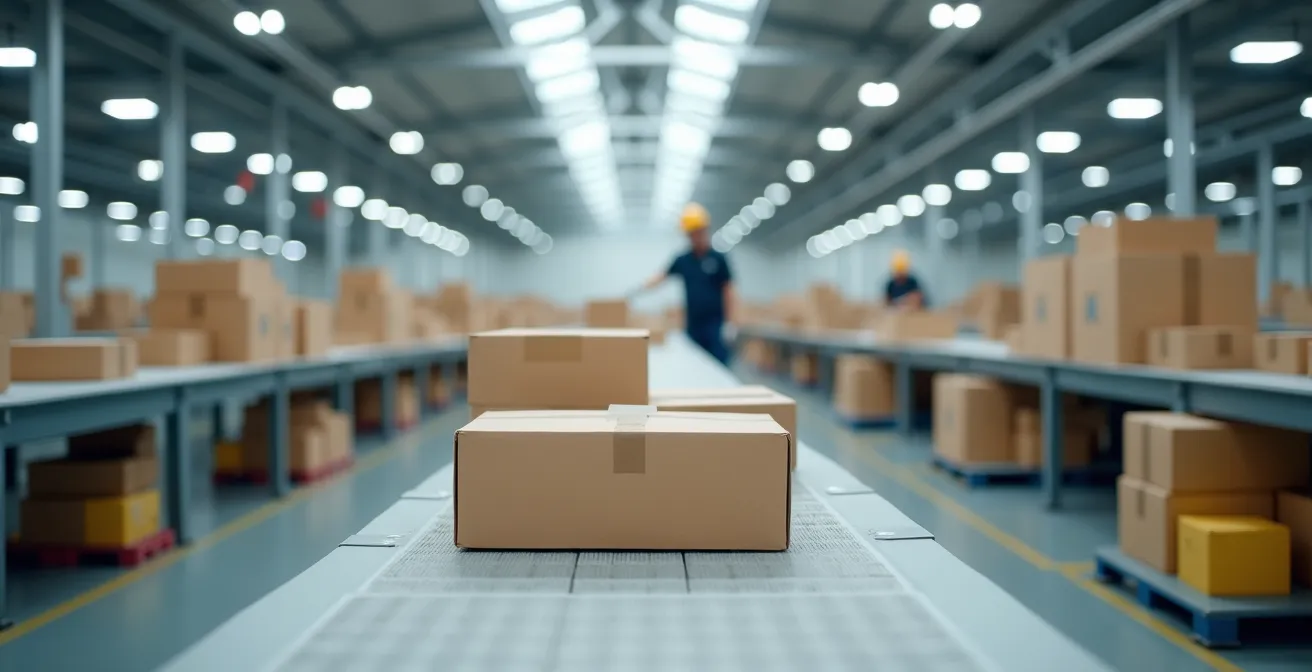
An efficient returns operation, as depicted above, is not a chaotic warehouse but a streamlined facility designed for triage and value recovery. However, the real innovation happens before the product even arrives here. Leading companies are implementing a “Decentralized Triage” strategy, which is a game-changer for margin protection. This approach avoids the high cost of shipping every single returned item back to a central hub for evaluation.
Case Study: The ‘Decentralized Triage’ Strategy
Forward-thinking leasing companies optimize returns by creating a network of local partners, such as retail stores or certified repair shops, to act as return hubs. As described by industry analysts, this ‘Decentralized Triage’ strategy allows for basic inspection, testing, and consolidation to happen at a local level. Products that only need minor repairs are fixed on-site, while others are batched together for more cost-effective bulk shipment. This dramatically slashes transportation costs, reduces the time assets spend out of circulation, and maintains the overall quality of the asset pool.
This model turns a logistical nightmare into a competitive advantage. It not only cuts down on shipping costs but also speeds up the entire value recovery process. A product can be inspected, refurbished, and ready for its next lease in a fraction of the time, maximizing its revenue-generating potential. By building this network of local partners, you create a more resilient and cost-effective system for managing the inevitable flow of returning assets, ensuring that reverse logistics becomes a pillar of your profitability, not a drain on it.
Rent or Buy: Which Is More Ethical for a Wedding Guest Outfit?
The question of renting a dress for a single event versus buying it seems like a small, consumer-focused dilemma. However, it serves as a powerful micro-example of a massive societal shift that product manufacturers must understand: the growing preference for access over ownership. For a wedding guest, buying an expensive outfit that will be worn once is economically and environmentally inefficient. Renting provides a practical, affordable, and more sustainable solution. This same logic is increasingly being applied by businesses to high-value equipment.
Why own a specialized piece of machinery that is only used for certain projects? Why invest massive capital in an asset whose technology will be obsolete in three years? The consumer desire for a cost-effective, low-commitment, and sustainable option for a party dress directly mirrors the business desire for flexible, scalable, and financially efficient access to tools and technology. This trend is not a fleeting fashion; it’s a fundamental restructuring of market demand.
This pivot is a cornerstone of the circular economy, moving us away from a “take, make, dispose” model. As Stéphane Dierick, Director of Cloud Projects at Zuora, highlights, this is becoming a business imperative.
Product-as-a-Service is a pillar of the circular economy, but its potential remains largely untapped in many industries. As regulatory pressures increase, more businesses will turn to circular and PaaS models to stay competitive and compliant.
– Stéphane Dierick, Director of Cloud Projects, Zuora
For a product manufacturer, ignoring this shift is a critical error. The “renter’s mindset” that makes sense for a wedding guest is the same mindset driving your future B2B customers. By offering your product as a service, you are not just creating a new pricing model; you are aligning your business with the future of consumption and positioning yourself as a solution-provider in the burgeoning circular economy.
Why Green Businesses Have a 20% Higher Employee Retention Rate?
While the financial and environmental benefits of a circular, service-based model are clear, one of its most powerful assets is its impact on human capital. Companies that genuinely embrace sustainability report significantly higher employee retention—some studies suggest rates as much as 20% higher than their conventional counterparts. This isn’t just about feeling good; it’s about purpose, innovation, and career development.
Working in a circular business model provides employees with a tangible sense of purpose. Instead of simply pushing units out the door, their work directly contributes to waste reduction and resource efficiency. This aligns with the values of a growing portion of the workforce, particularly younger generations who prioritize impact over a simple paycheck. This engagement is further fueled by the operational excellence inherent in these models; according to some analyses, companies using subscription financing solutions experience a 15% average improvement in operational efficiency, creating a smoother, more satisfying work environment.
Furthermore, the transition to a product-as-a-service model creates entirely new and exciting career paths. Success is no longer measured by a simple “sales quota” but by sophisticated metrics like Customer Lifetime Value (CLV) and Asset Uptime. This requires a more skilled and analytical workforce. A field technician can evolve into a predictive maintenance analyst, using data to prevent failures before they happen. Engineers can become “intrapreneurs,” tasked with solving complex circular economy challenges like designing for disassembly or creating new value from returned products. By offering transparent impact reporting and investing in skills like data science and sustainable design, you create a dynamic environment where employees see a clear future and feel they are part of a forward-thinking mission.
Key Takeaways
- Shift from Unit Price to Lifecycle Value: The core economic change is to stop thinking about one-time sales and start maximizing the total revenue an asset can generate through leasing, refurbishment, and resale.
- Design for Service is Non-Negotiable: A profitable leasing model is impossible without products designed for easy repair, modularity, and disassembly. This is an engineering priority, not an afterthought.
- CSR as a Profit Center: The most effective CSR strategies are not separate budget items but are woven into the business model itself, creating a self-funding system that drives both social good and financial ROI.
How to Implement a CSR Strategy in a Small Business With Zero Extra Budget?
For many small and medium-sized businesses, Corporate Social Responsibility (CSR) feels like a luxury—a noble goal that requires a dedicated budget they simply don’t have. The traditional view of CSR involves costly initiatives like carbon offsetting or philanthropic donations. However, a product-as-a-service model offers a revolutionary alternative: it allows a company to build a powerful, self-funding CSR strategy directly into its core business operations.
This is achieved through an “Access-as-CSR” model. Instead of selling a high-cost product upfront, offering it as a low-cost monthly lease makes essential tools and technology accessible to a much wider audience, including other small businesses, startups, or low-income customers who were previously priced out of the market. This act of democratization is a profound social good. It’s not a donation; it’s a market expansion strategy that simultaneously serves the community. The increased revenue and customer loyalty generated from this expanded market can more than pay for the operational shifts required, creating a sustainability program with a positive ROI.
Case Study: The ‘Access-as-CSR’ Model
Innovative small businesses are leveraging leasing as a self-funding CSR engine. By offering their products via low monthly payments instead of a prohibitive upfront cost, they provide access to critical tools for underserved segments of the market. This approach serves as a powerful social good while simultaneously expanding the company’s total addressable market. The new revenue streams created by this model make the program profitable, proving that positive social impact and financial growth can be one and the same.
This approach fundamentally transforms CSR from a cost center into a profit center. Every new customer who benefits from the accessible pricing is a testament to the company’s social impact, creating powerful stories for earned media without a separate marketing budget. As the business grows, so does its positive impact, creating a scalable and authentic CSR program that is inextricably linked to the company’s success.
| Aspect | Traditional CSR | Leasing-Based CSR |
|---|---|---|
| Budget Required | Separate CSR budget needed | Self-funding through revenue model |
| Impact on Profitability | Cost center | Profit center with positive ROI |
| Marketing Investment | Additional spend required | Each milestone creates earned media |
| Social Impact | Limited by budget | Scales with business growth |
| Environmental Benefit | Offsetting activities | Built into business model |
The transition from selling products to providing them as a service is the single most important strategic pivot a modern manufacturer can make. It creates a resilient, profitable, and sustainable business for the future. The first step is to stop seeing your product as a one-time transaction and start seeing it as a long-term, value-generating asset. Begin today by analyzing your product’s lifecycle and identifying the hidden revenue opportunities waiting to be unlocked.