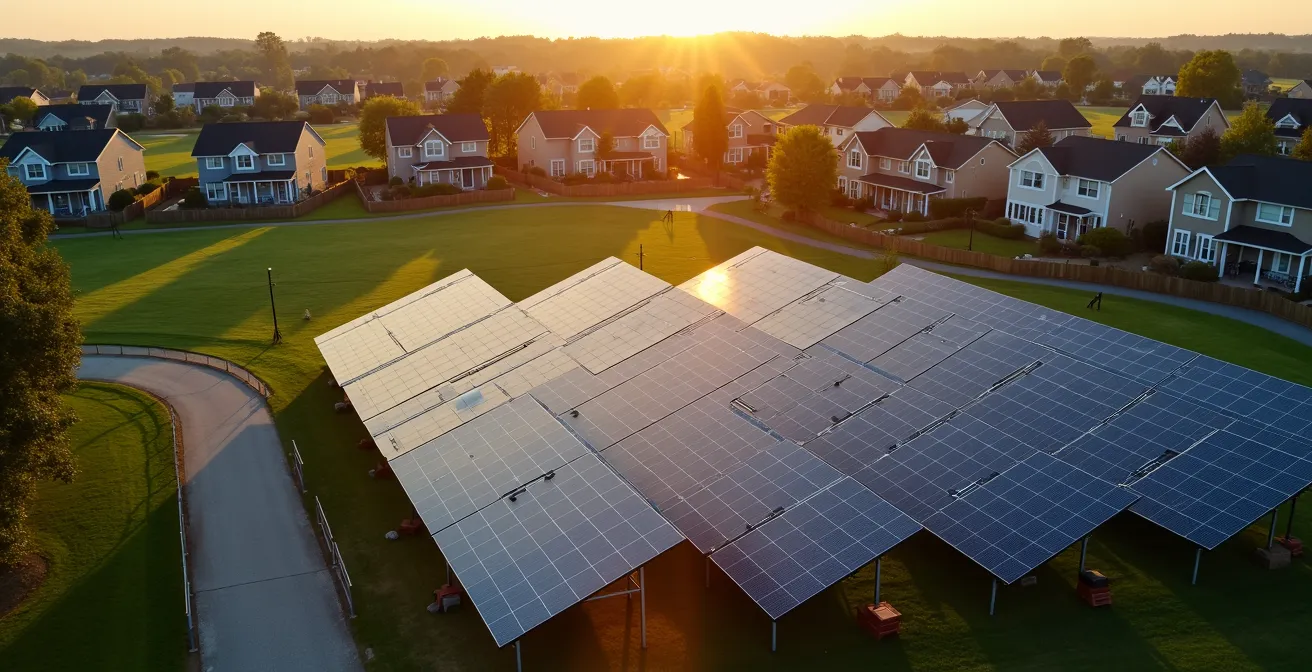
Launching a community solar project is less about engineering and more about mastering the strategic game of finance, policy, and utility negotiations.
- Utilities can use multi-million dollar “interconnection fees” to delay or kill projects; you must have a legal and regulatory counter-strategy ready.
- Long-term viability depends on budgeting for 25+ years of operational costs, not just the initial build, a detail that often bankrupts co-ops within five years.
Recommendation: Focus on mastering the financial and political landscape before a single solar panel is purchased. The technology is the easy part.
For any community leader, the dream of energy independence is powerful. It’s a vision of lower utility bills, a cleaner environment, and a stronger, more resilient neighborhood. Many assume the path to a community solar project is a straightforward construction job: gather interested neighbors, find a large sunny roof, and install the panels. This is the common advice, but it dangerously overlooks the real challenges.
The truth is, a successful project is forged not just in steel and silicon, but in boardrooms and regulatory filings. The biggest hurdles aren’t technical; they are financial and political. You’ll face off against utility companies that may see your project as a threat, compete for limited government grants against thousands of others, and make budgetary decisions that will determine if your co-op thrives for decades or goes bankrupt in five years.
But if the real challenge isn’t building the project, but navigating the system, how can you prepare? This guide moves beyond the basics to give you the strategic playbook. We will focus on the critical, often-overlooked aspects that determine success: winning the interconnection battle, stacking funding sources effectively, making smart technology choices, and ensuring long-term financial health. This is your roadmap to turning that vision of energy independence into a lasting reality.
To navigate this complex journey, we’ve broken down the key strategic milestones. This structured approach will guide you from initial conflicts with utility providers to the long-term operational decisions that ensure your project’s success.
Summary: How to Successfully Launch a Community Solar Project in Your Neighborhood
- Why Your Utility Company Might Block Your Community Solar Connection?
- How to Secure Government Grants for Local Energy Cooperatives?
- Rooftop Solar or Small Wind Turbines: Which Fits Your Local Climate?
- The Budget Mistake That Bankrupts Energy Co-ops After 5 Years
- When to Break Ground: Aligning Construction With Fiscal Year Tax Incentives
- How to Get ISPs to Extend Fiber to Your Property Without Paying $10,000?
- Why Planting Trees Is Not Always a Permanent Carbon Solution?
- How to Lower Your Heating Bill by 20% Using Smart Thermostats?
Why Your Utility Company Might Block Your Community Solar Connection?
The first major battle you’ll likely face is not with financing or construction, but with your local utility provider. While you see a community benefit, utilities may see a threat to their business model and a strain on their grid infrastructure. This opposition often materializes as exorbitant “interconnection fees”—the cost to connect your project to the grid. These fees can be weaponized to make a project financially unviable. For example, some developers have faced shocking sticker prices, with one project quoted a $60 million interconnection cost for a project that only cost $8 million to build, according to recent Nexamp project estimates.
This isn’t just a hypothetical. In Minnesota, a community solar cooperative in Chisago County was forced to withdraw its project after Xcel Energy levied $4-6 million in interconnection fees. This tactic was not an isolated incident; eight other projects in the area were similarly blocked by what were deemed excessive grid upgrade costs. This strategy allows utilities to effectively halt distributed clean energy development while maintaining a public image of supporting renewables. As a community leader, you must anticipate this “interconnection warfare” and prepare a robust counter-strategy from day one.
Your Playbook for Overcoming Utility Opposition
- Meticulous Documentation: Document all interconnection requests with timestamps and keep records of all correspondence. This creates an evidence trail for regulators.
- Strategic Framing: Frame your project as a “Non-Wires Alternative” (NWA) that helps solve grid congestion or stability problems for the utility, turning your project from a burden into a solution.
- Regulatory Leverage: Research and leverage Public Utility Commission (PUC) precedents from other cases to challenge excessive or discriminatory interconnection fees.
- Data as a Bargaining Chip: Propose providing the utility with valuable grid-edge data (like voltage and frequency) from your smart inverters in exchange for a smoother interconnection process.
- Build a Coalition: Connect with other solar developers in your region facing similar challenges. Presenting a unified case to regulators is far more powerful than fighting alone.
How to Secure Government Grants for Local Energy Cooperatives?
Once you have a strategy for the grid, the next hurdle is financing. Government grants, especially those from the Inflation Reduction Act (IRA), are a cornerstone of community solar funding. However, you are not alone in seeking them. The competition is fierce. For the IRA’s low-income community solar bonus credit, the Department of Energy dashboard reveals overwhelming demand, with over 46,000 applications representing 8 gigawatts of capacity competing for just 1.8 gigawatts of available credits annually. This means your application must be flawless and strategically positioned.
The key to success is not relying on a single grant, but mastering the art of “grant stacking.” This involves combining federal tax credits with state programs, philanthropic grants, and even private investment. A prime example of this is the Solar4Us project in Baltimore. The Climate Access Fund ingeniously covered up to 50% of the system’s costs by leveraging the IRA’s “direct pay” option. They stacked the 30% base tax credit with a 20% bonus for serving a low-income community, then combined it with social impact capital and philanthropic funds. This 804 kW project now provides electricity savings of 20-25% to 150 local households with no upfront cost, a testament to creative financing.

As the image suggests, preparing a winning grant proposal is an exacting process. It requires meticulous planning, a deep understanding of eligibility criteria, and a compelling narrative about your project’s community impact. Simply filling out a form is not enough; you must build a comprehensive financial case that demonstrates viability and social value.
Rooftop Solar or Small Wind Turbines: Which Fits Your Local Climate?
Choosing the right technology is more than a technical decision; it’s a social and environmental one. While solar panels are the default for many, small wind turbines can be a powerful alternative or complement, depending on your local climate and community context. The choice impacts everything from visual aesthetics and noise levels to maintenance needs and when you produce power. Your goal is to find the technology—or combination of technologies—that maximizes energy output while maintaining community support.
A detailed comparison is essential to make an informed choice. Beyond simple cost, consider factors like land use, required maintenance skills, and peak production times. Solar excels during sunny days, while wind often performs better at night or during winter months, creating an opportunity for a more consistent 24-hour power supply if combined. The following table, based on data from the Department of Energy, outlines the key trade-offs as highlighted in their community solar basics guide.
| Factor | Rooftop Solar | Small Wind Turbines |
|---|---|---|
| Visual Impact | Low profile, minimal glare with proper orientation | Height visibility (30-140 ft typical) |
| Noise Level | Inverter hum (minimal) | Blade noise (35-50 dB at distance) |
| Maintenance Skill Required | Basic electrical work | Complex mechanical expertise |
| Peak Production Time | Daytime/Summer | Night/Winter (often) |
| Energy Density | 15-20 watts/sq ft | Varies by wind speed |
| Community Acceptance | Generally high | Mixed (height/noise concerns) |
To make the optimal decision, your assessment must go beyond raw data. It’s crucial to conduct a social acceptance survey in your neighborhood to gauge preferences on visual and noise impacts. Furthermore, analyze how a hybrid system could work. Combining solar’s daytime production with wind’s potential night and winter generation can create a more resilient system, reducing the need for expensive battery storage. Finally, evaluate the local talent pool: are there qualified technicians available to maintain complex wind turbines, or is the expertise primarily in electrical work for solar?
The Budget Mistake That Bankrupts Energy Co-ops After 5 Years
Securing initial funding feels like crossing the finish line, but it’s actually the starting gun for a 25- to 30-year marathon. The most catastrophic financial mistake a new energy co-op can make is focusing solely on the upfront construction cost while underestimating or ignoring long-term Operations and Maintenance (O&M) expenses. A solar project is not a “set-it-and-forget-it” asset. It requires ongoing cleaning, monitoring, and eventual equipment replacement (like inverters). Failing to budget for this is why many well-intentioned co-ops face financial crisis within five years.
While annual maintenance might seem small, averaging around $300-$600 per year for a residential-sized system, these costs accumulate significantly over a 25-year lifespan. For larger community-scale projects, these figures are much higher. Authoritative research from the Lawrence Berkeley National Laboratory provides a clear picture. Their analysis shows that levelized lifetime operational expenses, while declining over time, were still a significant $17/kWdc-yr in 2019. Crucially, the Berkeley Lab study highlights that core O&M costs are often matched by other variable expenses like property taxes and land lease payments, doubling the long-term financial burden.

A successful project requires a comprehensive, 25-year financial model from day one. This budget must include a dedicated O&M reserve fund that accounts for inverter replacements (typically every 10-15 years), panel degradation, insurance, property taxes, and administrative overhead. This foresight is what separates a sustainable community asset from a future liability.
When to Break Ground: Aligning Construction With Fiscal Year Tax Incentives
The timing of your project’s construction is not just a logistical decision—it’s a critical financial one. Breaking ground at the right moment can unlock thousands or even millions of dollars in tax incentives and revenue, while poor timing can jeopardize your eligibility. The most important factor to track is the federal Investment Tax Credit (ITC). Thanks to the Inflation Reduction Act, the federal Investment Tax Credit remains at its peak rate of 30% through 2032, creating a decade-long window of opportunity. However, to capture this and other incentives, your project timeline must be strategically managed.
Mastering this requires aligning multiple moving parts. You must synchronize your construction schedule with tax deadlines, regulatory milestones, and even seasonal market fluctuations for energy certificates. Here are key strategies for optimizing your project’s timeline:
- Execute a “Safe Harbor” Strategy: This legal maneuver allows you to lock in the current tax credit rate by incurring just 5% of your total project costs early on. This protects you from any future reductions in the ITC.
- Monitor REC/SREC Markets: The value of Renewable Energy Certificates (RECs) can fluctuate. Monitor market prices quarterly and aim to have your system commissioned during a period of high prices to maximize this revenue stream.
- Align with Utility Cycles: Submit your interconnection application to align with the utility’s capital planning cycles, which often happen in the fourth quarter (Q4). This can sometimes lead to a smoother approval process.
- Protect Against Delays: Your construction contracts must include provisions for supply chain or permitting delays to protect your tax credit eligibility, which often depends on meeting a specific “placed-in-service” deadline.
In short, your project manager must wear the hat of a financial strategist, not just a construction foreman. Every decision, from signing a purchase order to submitting a permit, must be viewed through the lens of tax and revenue optimization.
How to Get ISPs to Extend Fiber to Your Property Without Paying $10,000?
Once your community has achieved energy independence, the next frontier in neighborhood modernization is often digital infrastructure. Just as you took control of your power, securing high-speed internet can feel like another battle against a large, unresponsive provider. Many communities, especially those slightly outside of major service areas, are quoted exorbitant fees—often tens of thousands of dollars—for “last-mile” fiber optic extension. But as with the utility fight, there are strategies to overcome this.
The core principle is to shift the provider’s calculation from a high-cost, single-customer extension to a low-cost, multi-customer expansion. You must demonstrate collective demand and reduce the provider’s perceived risk and cost. First, organize your neighbors. Conduct a survey within your HOA or community to get firm commitments from dozens of households willing to sign up for service. Presenting an Internet Service Provider (ISP) with a list of 50 guaranteed new customers is far more compelling than a single request.
Second, do the legwork for them. Investigate local and state broadband expansion grant programs. Many governments have funds specifically designed to close these last-mile gaps. By identifying a potential public subsidy that could cover a portion of the construction cost, you dramatically sweeten the deal for the ISP. You are no longer asking them to foot the entire bill; you’re presenting them with a partnership opportunity that has a clear and immediate return on investment.
Why Planting Trees Is Not Always a Permanent Carbon Solution?
As your community embraces clean energy, it’s natural to explore complementary environmental initiatives like tree-planting programs. Trees are universally seen as a positive, tangible way to fight climate change. While they are undoubtedly beneficial for air quality, biodiversity, and aesthetics, it’s crucial for a strategic community leader to understand their limitations as a permanent carbon solution. Relying on them as a primary offset for emissions can be misleading if you don’t account for the nuances.
The first issue is permanence. A forest is not a static carbon vault. It is a dynamic ecosystem vulnerable to events that can release all its stored carbon back into the atmosphere in a short time. This includes forest fires, which are increasing in frequency and intensity, as well as disease and insect infestations. A tree planted today is not guaranteed to be storing carbon 80 years from now. The second factor is timescale. A newly planted sapling absorbs a negligible amount of carbon. It takes decades for a tree to reach maturity and achieve its maximum carbon sequestration rate. Therefore, tree planting is a long-term investment, not a short-term fix for current emissions.
Finally, there is the issue of land use and proper management. Planting a monoculture of a non-native species can harm local biodiversity. For a tree-planting program to be a truly effective carbon sink, it must be part of a broader, well-managed ecosystem restoration plan. The takeaway is not to stop planting trees, but to see them as one piece of a larger puzzle. They are a vital complement to, not a replacement for, the direct, immediate, and permanent emission reductions provided by your community solar project.
Key Takeaways
- Utility interconnection is a strategic negotiation, not a simple request; prepare for “interconnection warfare” with meticulous documentation and regulatory leverage.
- Secure funding by stacking grants (like IRA Direct Pay) with other capital and creating a comprehensive 25-year budget that includes all O&M costs, not just the initial build.
- Align your construction timeline with tax incentive deadlines (like the ITC) and REC market cycles to maximize your project’s financial returns from day one.
How to Lower Your Heating Bill by 20% Using Smart Thermostats?
Generating your own clean, affordable energy is the supply-side victory. The crucial other half of the equation is managing demand—optimizing how that energy is used within each home. A community solar project becomes infinitely more powerful when paired with smart energy consumption. For community leaders, promoting the adoption of smart thermostats is one of the highest-impact, lowest-cost initiatives to amplify the benefits of your new energy co-op. A smart thermostat can realistically lower a home’s heating and cooling bill by 15-20% by learning household patterns and optimizing HVAC usage.
Unlike traditional programmable thermostats that run on a fixed schedule, a smart thermostat uses a combination of sensors, algorithms, and Wi-Fi connectivity to make intelligent decisions. It knows when you’re home or away (geofencing), adjusts to changing weather conditions, and provides detailed energy usage reports that empower homeowners to make even smarter choices. For the community at large, widespread adoption means a lower aggregate energy demand. This reduces the strain on your solar project, especially during peak times, and increases the amount of excess power your co-op can sell back to the grid, generating more revenue for everyone.
As a community leader, you can facilitate this by negotiating a bulk-purchase discount with a smart thermostat manufacturer or partnering with your local utility, as many offer rebates for these devices. By framing it as the final step to maximizing the return on the community’s solar investment, you can drive high adoption rates and create a truly integrated, smart-energy neighborhood.
To translate these strategies into a concrete plan for your neighborhood, the next logical step is to conduct a formal feasibility study that models costs, policy hurdles, and long-term financial returns.