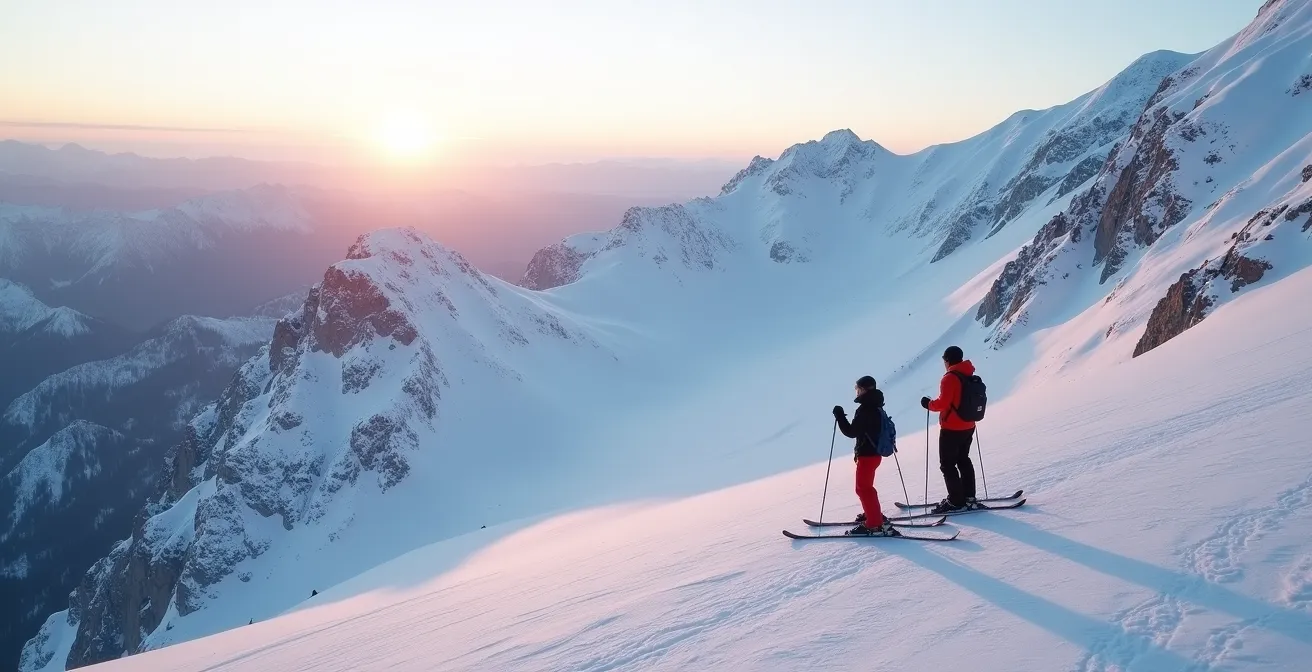
Staying safe in the backcountry isn’t about memorizing the ‘danger zone’ of 30-45 degrees; it’s about understanding that the most lethal threats are often invisible.
- Buried weak layers, not surface conditions, are the primary trigger for most fatal slides.
- Your group’s social dynamics can be as dangerous as any physical terrain trap.
- Technology is an aid, not a guarantee; muscle memory in rescue is what saves lives.
Recommendation: Shift your focus from memorizing simple rules to learning how to read the snowpack’s layered history and your group’s behavior in real-time.
For the advanced skier, the allure of untracked powder beyond the resort boundary is a powerful siren song. You have the skill to navigate steep, challenging lines. But the moment your skis cross that rope, the rules of the mountain change entirely. Here, the greatest risks are not the ones you can see, but the ones you can’t. The environment is no longer managed; it is wild, indifferent, and governed by the unforgiving laws of physics.
Most introductory advice focuses on the basics: read the avalanche forecast, carry a beacon, shovel, and probe, and measure the slope angle. While essential, these are merely the entry fee for admission into the backcountry. They are the “what,” not the “why” or the “how.” True recognition of avalanche terrain goes deeper. It requires a fundamental shift in mindset—from seeing the snow as a surface to ski on, to understanding it as a complex, layered history of every storm, wind event, and temperature swing of the season.
This guide is built on a single, life-saving principle: to survive, you must learn to think like the mountain. It means understanding the invisible weaknesses buried feet beneath your skis, recognizing the psychological traps that lead even expert groups to make fatal errors, and practicing for failure until the response is instinct. We will deconstruct the anatomy of the snowpack, refine your rescue skills into pure muscle memory, evaluate the real-world effectiveness of survival technology, and confront the human factors that are so often the final, tragic link in the accident chain.
This article provides a structured approach to developing that crucial backcountry mindset. Each section builds upon the last, moving from the microscopic structure of the snow to the macroscopic dynamics of weather and group psychology, providing a comprehensive framework for your survival.
Summary: A Skier’s Framework for Reading and Surviving Avalanche Terrain
- Why Weak Layers Buried Deep in Snow Cause Sudden Slides?
- How to Practice a Beacon Search Until It Is Muscle Memory?
- Airbag Backpack or AvaLung: Which Tech Increases Survival Odds More?
- The Social Mistake That leads Expert Groups into Dangerous Terrain
- When to Ski South Faces: Understanding Sun Effect on Snow Stability
- Why Your Roof Needs Hurricane Straps Even If It Is Heavy?
- How to Read the Fine Print to Ensure “Adventure Sports” Are Covered?
- How to Train for a High-Altitude Trek While Living at Sea Level?
Why Weak Layers Buried Deep in Snow Cause Sudden Slides?
The most catastrophic avalanches rarely originate from the snow that’s falling today. They are triggered by the failure of a fragile, invisible layer buried deep within the snowpack—a ghost from a past storm. This is the concept of a persistent weak layer, and understanding it is the single most important step in recognizing avalanche terrain. Think of the snowpack not as a uniform blanket, but as a layered cake of the winter’s entire weather history. Some layers are strong and well-bonded; others are brittle and disconnected, waiting for a trigger.
The two most notorious weak layers are surface hoar and depth hoar. Surface hoar forms on cold, clear nights, creating delicate, feather-like crystals on the snow surface. When buried by subsequent snow, these feathers become a slick, unstable plane, much like a layer of ball bearings. Research confirms the danger, showing that in one study, 34% of fatal avalanches had surface hoar failure layers. Depth hoar, or “sugar snow,” forms within the snowpack, especially when the pack is thin and there’s a large temperature gradient between the warm ground and the cold air. This process turns solid snow crystals into large, cup-shaped, and non-cohesive grains that cannot bear weight.
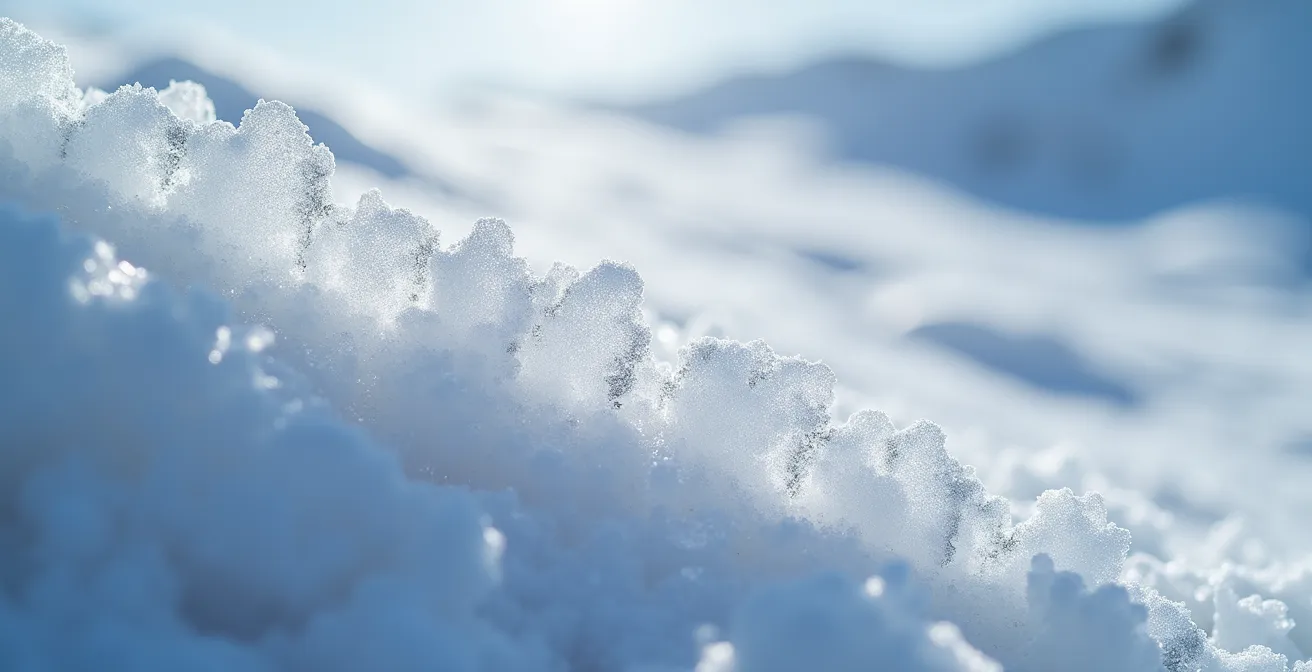
As the visual of these crystals shows, their structure is inherently fragile. Depth hoar is particularly treacherous in continental climates like the Rockies, where it can persist all season. In shallower snowpacks, often found on wind-scoured ridges or shady mid-elevation slopes, these weak layers are closer to the surface and more easily triggered by the weight of a single skier. When the weak layer collapses, the massive slab of snow above it detaches and slides all at once. This is why a slope can feel stable one moment and catastrophically fail the next; you aren’t skiing on the top layer, you are skiing on the structural integrity of every layer beneath you.
How to Practice a Beacon Search Until It Is Muscle Memory?
In an avalanche burial, the clock is your greatest enemy. Your partner has a high chance of survival if rescued quickly, but evidence shows this rate drops significantly after just 10 minutes. Under the immense stress of a real event, with adrenaline surging and a life on the line, fine motor skills and complex decision-making evaporate. You will not rise to the occasion; you will fall to the level of your training. This is why practicing a beacon search until it becomes pure muscle memory is not just recommended—it is a mandatory prerequisite for backcountry travel.
Effective practice is not about simply finding a buried beacon in a calm setting. It’s about building a flawless, repeatable sequence that holds up under extreme pressure. A progressive training regimen is the only way to achieve this level of automaticity. The goal is to move from a conscious, step-by-step process to an unconscious, fluid rescue flow.
A robust training sequence should be practiced regularly, with increasing complexity and stress inoculation:
- Start with the ‘Run-Walk-Crawl’ method: RUN during the primary search (when you first acquire a signal, often at 70+ meters), WALK during the secondary search (calmly following the signal’s flux line to within 3 meters), and CRAWL during the pinpoint search (with the beacon held just above the snow surface for final location).
- Practice multi-burial scenarios: Bury two beacons 10-15 meters apart. After finding the first victim, use your beacon’s ‘mark’ function and immediately move to acquire the next signal. This is a critical, high-stress skill.
- Add stress inoculation: Practice after a strenuous ski run to induce fatigue. Practice with bulky gloves and cold hands. Have a partner yell and add time pressure to simulate the chaos of a real event.
- Master the ‘Three Circle’ backup technique: If your beacon’s marking function fails in a multi-burial, this is your backup. Take three large steps away from the first victim and walk in a circle to methodically re-acquire the next strongest signal.
- Integrate the full rescue sequence: Practice the seamless transition from fine search to probing (learning the tactile difference between a ‘hard’ strike on rock versus a ‘springy’ strike on a body) and finally to strategic, efficient shoveling.
Airbag Backpack or AvaLung: Which Tech Increases Survival Odds More?
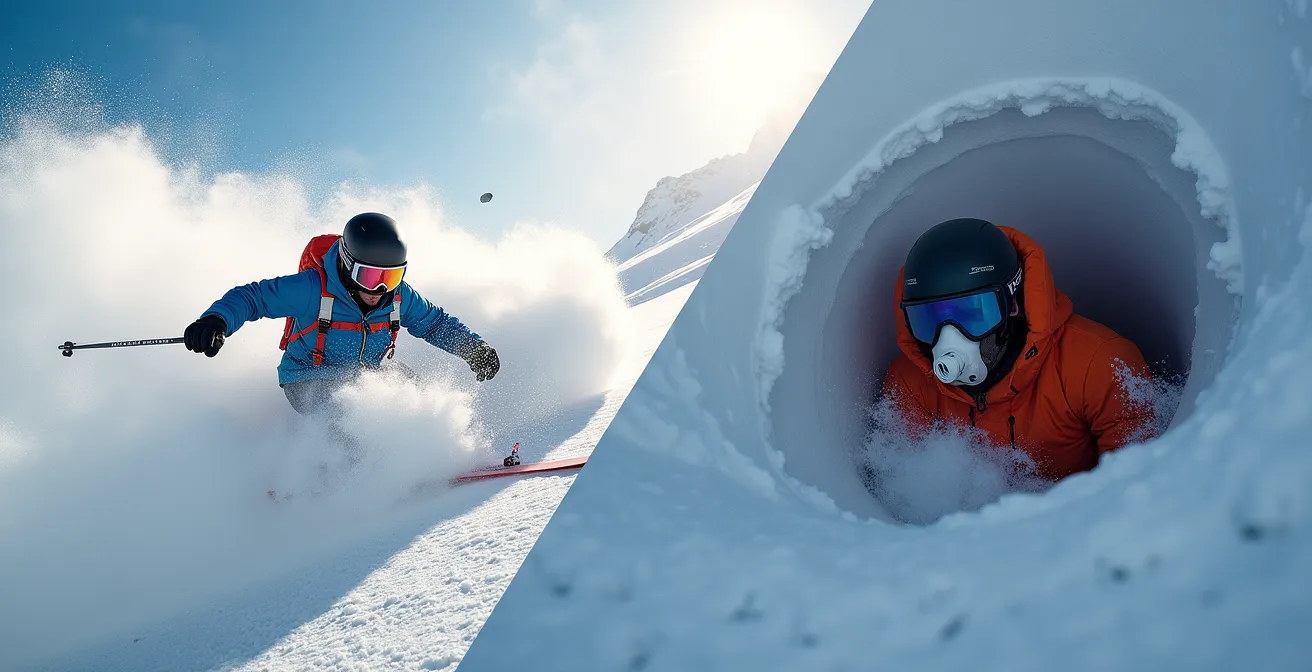
In the conversation about avalanche survival, technology plays a prominent role. Two of the most discussed pieces of gear are the avalanche airbag backpack and the AvaLung. It’s crucial to understand that they are not interchangeable; they address two completely different phases of an avalanche incident. An airbag is designed to prevent or minimize burial depth through the principle of inverse segregation (larger objects rise to the surface of moving debris). An AvaLung is designed to extend breathable air supply if you are already buried. Deciding which increases survival odds more depends entirely on the scenario.
The following table, based on common avalanche scenarios, breaks down the effectiveness of each technology. As made clear in documents like the EAWS Avalanche Problems Standards, the nature of the avalanche and terrain are key determinants.
| Scenario | Airbag Effectiveness | AvaLung Effectiveness | Key Consideration |
|---|---|---|---|
| Open terrain avalanche | High – keeps victim on surface | Low – only helps if buried | Prevention of burial is primary goal |
| Tree well burial | Low – doesn’t prevent tree well falls | High – extends breathing time | Confined space favors breathing device |
| Deep burial scenario | Medium – reduces burial depth | High – can triple survival time | Air pocket creation critical |
| Remote triggering | High – immediate deployment possible | Medium – requires burial to activate | Split-second deployment matters |
An airbag offers the best chance of survival by preventing the worst-case scenario: a deep burial. However, it is not a guarantee. It can fail to deploy, be torn, or be ineffective in certain types of terrain like gullies or heavy timber. The AvaLung is your last line of defense when the worst has already happened, pulling air from the surrounding snowpack and expelling CO2 behind you to prevent the formation of a deadly ice mask.
While the debate over technology is valid, it should never overshadow the importance of decision-making. As the European Avalanche Warning Services state, prevention is paramount. They offer a stark reminder:
The release of avalanches in persistent weak layers are a significant cause of recreational avalanche fatalities. Persistent weak layers are very challenging to recognize. Travel conservatively and avoid terrain features (e.g. large steep slopes) where consequences of being caught are large (e.g. deep burial). Consider the history of weather and snow cover processes in the area. Be extra cautious in areas with a thin snowpack and at the transition from thin to deep snowpack.
– European Avalanche Warning Services, EAWS Avalanche Problems Standards
The Social Mistake That leads Expert Groups into Dangerous Terrain
The most insidious terrain traps are not found on a map; they are found within the human mind. In the analysis of avalanche fatalities, a recurring theme emerges: human factors. These are the psychological shortcuts, social pressures, and cognitive biases that lead groups—even those composed of seasoned experts—to make disastrous decisions. Ignoring this social dimension of risk is one of the most common and fatal mistakes in the backcountry.
Heuristic traps are mental shortcuts that work well in everyday life but can be deadly in avalanche terrain. Common examples include:
- Familiarity: “I’ve skied this slope a dozen times and it’s always been safe.” This ignores the fact that the snowpack is a dynamic system, and past stability does not guarantee future safety.
- Expert Halo: Deferring all decision-making to the most experienced person in the group, silencing valuable dissenting opinions or observations from others.
- Summit Fever: A relentless focus on a goal (like reaching a peak or skiing a specific line) that overrides clear signs of danger.
- Social Proof: “There are other tracks on the slope, so it must be safe.” This assumes others have done their due diligence, which is a dangerous assumption.
Case Study: The Danger of Inaccurate Data and Group Dynamics
In a tragic 2019 accident in Colorado, a group participating in an avalanche training class triggered a fatal slide. One of the contributing factors highlighted in the accident report was that the slope angle they were on was several degrees steeper than what their mapping tools had indicated. This seemingly small discrepancy, combined with the complex group dynamics of a training course, led them into terrain that was more dangerous than they perceived. It’s a sobering reminder that data is a guide, not a gospel, and that even in a learning environment, social pressures can cloud objective judgment.
The antidote to these social mistakes is a culture of open, honest, and humble communication. It begins before you even leave the car, with a clear trip plan and stated objectives. It continues throughout the day with constant check-ins, where every member of the group, regardless of experience level, feels empowered to voice concerns or observations. A simple question like, “What are you seeing right now?” or “How are you feeling about this slope?” can be enough to break the spell of a heuristic trap and force the group to re-evaluate the objective evidence in front of them.
When to Ski South Faces: Understanding Sun Effect on Snow Stability
The sun is a powerful engine of change in the mountains, and its effect on snow stability varies dramatically depending on aspect (the direction a slope faces). While general wisdom points to northerly aspects as being more dangerous due to the preservation of weak layers, southerly aspects present their own unique set of hazards driven by solar radiation. Understanding the sun’s daily and seasonal cycles is key to knowing when—and when not—to ski south-facing slopes.
In the Northern Hemisphere, south-facing slopes receive the most direct sunlight. This causes a daily cycle of melting and refreezing. On a good spring day, this cycle creates desirable “corn snow”—a skier’s dream. However, it can also create dangerous conditions. If the snow melts too quickly or the meltwater percolates down and hits a buried weak layer, it can lubricate that layer and trigger a wet slab avalanche. These slides are often heavy, powerful, and destructive. Conversely, if a strong overnight refreeze does not occur, the snowpack can remain unconsolidated and unstable from the previous day’s warming.
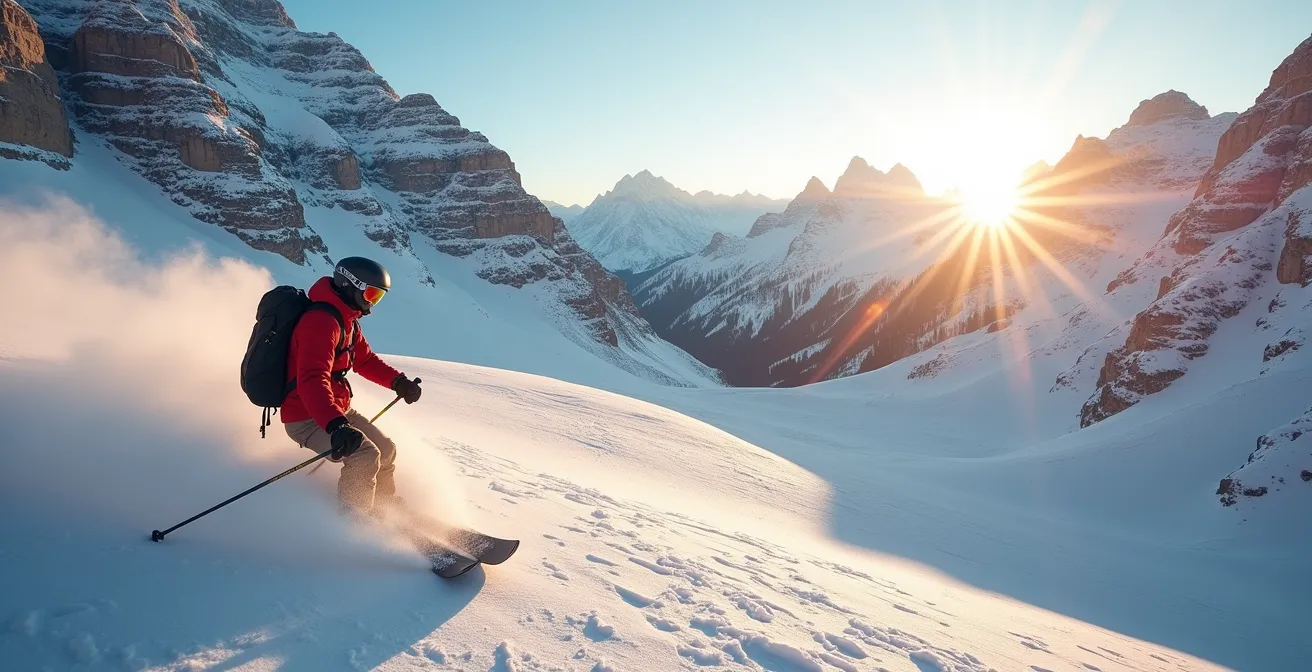
In contrast, north-facing slopes remain shaded for much of the day, keeping the snowpack cold. This preserves light, dry powder but also preserves those persistent weak layers discussed earlier. This is why terrain analysis often reveals that north-facing slopes at 38 degrees represent a very high probability for dry slab avalanches. The key is recognizing that different aspects present different problems at different times. Timing is everything on solar aspects.
Action Plan: Your Solar Radiation Assessment Checklist
- Monitor First Warming: Be extremely cautious on the first warm, sunny day after a storm. This is a common trigger for wet avalanches as the new snow has not yet stabilized.
- Observe Rollerballs: Watch for small balls of snow (rollerballs or pinwheels) spontaneously rolling down the slope. This is a clear sign the surface is warming rapidly and the safe window for skiing that aspect is closing.
- Check the Refreeze: Before skiing a solar aspect in the morning, use your ski pole or an ice axe to test the overnight refreeze. It should be firm and supportive. If it’s soft and slushy at dawn, the slope did not refreeze properly and is likely unstable.
- Time Your Descent: On a typical warm spring day, plan to be on and off south-facing slopes early, often before 11 a.m., before the sun’s energy has had too much time to destabilize the snowpack.
- Assess Aspect Transitions: Remember that east-facing slopes get the morning sun first, behaving like south faces early in the day. West-facing slopes get the intense afternoon sun, holding their stability longer but also becoming dangerous later in the day.
Why Your Roof Needs Hurricane Straps Even If It Is Heavy?
It seems counterintuitive that a massive, heavy roof could be lifted by wind, but this highlights a principle directly applicable to avalanche safety: it is not about total weight, but about differential pressure and structural connections. A hurricane creates immense negative pressure above a roof, effectively sucking it upwards, while the wind forces its way underneath. Without hurricane straps—small, simple metal connectors that anchor the roof trusses to the walls—the roof’s weight is irrelevant. The connections fail, and the structure is compromised.
This is a powerful metaphor for the snowpack. A deep, heavy slab of snow feels solid and safe, much like a heavy roof. But if it rests on a poorly connected, weak layer of depth hoar, its weight becomes its greatest liability. The weak layer cannot handle the shear stress, and the connection fails. Just as hurricane straps provide the crucial link that holds a house together against an invisible force, the bonds between snow layers provide the structural integrity of the snowpack. Judging a slope by its surface depth alone is like judging a roof by its weight—a potentially fatal miscalculation.
How to Read the Fine Print to Ensure “Adventure Sports” Are Covered?
Reading the fine print of an insurance policy is an exercise in explicit risk assessment. The document forces you to confront exactly what is covered and, more critically, what is excluded. The language is precise because the financial consequences are real. You must adopt this same lawyerly scrutiny when entering the backcountry. The mountain has its own “insurance policy,” and you must learn to read its fine print.
The daily avalanche forecast is the policy summary—it gives you the overview, the general danger rating, and the key problems to look out for. But the snowpack itself contains the non-negotiable terms and conditions. These are the on-the-ground exclusion clauses that can instantly void your “safety policy.” Signs like “whumpfing” (the collapsing sound of a weak layer failing under you), shooting cracks propagating from your skis, or recent avalanche activity are not suggestions; they are explicit warnings from the mountain that the conditions are untenable. Ignoring this fine print is a breach of contract with reality, and the consequences are absolute.
Key Takeaways
- The most dangerous avalanches are caused by invisible weak layers buried within the snowpack, not surface conditions.
- Rescue skills are perishable; only consistent practice under stress builds the muscle memory required for a real-world event.
- Human factors, such as social pressure and cognitive biases, are a leading cause of accidents and must be managed as actively as terrain choices.
How to Train for a High-Altitude Trek While Living at Sea Level?
Training for a high-altitude expedition while living at sea level teaches a fundamental truth of adaptation: you cannot fake acclimatization. You can build cardiovascular fitness, but you cannot replicate the physiological changes that occur when the body adapts to a low-oxygen environment without controlled, progressive exposure. This principle is a direct parallel to backcountry expertise. Your fitness as a resort skier does not automatically translate to safety in avalanche terrain. You must undergo a separate and deliberate process of acclimatization to risk.
This “backcountry acclimatization” is not about a single course or one book. It is a slow, methodical process of building experience. It means starting on low-angle, simple terrain and gradually increasing the complexity as your skills and judgment develop. Each trip is an opportunity for exposure and adaptation. Each snow pit you dig, each weather pattern you observe, and each conservative decision you make to turn back builds your capacity. You are training your mind to operate in an environment that is inherently hostile and unforgiving. Rushing this process is like flying directly to the summit of Everest—a recipe for disaster.
Your journey into the backcountry begins not when you cross the rope, but when you commit to this lifelong process of learning and adaptation. It demands humility, constant vigilance, and the discipline to turn back. Start now by studying the daily forecast not as a simple color code, but as a detailed story of the snowpack. Plan a conservative route, discuss it with your partners, and treat every trip as a lesson from the ultimate teacher: the mountain itself.
Frequently Asked Questions on Recognizing Avalanche Terrain
What are the most common group dynamic failures in avalanche incidents?
When we look at avalanche involvements and fatalities, there’s almost always dysfunctional group dynamics or poor decisions that lead up to the event. While there are entire realms of academic study dedicated to decision-making, with a little practice you can learn to recognize when group dynamics are effective versus dysfunctional.
How can groups improve communication before entering avalanche terrain?
Effective communication is one of the best ways to promote good group dynamics. This starts before you head out for the day and continues until you’re back at the car. Use a checklist to help your group communicate and make decisions
What role should avalanche forecasts play in group discussions?
Finding conditions different from those described in the forecast is another reason to avoid or minimize your exposure to avalanche terrain.