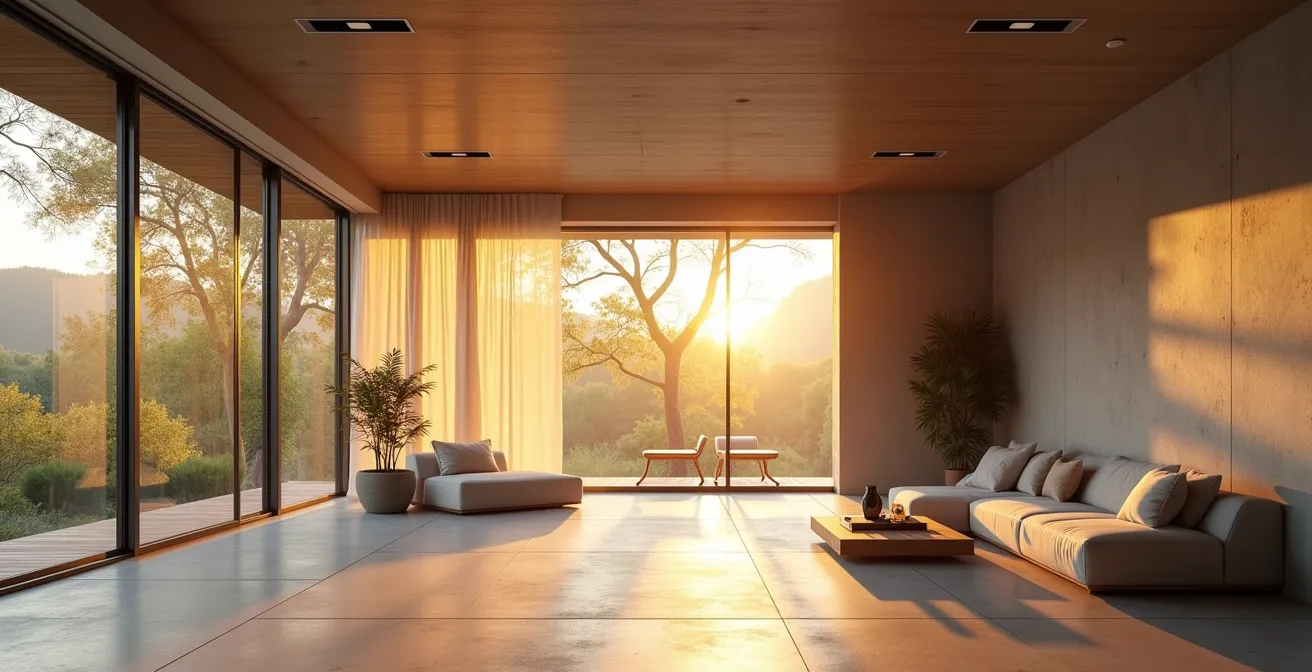
In summary:
- Treat your home like a thermal battery: absorb coolness at night and seal it in during the day.
- Master airflow by creating pressure differentials with windows and fans to actively pull cool air in.
- Block radiant heat at the source, on the *outside* of your windows, to prevent it from ever entering your home.
- Reduce indoor humidity to make the same air temperature feel significantly cooler and more comfortable.
When a heatwave hits, the common advice feels frustratingly familiar: close the curtains, use a fan, and avoid the oven. While not wrong, these tips only scratch the surface. They treat the symptoms of a hot house without addressing the root cause. The default response is often to reach for an air conditioner, an energy-intensive solution that isn’t always available, affordable, or desirable.
But what if the solution wasn’t a bigger machine, but a smarter approach? The principles of passive house design offer a more elegant and effective way to manage indoor temperatures. This isn’t about a random list of “hacks”; it’s about understanding the fundamental physics of your home—how it absorbs, retains, and sheds heat. By mastering the concepts of thermal mass, convection, and radiant heat, you can transform your living space from a passive heat trap into an active cooling system.
This guide will deconstruct the science behind keeping your home cool. We will move beyond the obvious tips to explore the physics of how your walls store energy, how to strategically orchestrate airflow, and why the location of your shades matters more than the material. Prepare to think like a building scientist and reclaim your comfort, no AC required.
Summary: Rethinking Home Cooling Through Physics
- Why Stone Walls Keep You Cool During the Day but Hot at Night?
- How to Position Windows to Create a Natural Breeze Through Your Home?
- External Shutters or Blackout Curtains: Which Stops Heat Better?
- The Ventilation Mistake That Heats Up Your Home Instead of Cooling It
- Dehumidifying Strategies: Feeling Cooler at 26°C by Lowering Moisture
- How to Program “Away” Routines That Actually Save Money?
- The Sizing Mistake That Makes Your AC Unit Break Down Faster
- How to Calculate the Real Payback Period of an A+++ Appliance?
Why Stone Walls Keep You Cool During the Day but Hot at Night?
The feeling of a cool stone building on a hot afternoon isn’t magic; it’s physics. This phenomenon is due to a property called thermal mass, which is the ability of a material to absorb, store, and later release heat energy. Materials with high thermal mass, like stone, concrete, and brick, act like thermal batteries. During the day, as the sun beats down, they slowly absorb a massive amount of heat from the environment, keeping the interior space pleasantly cool. This “thermal lag” prevents the daytime heat from quickly penetrating your living space.

However, this thermal battery has a flip side. As night falls and the outside air cools, the process reverses. The walls, now fully charged with heat, begin to radiate that stored energy back into the house. This is why a stone house can feel oppressively warm in the evening, long after the sun has set. The key to leveraging thermal mass is to control this charge-and-discharge cycle. Indeed, research from Jordan demonstrates that a room with traditional clay walls (high thermal mass) stayed 4°C cooler than one with concrete walls and a remarkable 10°C cooler than the outside temperature during the day, showcasing the power of the right material.
How to Position Windows to Create a Natural Breeze Through Your Home?
Moving air is a powerful tool for cooling, not because it lowers the air temperature, but because it accelerates heat transfer away from your skin through convection and evaporation. The common instinct is to point a fan directly at you, but a more effective, whole-room strategy involves creating a pressure differential. This turns your home into a wind tunnel, actively pulling in cool air from the outside and exhausting hot air.
The most effective method is known as cross-ventilation. The counter-intuitive key is to place a box fan in one window facing *outward*. This actively pushes hot, stale air out of the room, creating a low-pressure zone. Nature abhors a vacuum, so cooler, higher-pressure air from outside will be drawn in through another open window, ideally one on the opposite side of the house and in the shade. It’s a common misconception that fans “cool” the air; they simply move it. By using a fan to exhaust air, you are using physics to create a consistent, refreshing breeze.
To maximize this effect, close all other windows and interior doors to channel the airflow into a direct path between the inlet and outlet. This strategy is most effective at night or in the early morning when the outside temperature is lower than the inside temperature. Given that up to 30% of unwanted heat comes via windows, managing them for airflow is as crucial as managing them for sunlight. Proper airflow can create a significant cooling effect, making the room feel far more comfortable.
External Shutters or Blackout Curtains: Which Stops Heat Better?
When the sun hits a window, it introduces heat into a room primarily through radiant heat gain. The most common defense is an internal blackout curtain. While they do block visible light, a significant amount of heat has already passed through the glass and is now trapped between the curtain and the window, where it slowly radiates into the room. According to some studies, even the most effective neutral-toned curtains with white plastic backings can reduce heat gain by up to 33 percent.
The far superior strategy is to stop the sun’s rays *before* they hit the glass. This is where external solutions shine. External shutters, awnings, or even purpose-built solar screens are dramatically more effective because they create a physical barrier on the outside of the thermal envelope. The heat is absorbed and dissipated into the outside air, never getting a chance to heat the window pane itself. The difference in performance is not minor; it’s a game-changer.
The following table, based on data from various home improvement sources, clearly illustrates the performance gap. While blackout curtains offer a modest improvement, external solutions provide a far more powerful defense against solar radiation.
| Solution Type | Heat Reduction | Cost Range | Installation Difficulty | Visibility Impact |
|---|---|---|---|---|
| Internal Blackout Curtains | Up to 33% | $30-150/window | Easy (DIY) | Blocks all light |
| External Shutters | Up to 90% | $200-600/window | Professional needed | Adjustable |
| Window Film | 30-50% | $20-80/window | Moderate (DIY) | Slight tint |
| External Awnings | 65-77% | $300-800/window | Professional needed | No impact on view |
The Ventilation Mistake That Heats Up Your Home Instead of Cooling It
Ventilation is a double-edged sword. While it’s a powerful cooling tool at night, applying the same logic during the day is the single most common mistake that actively heats up a home. The golden rule of passive cooling is simple: never ventilate when the outside air temperature is higher than your inside air temperature. Opening windows on a hot afternoon doesn’t let “fresh air” in; it invites a wave of heat that your home’s thermal mass will promptly absorb.
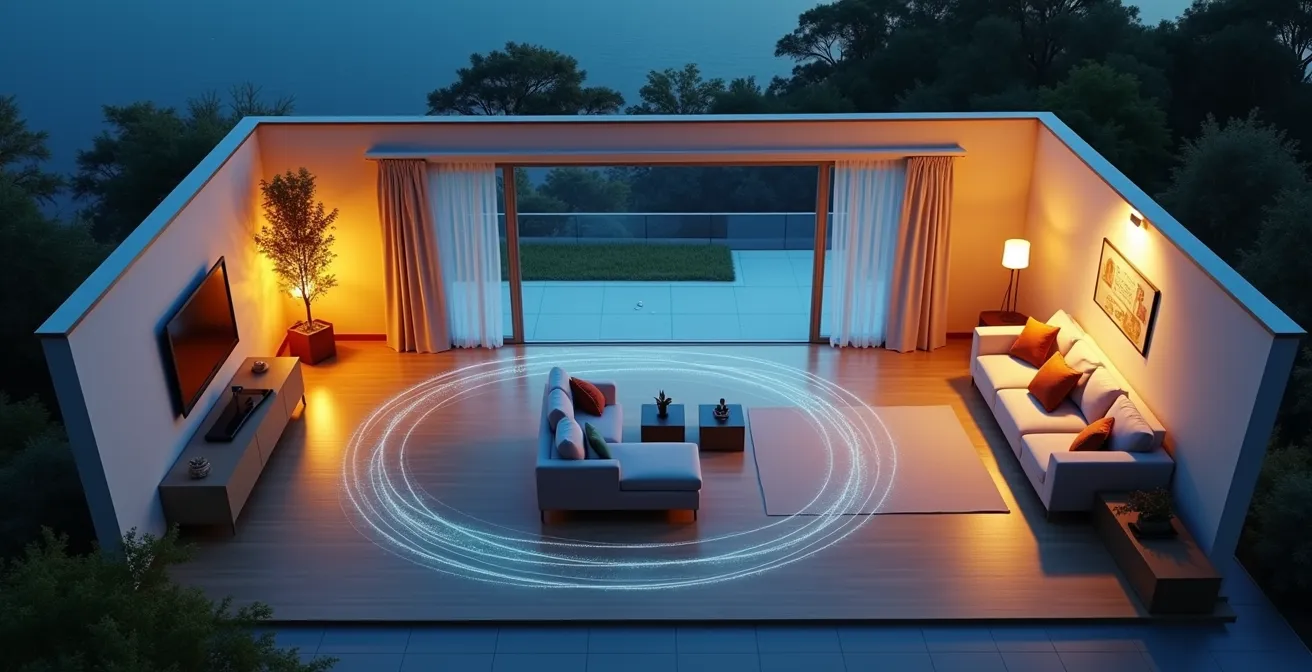
Think of your house like a thermos. After a night of cooling (with windows open), your goal in the morning is to trap that cool air inside for as long as possible. This means closing and sealing all windows and doors, and drawing your blinds or shutters. By creating a sealed thermal envelope, you slow down the rate at which the day’s heat can infiltrate your cool reservoir. Running kitchen or bathroom exhaust fans during this time is also a mistake, as they actively pull hot makeup air into the house through tiny cracks and gaps.
The only way to know for sure is to use two thermometers: one inside and one outside in the shade. Only when the outdoor temperature drops below the indoor temperature should you begin the ventilation process. This disciplined approach to opening and closing the house is the core of “night-flush ventilation” and is fundamental to maintaining a comfortable indoor climate without mechanical cooling.
Dehumidifying Strategies: Feeling Cooler at 26°C by Lowering Moisture
Perceived temperature isn’t just about the number on the thermometer; it’s heavily influenced by humidity. Humid air feels warmer because the high moisture content slows down the evaporation of sweat from your skin—your body’s primary cooling mechanism. By reducing the humidity, you can feel significantly cooler even if the actual air temperature remains the same. As home climate experts confirm, drier air enhances the body’s natural cooling process, making 26°C (79°F) at 40% humidity feel far more comfortable than the same temperature at 80% humidity.
Many daily activities introduce moisture into your home’s air. Cooking, showering, and even breathing add water vapor. The first step is to perform a moisture audit and eliminate these sources at the root. While a mechanical dehumidifier is an option, it also produces waste heat. A passive-first approach focuses on prevention. For example, always use lids on boiling pots and run the bathroom exhaust fan during and for 20 minutes after a shower to vent moist air directly outside.
Fixing leaks and avoiding drying clothes indoors are also crucial steps. This proactive management of your home’s internal moisture load is a subtle but powerful lever in your passive cooling toolkit. It’s a strategy that enhances the effectiveness of all other cooling methods, particularly those based on airflow.
Your Home Humidity Audit Checklist
- Kitchen Sources: Cover all boiling pots when cooking. Use cold water for washing when possible to minimize steam.
- Bathroom Sources: Run the bathroom exhaust fan during and for 20 minutes after every shower.
- Appliance Vents: Check that your clothes dryer is properly vented to the outside, not into an attic or crawlspace.
- Plumbing Leaks: Inspect under sinks and around toilets for any leaks. Even small, slow drips add significant moisture over time.
- Laundry Habits: Avoid hanging wet clothes to dry indoors during hot, humid weather. If you must, place them in a small, closed room with a dehumidifier.
How to Program “Away” Routines That Actually Save Money?
In the context of passive cooling, an “away” routine isn’t about adjusting a thermostat; it’s a physical lockdown procedure to preserve the cool air you’ve captured overnight. The goal is to turn your home into a fortress against the sun and heat while you’re out. This saves “money” not on an electricity bill, but by preventing the need for energy-intensive cooling upon your return. The most crucial part of this routine is timing.
The morning lockdown must happen before the outside temperature surpasses the inside temperature, typically before 9 AM in summer. This involves closing every single window and, critically, closing all blinds, curtains, or shutters, especially on the east, south, and west-facing sides of the house. You are essentially putting your home into “thermos mode.” Additionally, turning off all non-essential electronics is vital. Devices on standby, like TVs, chargers, and game consoles, generate a surprising amount of “phantom heat” that slowly warms your sealed environment.
This disciplined daily cycle of nighttime cooling and daytime sealing is a core tenet of passive design, often called “night-flush ventilation.” It requires a shift in thinking from reactive cooling to proactive temperature management.
Case Study: The “Night-Flush” Ventilation Strategy
In regions like Vermont, where summer temperatures can be high during the day but drop significantly at night, homeowners use a technique building scientists call night-flush ventilation. They take full advantage of cool evenings by opening windows to create a cross-breeze, allowing the cool air to circulate all night. This process purges the heat stored in the home’s thermal mass. The critical follow-up step is closing all windows and blinds in the morning before the day heats up, effectively trapping the coolness inside for hours.
The Sizing Mistake That Makes Your AC Unit Break Down Faster
In conventional homes, “sizing” refers to choosing the right-sized AC unit. An oversized unit cycles on and off too quickly, failing to dehumidify the air properly and causing premature wear. In a home without AC, there’s a parallel “sizing mistake”: the assumption that you need a single, powerful solution to cool the entire house. This thinking leads to frustration. The passive design approach teaches a different lesson: instead of trying to cool the entire building, focus on personal cooling first.
This is about correctly “sizing” your efforts to your immediate environment. Why expend massive energy trying to lower the temperature of an entire unoccupied house when you can create a microclimate of comfort around yourself? This can be as simple as a damp cloth on your neck, a small fan aimed at your workspace, or cooling your own body from the inside out with cold drinks. It’s a fundamental shift from a macro to a micro-scale solution.
This approach is not just more efficient; it’s more resilient. It relies on small, inventive, and often non-electric solutions that provide immediate relief. It’s about being a sniper, not a bomber, in the fight against heat.
Case Study: Sized-for-One Personal Cooling
René Lauderback Robinson of Tulsa, Oklahoma, exemplifies this personal sizing principle. Instead of trying to cool her whole house, she uses homemade “corn sacks” stored in her freezer. She sews fabric bags in various sizes—a small one for a pillow, a long one to drape across her neck—and fills them with deer corn. The dense corn holds the cold for a remarkably long time, providing direct, localized cooling with no electricity and nothing to melt or cause a mess. It’s a perfectly “sized” solution for personal comfort.
Key Takeaways
- Manage Thermal Mass: Use your home’s structure as a battery, charging it with cool air at night and sealing it during the day.
- Control Airflow with Intention: Create pressure differentials to actively pull cool air in and push hot air out, rather than just circulating it.
- Block Radiant Heat Externally: The most effective way to stop solar heat is to block it before it ever touches your window glass.
How to Calculate the Real Payback Period of an A+++ Appliance?
When discussing an A+++ appliance, the “payback period” is a straightforward financial calculation: how long until the energy savings offset the initial cost? When applying this concept to passive cooling strategies, the calculation becomes less about money and more about a different kind of return on investment. The “payback” is measured in comfort, resilience, and well-being.
Investing time to learn these techniques, or money in external shutters or improved insulation, doesn’t offer a simple monthly saving on a utility bill. The returns are more profound. The primary payback is thermal autonomy—the ability to maintain a comfortable living space regardless of the outdoor temperature, without relying on a mechanical system. This leads to increased resilience, a crucial benefit during power outages that often coincide with extreme heatwaves.
Furthermore, these investments pay dividends in improved health. Natural ventilation enhances indoor air quality by reducing pollutants and CO2 buildup. Living in a home that “breathes” properly and maintains a stable temperature contributes to better sleep and overall well-being. The payback isn’t just about avoiding discomfort; it’s about actively creating a healthier and more sustainable living environment. This is the true, holistic profit of a passive approach.
- Increased comfort and well-being without dependency on mechanical systems.
- Resilience during power outages, as the house stays cooler naturally.
- Improved indoor air quality through consistent natural ventilation.
- A significantly reduced environmental impact and personal carbon footprint.
- Potentially enhanced property value due to permanent energy-efficient features.
By embracing these physics-based principles, you can move from being a victim of the weather to being the conductor of your own comfortable indoor climate. The next logical step is to perform a simple energy audit of your own home to identify the biggest opportunities for improvement.