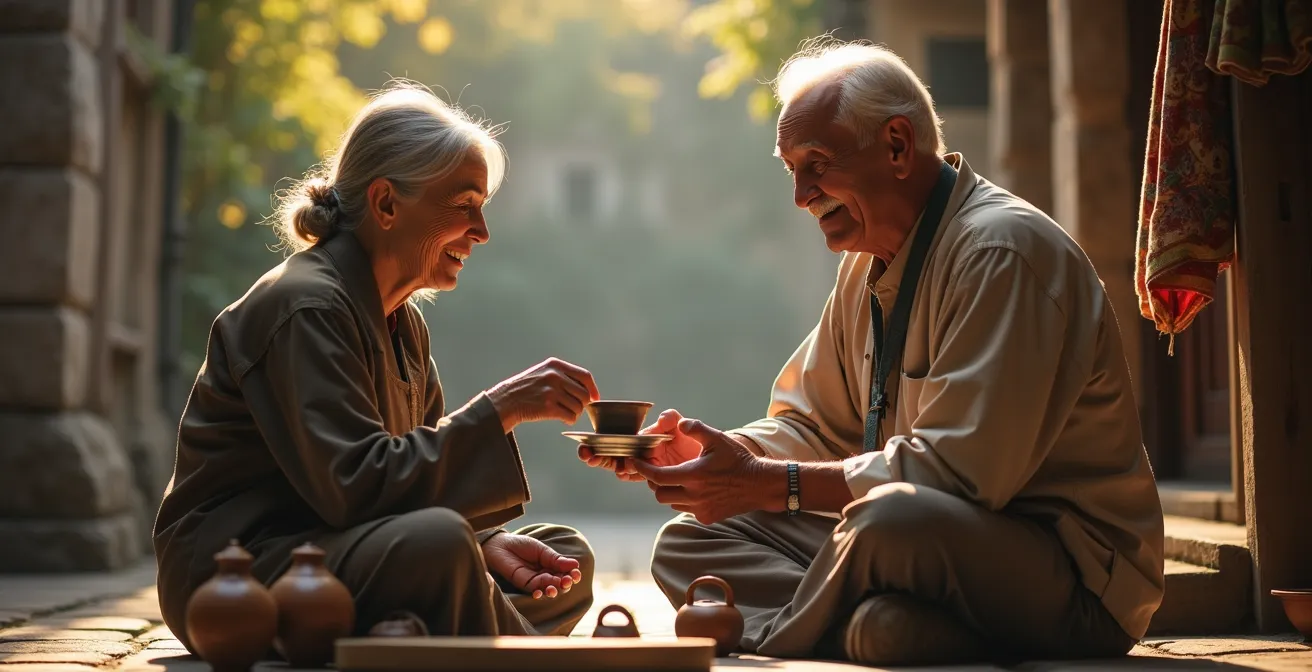
True cultural immersion isn’t found on a checklist, but through a conscious shift in perspective from consumer to respectful participant.
- Your choice of accommodation and efforts to speak the language are ethical decisions that directly impact local communities.
- Authenticity lies in community participation and lived stories, not in events staged for tourist consumption.
Recommendation: The goal is not to ‘find’ authenticity, but to thoughtfully and respectfully engage with the local cultural ecosystem.
The quest for “authentic” travel is a familiar one for any seasoned traveler. You’ve followed the guidebooks, you’ve wandered down the recommended side streets, yet you’re often met with a feeling of curated reality—an experience designed for you, the tourist, rather than a genuine glimpse into local life. The frustration of navigating crowds only to find more of the same, a sanitized version of culture, is a common pain point for those who travel not just to see, but to understand.
Conventional wisdom offers a litany of advice: “eat where the locals eat,” “get off the beaten path,” or “learn a few basic phrases.” While well-intentioned, these tips often remain on the surface. They treat culture as a product to be consumed or a checklist to be completed. They rarely address the more profound question of your role and impact as an outsider within a complex, living community. This approach can inadvertently lead you right back into the very tourist traps you sought to avoid, as “local” experiences become commodified for a visiting audience.
But what if the key isn’t a better list of things to *do*, but a fundamental shift in *how* we approach a place? What if genuine connection arises not from consuming a culture, but from becoming a mindful observer within its ecosystem? This isn’t about finding a secret, untouched paradise; it’s about changing your own perspective to see the authenticity that exists everywhere, even in the most popular cities. It is about understanding that your presence has an effect, and that with a little intention, you can make that effect a positive one.
This guide explores that mental shift. We will deconstruct common travel choices—from where you sleep to who you listen to—to reveal their hidden impact. By the end, you will have a new framework for traveling, one that prioritizes respectful engagement and unlocks the deeper, more meaningful connections you’ve been searching for.
For those who prefer a visual format, the following video offers a different kind of cultural touchstone. While it complements this guide in spirit, it provides a unique audio-visual journey.
To navigate this deeper approach to travel, we’ve structured this guide to address the critical decisions every traveler faces. Each section provides practical insights to help you move from a passive tourist to an active, respectful participant in the places you visit.
Contents: Beyond the Tourist Trail to True Cultural Connection
- Why Staying in Certain Neighborhoods Hurts the Locals You Want to Meet?
- How to Learn 20 Essential Local Phrases in One Week Before Departure?
- Homestay or Boutique Hotel: Which Offers Better Cultural Insight for Solo Travelers?
- The Red Flag That Reveals a “Traditional” Ceremony Is Staged for Tourists
- When to Visit Kyoto to Avoid the Tourists but Catch the Local Festivals?
- Certified Guide or Local Elder: Who Gives the Truer History?
- Private Hostel Room or Budget Hotel: Which Offers Better Value in Europe?
- How to Visit Ancient Ruins Without Contributing to Their Destruction?
Why Staying in Certain Neighborhoods Hurts the Locals You Want to Meet?
The choice of where you lay your head at night has a more significant impact on the local cultural ecosystem than almost any other decision. The common advice to “live like a local” by renting a short-term apartment in a historic city center often has the opposite effect. These “tourist bubbles” can inadvertently hollow out the very communities travelers hope to experience. When entire buildings or neighborhoods shift from residential housing to tourist lodging, local residents are often priced out, and essential businesses like bakeries, hardware stores, and tailors are replaced by souvenir shops and generic cafes.
This phenomenon, known as “overtourism,” transforms a living neighborhood into a theme park. As a case study on tourism trends highlights, Barcelona’s Gothic Quarter became a focal point of this issue, where the sheer volume of tourists led to resident protests and a sense that their home had been lost. When you stay in such an area, your interactions are overwhelmingly with other travelers or with a service economy entirely dependent on tourism, not with the local residents who have been pushed to the periphery.
To foster genuine connection, a traveler must act as a respectful guest in the city’s broader ecosystem, not just a consumer in its tourist core. This means making a conscious choice to support accommodations that are integrated into the community rather than ones that displace it. By choosing locally-owned guesthouses, family-run B&Bs, or hotels that employ local staff year-round and are situated just outside the most saturated zones, you distribute your economic impact more equitably and increase your chances of organic, everyday interactions. You become a part of the neighborhood’s rhythm rather than the reason it changed.
Action Plan: Choosing Your Accommodation Ethically
- Identify the right type: Choose family-run B&Bs or cooperatives over investor-owned properties to ensure money stays local.
- Check employment practices: Look for accommodations that employ local staff year-round, not just during peak season.
- Verify community contribution: Research if the property contributes to local community initiatives or conservation projects.
- Analyze the neighborhood: Select neighborhoods where tourism is a part of the economy, but doesn’t dominate it (ideally under 30%).
- Book directly: Whenever possible, book directly with the owners rather than through large platforms to maximize their revenue.
How to Learn 20 Essential Local Phrases in One Week Before Departure?
Learning a few local phrases is often presented as a mere courtesy, a simple “please” and “thank you.” But from an anthropological perspective, language is much more; it is a key that unlocks a different level of interaction. Attempting to speak the local tongue, no matter how imperfectly, signals respect, curiosity, and a willingness to step out of the comfortable English-speaking bubble. This small act of “intentional friction” can transform a transactional encounter into a human connection. A shopkeeper’s rehearsed smile can become a genuine one, and a simple question can lead to an unexpected conversation.
The challenge is retention. Memorizing a list of phrases the night before your flight is often ineffective. A far more powerful method is the Spaced Repetition System (SRS). This learning technique involves reviewing information at increasing intervals, moving it from your short-term to your long-term memory just before you’re about to forget it. Digital flashcard apps like Anki are built on this principle. A case study on language acquisition found that learners using SRS can achieve remarkable results; by dedicating just 15-30 minutes daily, it’s possible to learn and retain 20 essential phrases with over 90% accuracy in under a week.

The key is to focus on practical, conversational phrases beyond just greetings. Think about what you will actually do: ordering coffee, asking for directions to a specific place, complimenting a meal, or asking about a particular item in a market. This practical application makes the language come alive. The goal isn’t fluency; it’s to build a bridge. That bridge, however small, shows you see the local culture not as a backdrop for your vacation, but as a living world you wish to respectfully enter.
Homestay or Boutique Hotel: Which Offers Better Cultural Insight for Solo Travelers?
For the solo traveler seeking cultural insight, the choice between a homestay and a boutique hotel represents a fundamental trade-off between immersion and privacy. As travel anthropologist Sarah Chen notes in the *Sustainable Tourism Quarterly*, the distinction can be surprisingly simple:
The breakfast test reveals everything: Is it a generic continental buffet or a meal made with ingredients from the local market, shared with the hosts?
– Travel anthropologist Sarah Chen, Sustainable Tourism Quarterly
This single observation cuts to the heart of the matter. A homestay offers the potential for deep, unfiltered immersion. You are a guest in someone’s home, participating in the daily rhythms of life. Language practice is constant, and the “insider tips” you receive are not professional recommendations but the genuine advice of a resident. This is ideal for an extroverted traveler who thrives on spontaneous interaction and is willing to trade a degree of privacy for a rich, human connection.
A well-chosen boutique hotel, on the other hand, offers a more curated form of cultural exposure. While you have complete privacy, these establishments often pride themselves on their local character. The staff are residents who can provide professional, vetted recommendations, and the design often incorporates local art and craftsmanship. This is an excellent choice for a more introverted traveler who prefers to engage with the culture on their own terms, using the hotel as a comfortable, locally-infused base from which to explore.
The following table, based on an analysis of traveler experiences, breaks down the key differences for a solo traveler focused on cultural insight.
| Aspect | Homestay | Boutique Hotel |
|---|---|---|
| Cultural Interaction | Daily, authentic exchanges with hosts | Curated experiences with local staff |
| Privacy Level | Limited (shared spaces) | Complete (private room/facilities) |
| Language Practice | Constant immersion opportunity | Structured interactions only |
| Local Knowledge | Insider tips from residents | Professional recommendations |
| Ideal For | Extroverts seeking deep connection | Introverts wanting controlled exposure |
The Red Flag That Reveals a “Traditional” Ceremony Is Staged for Tourists
One of the most alluring prospects for a culture-seeking traveler is witnessing a traditional ceremony. Yet, this is also where the line between authentic cultural practice and “performative authenticity” is thinnest. Many popular destinations feature ceremonies that, while visually impressive, are essentially theatrical productions scheduled for tourist convenience. Discerning the real from the staged requires the eye of a mindful observer, looking for subtle cues that reveal the event’s true purpose.
The most significant red flag is often the timing and payment structure. Genuine ceremonies are typically tied to religious, seasonal, or lunar calendars, not the tourist high season. They happen when they are meant to happen, whether visitors are present or not. Furthermore, authentic community events are usually funded by the community itself or accept voluntary donations, whereas staged shows will have fixed ticket prices, specific showtimes, and professional marketing. The moment an ancient ritual is scheduled at 7 p.m. every Tuesday and Thursday, you should be skeptical.

Another powerful indicator is the audience and participants themselves. A genuine event will be populated predominantly by the local community, with multi-generational families participating. You will see elders, adults, and children engaging naturally. A staged event, by contrast, features an audience of tourists watching a group of professional performers. To avoid these traps, look for the following signs of an authentic event:
- It follows a specific, often non-touristic, calendar (religious or lunar).
- The audience is composed of at least 70% local people.
- Payment is through voluntary donation, not a fixed ticket price.
- Participants include multi-generational families, not just a cast of performers.
- Photography and videography may be restricted or regulated out of respect.
- When you ask other locals about it, they speak of it as a part of their community life.
When to Visit Kyoto to Avoid the Tourists but Catch the Local Festivals?
The dream of wandering through Kyoto’s serene temples and bamboo groves can quickly be shattered by the reality of peak-season crowds. The “right” time to visit a popular city is often not when the weather is perfect, but when the balance between tourist numbers and local life is optimal. This is the art of off-season or “shoulder season” travel, a strategy that a growing number of travelers are adopting. According to recent sustainable tourism data, 64% of travelers are now actively seeking these off-peak experiences to avoid crowds and find better value.
Traveling off-season does not mean sacrificing experience; it means trading one type of experience for another, often more intimate one. It requires research into a destination’s unique seasonal rhythms beyond the standard tourist calendar. A perfect illustration of this strategy is found in visiting Japan’s cultural capital.
Case Study: The Kyoto Rainy Season Strategy
Most travelers avoid Kyoto’s rainy season (‘tsuyu’) in June, fearing gray skies. However, mindful travelers discover exceptional advantages. Tourist numbers can drop by as much as 60% compared to the spring cherry blossom season. The rain transforms the city’s famous moss gardens into vibrant, almost impossibly lush landscapes. This period also hosts unique, local-centric hydrangea festivals at temples like Mimuroto-ji, which are less frequented by international tourists. As a bonus, hotel rates can be up to 40% lower, and iconic sites like Fushimi Inari or Arashiyama Bamboo Grove become quiet, contemplative spaces rather than crowded thoroughfares.
This approach can be applied globally. Consider the Mediterranean in late autumn, when the summer crowds have departed but the sea is still warm and the local wine harvest festivals are in full swing. Or a Nordic capital in the heart of winter, when you can experience the cozy culture of ‘hygge’ alongside locals rather than competing with summer tour groups. The key is to shift your mindset: instead of asking “When is the best weather?”, ask “When is the city most itself?”.
Certified Guide or Local Elder: Who Gives the Truer History?
When standing before an ancient monument or walking through a historic district, we are faced with a choice of narrator. Do we seek out a certified guide with a deep knowledge of dates, architectural styles, and archaeological findings? Or do we find a local elder whose memory holds the living stories, folklore, and cultural significance of that same place? The modern traveler often assumes these are mutually exclusive, but a deep cultural understanding requires embracing both.
A certified guide provides the essential framework of history—the “what.” They offer a narrative that is fact-checked, academically supported, and chronologically sound. They can explain the difference between Doric and Corinthian columns, contextualize a site within the rise and fall of empires, and point out details confirmed by decades of research. This factual foundation is indispensable; without it, a site is just a collection of old stones. It provides the intellectual structure upon which deeper understanding can be built.

A local elder, however, provides the soul—the “why.” They offer an oral history, a repository of lived experience, personal memories, and cultural wisdom that no textbook can capture. They can tell you not just when a building was constructed, but what it felt like to play in its shadow as a child. They can share the folklore associated with a river, the community’s emotional connection to a landmark, or how a historical event is remembered and felt by the people whose ancestors lived through it. This is the history that pulses with life, connecting the past to the present in a deeply human way.
The wisest approach is not to choose one over the other but to seek a dialogue between them. Hire a certified guide for a tour of a major archaeological site to get the facts straight. Then, spend time in a local cafe or community center, and, with humility and respect, listen to the stories shared by older residents. The “truer” history is not one or the other; it is the synthesis of the documented fact and the lived memory.
Private Hostel Room or Budget Hotel: Which Offers Better Value in Europe?
For the budget-conscious traveler in Europe, the choice between a private room in a hostel and a standard budget hotel room once came down to a simple calculation of cost versus privacy. Today, the lines have blurred, and the definition of “value” has expanded to include social opportunities and curated experiences. The modern hostel, in particular, has evolved far beyond its backpacker-dormitory roots, often offering a compelling alternative for travelers of all ages.
A budget hotel offers a predictable and private experience. You get a room, an en-suite bathroom, and a reliable, if often generic, level of comfort and anonymity. This is excellent value for travelers who prioritize solitude, need a quiet space to work, or simply use their accommodation as a place to sleep and store their belongings. The value is purely transactional: you pay for a private, secure space.
However, the new generation of “poshtels” or design-led hostels redefines value by adding a social dimension. A private room in one of these establishments often costs the same as a budget hotel room but includes access to a vibrant social ecosystem. These hostels feature communal kitchens, cozy lounges, co-working spaces, and organized events like walking tours, cooking classes, or bar crawls. This model taps into a growing desire for connection, as market research from 2024 reveals that 49% of millennial travelers prioritize social connections and shared experiences over absolute privacy. For a solo traveler, this can be invaluable, offering an instant, built-in community and easy opportunities to meet fellow travelers and share tips.
Therefore, the question of “better value” is deeply personal. If value means guaranteed privacy and quiet, a budget hotel is the clear winner. But if value includes the opportunity for spontaneous social connection, shared experiences, and access to a community of like-minded travelers, then a private room in a modern, well-run hostel often provides a far richer return on investment. It transforms your accommodation from a simple service into an integral part of your travel experience.
Key Takeaways
- True immersion is a mindset shift from consumer to mindful observer.
- Your accommodation and language efforts are ethical choices that impact the local ecosystem.
- Authenticity is found in community participation and lived stories, not staged events.
How to Visit Ancient Ruins Without Contributing to Their Destruction?
Ancient ruins are a powerful, tangible link to our shared human history. Yet, the very act of visiting them can contribute to their slow erosion—a paradox often described as “loving a place to death.” The cumulative impact of millions of footsteps, the oils from countless hands touching a fresco, and the economic pressures of mass tourism can cause irreparable harm. To be a mindful observer in these sacred spaces means adopting a philosophy of being a temporary guardian, not just a visitor. This is a sentiment echoed by a growing number of travelers; research shows that 64% of consumers are willing to pay more for sustainable tourism options that actively protect heritage sites.
The core principle of responsible visitation is to minimize your physical footprint while maximizing your intellectual and emotional engagement. This begins before you even arrive. Visiting the associated archaeological museum first provides crucial context. It allows you to see delicate artifacts up close, under protected conditions, so that when you are at the actual site, you feel less need to touch or get too close to the fragile structures themselves.
Once on site, your behavior is paramount. Staying on designated paths is not a suggestion; it is a critical rule to prevent soil erosion and protect undiscovered archaeology just beneath the surface. Never climb on walls or structures, no matter how sturdy they appear. A single misstep can dislodge a stone that has been in place for centuries. A more sustainable way to “interact” with a site is through modern technology. Augmented Reality (AR) apps can bring a ruin to life on your screen, allowing you to see how it once looked without physically touching anything. By following these and other responsible practices, you help ensure these windows into the past remain open for future generations.
- Visit the archaeological museum first to understand the context without touching artifacts.
- Choose tour operators that donate a portion of their fees to local conservation efforts.
- Always stay on designated paths and never climb, sit, or lean on ancient structures.
- Explore the buffer zones and support local businesses around the site to distribute foot traffic and economic benefits.
- Use digital tools like AR apps for an interactive experience without physical contact.
- Visit during off-peak hours (early morning or late afternoon) to reduce crowding and your impact.
- Support local guides who are certified in archaeological preservation and who advocate for responsible tourism.
The next time you plan a trip, use these principles not as a checklist, but as a lens to see the world differently. Start by researching the cultural ecosystem of your destination long before you book a flight.
Frequently Asked Questions about Finding Authentic Culture
What unique value does a certified guide provide?
Certified guides offer historically accurate, documented narratives with archaeological evidence and academic context that ensures factual precision.
What insights can local elders share that guides cannot?
Elders provide oral history, personal memories, cultural wisdom, and emotional resonance that textbooks miss – the lived experience behind historical facts.
How can travelers benefit from both perspectives?
Use certified guides for major historical sites, then seek elders through local cafes or community centers for neighborhood-specific stories and cultural context.