Sustainably sourcing wood is not about trusting logos; it’s a strict procurement process of verification that you, the homeowner, must own.
- “FSC Mix” does not guarantee your specific plank is from a certified forest; it’s a risk-mitigation system for the entire supply chain.
- Many popular hardwoods like Mahogany, Teak, and Rosewood are blacklisted due to illegal logging, regardless of what a retailer claims.
Recommendation: Treat any wood purchase like a professional procurement officer: demand the Chain of Custody (CoC) certificate number for the specific product, not just a verbal assurance or a logo on a brochure.
As a homeowner undertaking a renovation, you stand at a critical junction. You want the timeless beauty and warmth of a real wood floor, a feature that elevates a house into a home. Yet, a nagging concern shadows this decision: is this beautiful material contributing to the destruction of the world’s last remaining old-growth forests? You’ve likely heard the common advice: “look for an eco-label,” “buy local,” or “choose bamboo.” While well-intentioned, this guidance is dangerously simplistic and often wrong.
These platitudes fail to address the sophisticated and often deceptive global timber trade. They do not equip you to challenge a salesperson or to see past the greenwashing that is rampant in the building supply industry. The truth is, ensuring your flooring is ethically sourced requires a shift in mindset. You must move from being a passive consumer to an active, diligent procurement officer for your own home. The key is not to trust, but to verify. It’s not about recognizing a logo, but about demanding and interrogating the documentation that proves a product’s journey from a responsibly managed forest to your living room.
This guide is not a list of vague tips. It is a procedural manual. We will dissect the meaning behind certification labels, provide a clear blacklist of materials to avoid, and equip you with the precise questions and verification steps needed to hold suppliers accountable. This is how you guarantee your investment enhances your home without costing the planet its irreplaceable ecosystems.
This article provides a structured approach to timber verification. Below, the table of contents outlines the key stages of your due diligence process, from understanding certification nuances to ensuring the final product is safe for your home.
Contents: A Homeowner’s Guide to Ethical Wood Procurement
- Why “FSC Mix” Is Not the Same as “FSC 100%”?
- How to Recognize Tropical Hardwoods You Should Avoid Buying?
- Bamboo or Oak: Which Is Truly More Sustainable for Flooring?
- The Supply Chain Gap Allowing Illegal Wood Into Big Box Stores
- When to Buy Local Wood: Understanding Seasonal Availability
- How to Verify if a “Cruelty-Free” Logo Is Legit or Fake?
- How to Verify the Safety of Reclaimed Wood for Interior Use?
- How to Select Insulation That Is Healthy for You and the Planet?
Why “FSC Mix” Is Not the Same as “FSC 100%”?
The most common point of failure for a conscientious homeowner is misunderstanding the Forest Stewardship Council (FSC) labels. Seeing the logo, you feel a sense of relief. This is a critical error. There are three distinct labels, and they carry vastly different weights. FSC 100% means every fiber in that product comes from an FSC-certified, audited, and well-managed forest. This is the gold standard. It is what you should always seek first.
FSC Mix, the most common label you will encounter, is fundamentally different. It does not mean your specific plank of wood is from a certified forest. It means the product is made from a mixture of materials: some from FSC-certified forests, some from recycled sources, and some from “Controlled Wood.” Controlled Wood is material that has been risk-assessed to avoid the worst sources, such as illegally harvested wood or wood from forests where high conservation values are threatened. It’s a system to improve the mainstream supply chain, but it is not a guarantee of origin for your specific piece.
The difference is so significant that professional green building standards penalize the “Mix” label. For instance, a product certified as FSC 100% can score a full 7 points under BREEAM environmental certification guidelines, while an FSC Mix product scores only 5. This two-point gap represents a significant difference in verifiable environmental performance. Think of it like buying renewable energy for your home; you’re supporting the system’s shift, but the specific electrons powering your lights might be from a mixed-source grid. FSC Mix is a good, but not perfect, option when FSC 100% is unavailable.
How to Recognize Tropical Hardwoods You Should Avoid Buying?
While certification provides a framework, some woods are so intrinsically tied to illegal logging and habitat destruction that they should be considered blacklisted. A procurement officer’s primary duty is risk avoidance, and these species represent an unacceptable risk to both forests and your ethical standards. The demand for these beautiful but threatened woods is a direct driver of deforestation in the Amazon, Southeast Asia, and Africa. For example, illegal logging is a primary factor in the staggering 30% decline in mahogany populations over the past three decades.
Retailers may use marketing aliases or claim their supply is “legal,” but the supply chains for these woods are notoriously opaque and often fraudulent. Your best defense is a simple, strict “do not buy” policy. The visual appeal of these woods is undeniable, but their true beauty lies in the ecosystems they support when left standing.
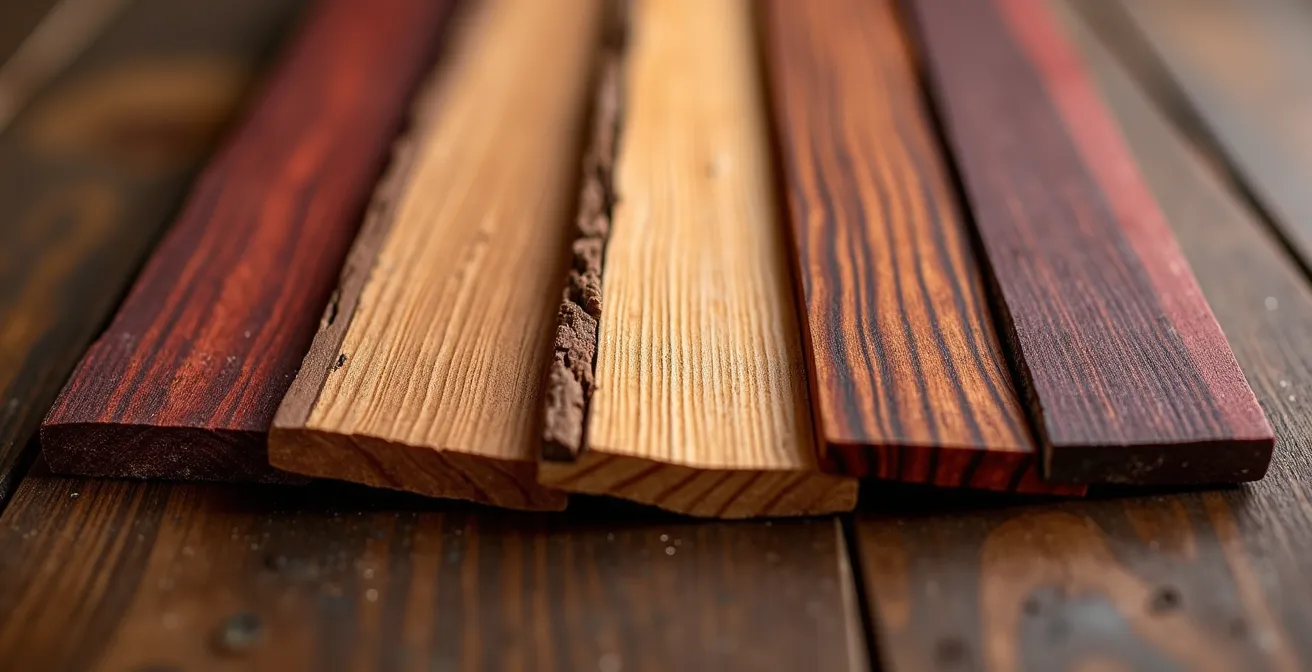
To aid in your due diligence, the following table lists some of the most at-risk tropical hardwoods. You should treat this as a non-negotiable blacklist. No certification claim can erase the extreme risk associated with these species.
| Wood Type | Marketing Aliases | Conservation Status | Primary Concern |
|---|---|---|---|
| Honduran Mahogany | Broad-Leaf Mahogany, Genuine Mahogany | Near Extinction | Illegal Amazon logging |
| Teak | Gold Standard Wood | Endangered | Over-harvesting in Southeast Asia |
| Rosewood | Madagascar Rosewood | Critically Endangered | Illegal trafficking affecting lemur habitats |
| Purpleheart | Amaranth | Near Extinction | Overharvesting in Central/South America |
| Ramin | White Ramin | Vulnerable | Borneo rainforest destruction |
Bamboo or Oak: Which Is Truly More Sustainable for Flooring?
This common question is a trap. It leads you to believe that sustainability is an inherent quality of a single plant species. This is false. A material’s sustainability is not determined by the material itself, but by the entire system of its cultivation, processing, transportation, and certification. Bamboo, often touted as a miracle grass, can be a terrible choice if it’s grown on clear-cut land, processed with toxic, formaldehyde-based adhesives, and shipped halfway around the world from an uncertified source.
Conversely, a slow-growing hardwood like Oak can be a far superior choice if it comes from a local, well-managed, FSC 100% certified forest. The focus should never be on “bamboo vs. oak” but on “certified vs. uncertified” and “local vs. global.” A particularly strong option that resolves this dilemma is FSC-certified engineered flooring. This product uses a thin top layer of the desired “show” wood (like oak) over a core of fast-growing, locally sourced, certified plywood (like birch).
This approach is vastly more efficient. An industry sustainability analysis reveals that 3 to 5 times more flooring can be created from the same single log when making engineered planks compared to solid wood planks. One company, The Solid Wood Flooring Company, exemplifies this by using FSC-certified birch for its ply layers. This demonstrates a system-based approach—combining FSC Chain of Custody with efficient material use—that is far more meaningful than the simple, and often misleading, choice of a raw material like bamboo.
The Supply Chain Gap Allowing Illegal Wood Into Big Box Stores
The single greatest challenge in sourcing ethical wood is supply chain opacity. From the moment a tree is cut to the moment a plank is sold in a big-box store, the material may pass through dozens of hands across multiple countries. This complexity creates gaps where illegal or uncertified wood can be laundered into the legitimate market. The scale of the problem is staggering; according to a Global Financial Integrity Report, it’s estimated that up to 90% of tropical timber traded globally may be illegally sourced.
This is often achieved by shipping raw logs from a high-risk country (like in the Amazon or Southeast Asia) to a processing country with lax oversight (often China), where it is turned into flooring. The final product is then stamped “Made in China,” effectively erasing its true, destructive origin. This isn’t theoretical; it’s a documented and widespread practice. As David Gehl of the Environmental Investigation Agency stated after analyzing timber imports:
It’s impossible to verify the legality of tropical hardwood products coming from China. I’ve seen the same documentation used for different loads of wood.
– David Gehl, Environmental Investigation Agency
This is why your role as a procurement officer is so vital. You cannot trust the “Made In” label or a retailer’s word. You must have a checklist of precise, non-negotiable questions to pierce through this opacity.
Your Verification Checklist: Questions to Ask Your Retailer
- Can you provide the specific Chain of Custody (CoC) certificate number for this product, not just a general company certificate?
- What is the country of harvest for the timber, and can you provide documentation to prove it is different from the country of manufacture?
- Which independent, third-party body audited your supplier’s certification, and can I see the audit report?
- Has this product’s origin been verified through a digital traceability system or another form of immutable documentation beyond the invoice?
- Does the invoice for this specific product I am buying explicitly list the FSC claim and your company’s FSC certificate code?
When to Buy Local Wood: Understanding Seasonal Availability
“Buy local” is excellent advice, but it’s incomplete. Local is only better if it’s also certified, responsibly managed, and available. The principles of procurement due diligence apply just as much to a small local sawmill as they do to a multinational corporation. A local source must still be able to prove its Chain of Custody. If they can’t provide a certificate number you can independently verify, it’s an unsubstantiated claim.
Furthermore, working with small, local, and truly sustainable suppliers requires a shift in consumer expectations. Unlike the vast, on-demand inventory of a global big-box store, local sawmills operate in tune with forest management cycles. Sustainable harvesting is not an on-demand process. Specific species and grades of wood are only available at certain times of the year, after a responsible harvest has occurred and the wood has been properly seasoned or kiln-dried.

This means planning is essential. As demonstrated by suppliers like Galleher Corporation, which maintains an FSC chain of custody for its locally-sourced products, even certified local wood isn’t always in stock. They recommend customers allow for significant lead time when placing orders. This isn’t a sign of poor service; it’s the hallmark of a truly sustainable operation that prioritizes forest health over instant gratification. If you want to use local wood, you must adopt a procurement mindset: plan your project months in advance and work with the supplier’s sustainable harvesting schedule.
How to Verify if a “Cruelty-Free” Logo Is Legit or Fake?
The term “cruelty-free” is most often associated with cosmetics, but in the context of our planet’s ecosystems, what is the clear-cutting of a primary rainforest if not an act of immense cruelty? The principle of verifying a claim, whether it’s “not tested on animals” or “sustainably harvested,” is universal. Any legitimate eco-label, from the FSC’s tree logo to the Leaping Bunny, operates on a non-negotiable principle: third-party verification backed by a public database.
A logo by itself is meaningless. It is merely a visual shortcut for a claim. The real value lies in the rigorous, audited system behind it. Self-made claims like “Earth-Friendly,” “Eco-Conscious,” or “Natural Wood” are marketing terms designed to make you feel good without offering any proof. A legitimate certification is always accompanied by a specific license or certificate number (e.g., FSC-C000000). This code is your key.
Your verification process for any eco-label is a simple, three-step forensic exercise:
- Find the Code: Locate the specific license number on the product, invoice, or supplier’s website. Ignore the product if no code is provided.
- Access the Database: Go to the official certifier’s public database online (e.g., the FSC’s certificate database). Do not use a link provided by the seller; find it yourself via a search engine.
- Verify the Status: Enter the code. The database must confirm that the certificate is valid, that it belongs to the company in question, and that it covers the specific product you are buying.
This level of documentation is not optional; it’s a requirement for professional systems like LEED (Leadership in Energy and Environmental Design), which does not accept an on-product label as proof. Instead, it requires project teams to submit invoices showing the supplier’s FSC certificate code to earn credit. This is the level of rigor you must adopt.
How to Verify the Safety of Reclaimed Wood for Interior Use?
Reclaimed wood presents a compelling narrative: it saves trees, preserves history, and offers unmatched character. While often an excellent sustainable choice, it introduces a different kind of risk that a procurement officer must manage: human health and safety. This wood has had a previous life, and you must investigate what that life entailed. It could have been treated with lead-based paint, soaked in industrial chemicals or pesticides, or become home to pests like powderpost beetles.
Sourcing safe reclaimed wood is not about aesthetics; it is about forensic investigation. The supplier must provide more than a good story; they must provide a guarantee of safety. Your due diligence should focus on a physical inspection and a contractual obligation from the supplier. Never install reclaimed wood without performing these checks.
Before bringing reclaimed wood into your home, you or your supplier must complete a comprehensive safety audit. This includes:
- Lead Paint Testing: Every painted surface must be tested using a reliable method like 3M LeadCheck swabs. Assume paint contains lead until proven otherwise.
- Pest Inspection: Look for small, pin-like holes or fine sawdust (frass), which indicate an active powderpost beetle or other wood-boring insect infestation.
- Chemical Contamination: Avoid wood with dark, oily stains or unusual chemical smells, which could indicate treatment with creosote, industrial oils, or pesticides not safe for interior use.
- Sterilization Verification: The wood must be kiln-dried to a core temperature that sterilizes it, killing any insects, eggs, or mold spores. Demand the kiln-drying certificate.
- Written Attestation: The supplier must provide a signed document attesting to the wood’s known history and confirming it is certified safe for interior residential use.
Key Takeaways
- Verification over Trust: The core principle of ethical sourcing is not to trust a logo or a salesperson’s claim, but to actively verify it through independent databases and Chain of Custody documentation.
- The Power of the Code: A legitimate certification is always backed by a specific certificate code (e.g., FSC-C000000). This code, not the logo, is your primary tool for verification.
- System, Not Species: True sustainability lies in the entire system of management, harvesting, and processing—not in the inherent qualities of a single species like bamboo or oak.
How to Select Insulation That Is Healthy for You and the Planet?
The rigorous procurement principles you have learned for flooring are not limited to flooring. This mindset is a universal tool for building a healthier, more sustainable home. Consider another critical component of your renovation: insulation. While materials like fiberglass or foam are common, you can apply your newfound wood-sourcing expertise here as well.
Wood-based insulation materials, such as cellulose (made from recycled paper) and wood fiberboard, are excellent alternatives. And just like with flooring, you must ask the same critical questions: Is the source material from responsibly managed forests? Can the manufacturer prove it with a legitimate, third-party certification?
Leading companies are already applying these principles. Cornerstone Specialty Wood Products, for instance, produces ResinDek engineered wood panels used in construction and for insulation substrates. Their products carry both an FSC certification (FSC-C124474) and validation from SCS Global Services. This demonstrates that the same Chain of Custody system that tracks a plank of oak flooring can and should be applied to the wood fibers that make up your insulation. By choosing a product with this level of verification, you are supporting a virtuous cycle. As the Forest Stewardship Council itself states, “FSC certification creates an incentive for forest owners and managers to follow best social and environmental practices.”
You now possess the framework of a sustainable procurement officer. The next time you walk into a showroom, you are no longer a passive consumer. You are an auditor, armed with the knowledge to demand accountability and the tools to verify claims. By making this mindset your standard operating procedure for all renovation decisions, you actively choose to build a better home and support a healthier planet.