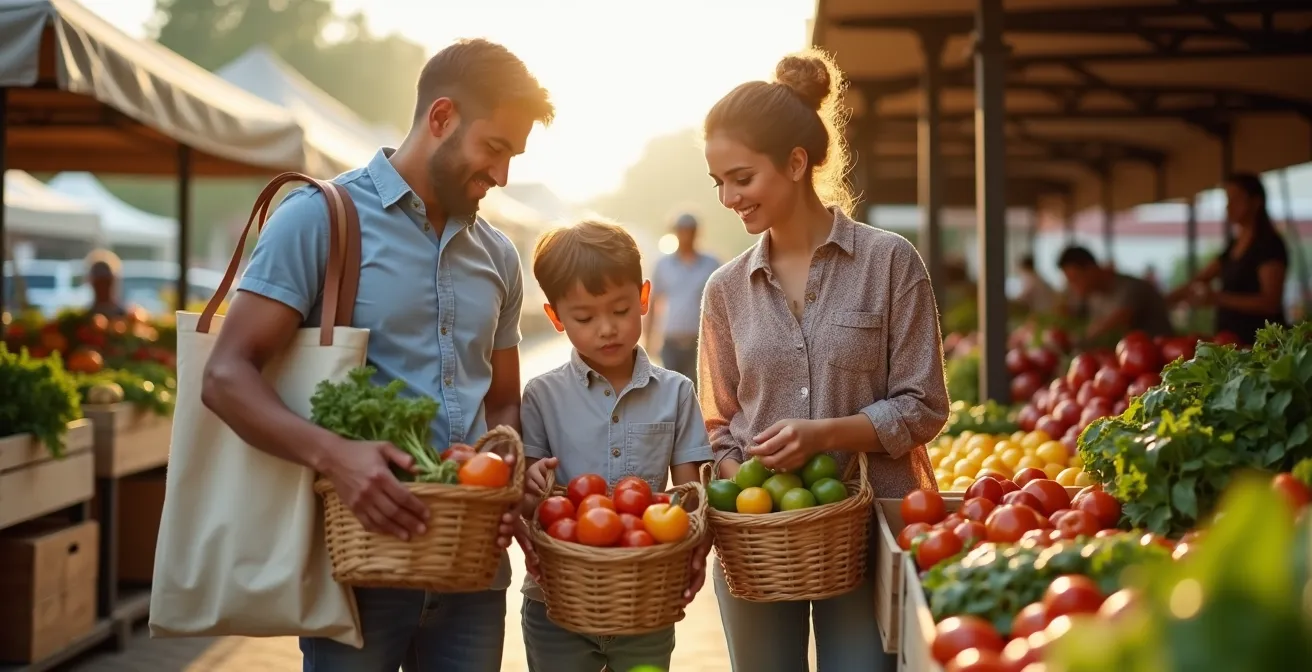
The secret to affording organic food isn’t about having a bigger budget; it’s about mastering a system of strategic trade-offs to get the most health benefits for every dollar spent.
- Prioritize organic for produce with the highest pesticide loads (the “Dirty Dozen”) and save on the rest.
- Embrace high-quality store brands and frozen organic options to cut costs by up to 40% without sacrificing nutrition.
Recommendation: Shift your focus from buying *everything* organic to maximizing your family’s “Nutritional ROI” by avoiding marketing traps and food waste.
Walking into a grocery store with the goal of feeding your family healthy, organic food can feel like a battle. On one side, there’s the desire to avoid pesticides and processed ingredients. On the other, there’s the very real shock of a grocery bill that seems to inflate with every “USDA Organic” label you put in your cart. For many parents, the dream of a 100% organic kitchen quickly collides with the reality of a middle-class budget, making Whole Foods feel like a luxury retailer.
The common advice is a familiar chorus: buy in bulk, look for sales, and maybe grow your own herbs. While well-intentioned, these tips barely scratch the surface. They don’t address the core dilemma: when you have limited funds, where should you direct your “organic dollars” to have the most significant impact on your family’s health? The frustration is real, leading many to feel that a truly organic lifestyle is simply unattainable.
But what if the entire approach is flawed? What if the key isn’t about trying to afford everything with a green label, but about becoming a savvy food strategist? This guide is built on a realistic principle: eating organic on a budget is a game of strategic trade-offs. It’s about learning where the organic label is non-negotiable, where it’s a “nice-to-have,” and where it’s simply a marketing gimmick designed to make you overpay. We will move beyond simple shopping lists to build a system that maximizes your nutritional return on investment (ROI), neutralizes marketing traps, and cuts hidden costs you may not even be aware of.
This article provides a complete system for making smart, budget-conscious decisions in every aisle. Below, the summary outlines the key strategies we will cover, from prioritizing your produce purchases to decoding the real value behind the price tag.
Summary: Your Guide to Strategic Organic Shopping
- Why You Must Buy These 12 Fruits Organic (And Skip the Rest)?
- How to Find Generic Organic Brands That Taste Like the Premium Ones?
- Frozen Organic or Fresh Conventional: Which Is Healthier in Winter?
- The “Health Halo” Mistake: Why Organic Cookies Are Still Junk Food
- When to Stock Up on Organic Grains and Oils for Maximum Savings?
- The “True Cost” Principle: Why a $5 Organic Apple Can Be Cheaper Than a $1 Conventional One?
- Why Does Your Grocery Bill Rise Faster Than the Official Inflation Rate?
- How to Reduce Household Waste by 50% Without Increasing Your Monthly Budget?
Why You Must Buy These 12 Fruits Organic (And Skip the Rest)?
The first rule of budget-conscious organic shopping is to accept that you don’t need to buy everything organic. The price difference is significant; analysis shows that organic produce can cost, on average, 52.6% more than its conventional counterpart. Therefore, the strategic approach is to focus your spending where it matters most: on the items with the highest pesticide residue. This is the concept behind the “Dirty Dozen,” a list published annually by the Environmental Working Group (EWG).
These are the fruits and vegetables that, due to thin skins or farming practices, absorb and retain the most chemicals. By prioritizing the organic versions of these items, you drastically reduce your family’s pesticide exposure without having to buy everything organic. Conversely, the “Clean Fifteen” list identifies produce with the least residue, where buying conventional is a safe and smart way to save money. This isn’t about compromise; it’s about maximizing your nutritional ROI.
Think of it as a targeted health investment. Every dollar spent on an organic strawberry or spinach is a dollar that actively works to lower your family’s chemical load. The key is to be selective and informed. For 2024, the priority items to always buy organic include:
- Strawberries: Consistently rank as having the highest levels of pesticide residue.
- Spinach and leafy greens: Often contain multiple different types of pesticides.
- Grapes and stone fruits (peaches, nectarines): Their thin skin makes them prone to absorbing chemicals.
- Apples and pears: Systemic pesticides, which are absorbed into the plant, are commonly used.
- Bell peppers and hot peppers: Subject to high levels of chemical treatment during their growth.
- Cherries and blueberries: These delicate fruits are frequently sprayed to prevent pests and mold.
Focusing on this high-priority list is the single most effective step to eating healthier on a budget. It transforms your shopping from a guessing game into a precise, evidence-based strategy.
How to Find Generic Organic Brands That Taste Like the Premium Ones?
Once you’ve mastered produce, the next frontier is packaged goods. Here, the price gap between premium organic brands and their generic or store-brand equivalents can be enormous. Many parents hesitate, fearing that a lower price means lower quality or less stringent organic standards. However, this is often a misconception fueled by clever branding. The secret is that many store brands are produced by the very same manufacturers that make the premium products.
Major retailers like Costco (Kirkland Signature), Kroger (Simple Truth), and Whole Foods (365) have invested heavily in their organic private labels. They leverage their massive purchasing power to secure high-quality products at a lower cost, passing the savings on to you. The key is to look past the packaging and focus on the ingredient list and the USDA Organic seal. If both are comparable, you’re likely getting a nearly identical product for 20-40% less. For instance, Trader Joe’s has built its entire brand on this model, achieving 72% brand recognition among U.S. consumers for its high-quality, affordable organic offerings.
This side-by-side comparison shows just how much you can save without compromising on quality. The ratings, based on consumer reviews and ingredient analysis, demonstrate that store brands are often on par with their more expensive competitors.

The following table illustrates the potential savings and quality parity between popular store brands and their premium counterparts. This data makes it clear that brand loyalty can be an unnecessary expense.
| Store Brand | Premium Equivalent | Average Savings | Quality Rating |
|---|---|---|---|
| Kirkland Organic (Costco) | Horizon/Organic Valley | 30-40% | 4.5/5 |
| 365 Whole Foods | Annie’s/Amy’s | 25-35% | 4.7/5 |
| Simple Truth (Kroger) | Nature’s Path | 20-30% | 4.3/5 |
Frozen Organic or Fresh Conventional: Which Is Healthier in Winter?
Here is a classic strategic trade-off every budget-conscious parent faces, especially during the winter months: a bag of frozen organic berries or a carton of “fresh” conventional ones that have traveled thousands of miles? Intuition might say fresh is always better, but science tells a different story. The frozen aisle can be your best ally for affordable, high-quality organic produce.
Fruits and vegetables destined for freezing are typically picked at their peak ripeness and flash-frozen within hours, a process that locks in their nutritional content. In fact, research shows that flash-freezing preserves nutrients effectively, with frozen vegetables retaining up to 90% of their vitamins. In contrast, “fresh” out-of-season produce may have spent weeks in transit and storage, losing a significant portion of its nutritional value by the time it reaches your kitchen.
This makes frozen organic a clear winner in both health and value. You get the benefit of organic (no pesticides) combined with peak-season nutrition, often at a fraction of the cost of its off-season fresh equivalent. A study from the University of California confirms this logic, highlighting the nutritional superiority of properly preserved foods. As experts from the University of California’s Division of Agriculture and Natural Resources noted in the Journal of Science Food and Agriculture:
Organic berries frozen at peak ripeness nutritionally outperform ‘fresh’ conventional berries shipped for weeks.
– University of California Agriculture Study, Journal of Science Food Agriculture
So, the next time you’re debating in the produce aisle, remember this trade-off. Opting for frozen organic berries, spinach, or peas is a savvy move that boosts your family’s nutrient intake while protecting your wallet.
The “Health Halo” Mistake: Why Organic Cookies Are Still Junk Food
The “USDA Organic” seal can create a powerful psychological effect known as the “health halo.” This is the tendency to perceive a food as healthier than it actually is simply because it carries a positive label. Marketers are experts at exploiting this, and it’s a trap that can derail both your budget and your health goals. An organic cookie, for example, is still a cookie—likely high in sugar, processed fats, and empty calories.
The data shows just how pervasive this bias is. According to a 2024 consumer survey that reveals this trend, a staggering 50% of Americans automatically believe organic products are healthier, regardless of their actual nutritional content. This mindset leads to overspending on processed “organic” snacks, juices, and cereals that offer little to no health advantage over their conventional counterparts. A savvy organic shopper learns to look past the halo and read the nutrition label first.
The most effective strategy is to use your organic budget for whole, unprocessed foods. Instead of buying expensive organic crackers or fruit snacks, redirect that money toward organic oats, fruits, and vegetables. By making simple, homemade alternatives, you not only save a significant amount of money but also gain complete control over the ingredients, especially sugar and sodium. This approach shifts your spending from high-margin, low-value processed goods to high-value, nutrient-dense staples. Here are some smart swaps:
- Replace organic cookies with homemade energy balls using organic oats and dates.
- Swap organic chips for air-popped organic popcorn, which offers a 70% cost saving.
- Choose fresh organic fruit over packaged organic fruit snacks.
- Make your own organic granola bars instead of buying the boxed versions.
- Prepare vegetable sticks with homemade hummus instead of buying organic crackers.
When to Stock Up on Organic Grains and Oils for Maximum Savings?
While prioritizing produce is key, a truly sustainable organic budget is built on a well-stocked pantry. The strategy here is what can be called “Pantry Economics”: buying staple goods like organic grains, beans, pastas, and oils in bulk when they are at their lowest price. This requires a bit of planning but yields massive long-term savings. The key is knowing *when* to buy.
Supermarket sales cycles are predictable. Retailers often discount baking supplies after major holidays, clear out old stock in the spring, and promote new harvest items in the fall. By aligning your bulk purchases with these cycles, you can stock up on essentials at discounts of up to 40%. This proactive approach prevents you from buying these items at full price on your weekly shopping trip, freeing up significant room in your budget for fresh produce.
Proper storage is crucial to make this strategy work. Invest in airtight containers (glass jars are excellent) to keep your bulk goods fresh and protected from pests. This not only preserves your investment but also creates an organized system that makes meal planning easier. An organized pantry is the backbone of a budget-friendly organic kitchen.
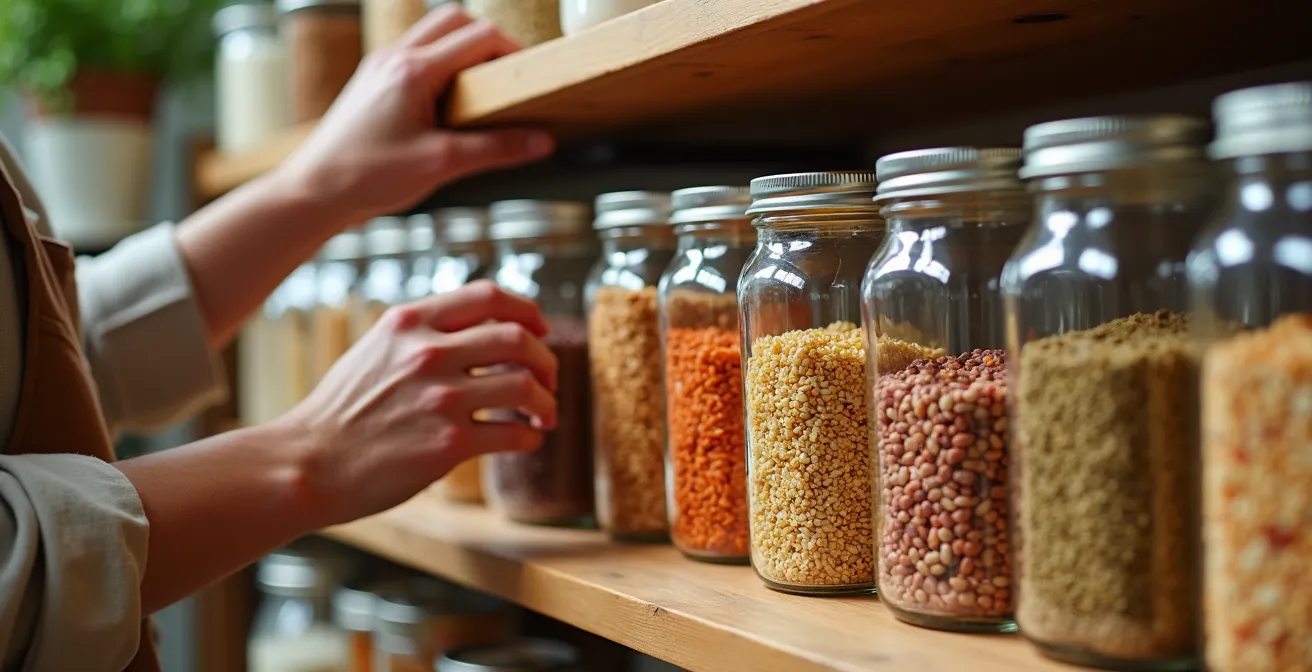
Use the following calendar as a guide for your strategic pantry stocking. Planning your purchases around these key months can lead to substantial savings over the course of a year.
| Month | Best Buys | Expected Discount |
|---|---|---|
| January | Post-holiday baking supplies, oils | 30-40% off |
| March | Grains, pasta (spring cleaning sales) | 25% off |
| September | Harvest grains, new crop oils | 20-30% off |
| November | Baking essentials for holidays | Buy-one-get-one deals |
The “True Cost” Principle: Why a $5 Organic Apple Can Be Cheaper Than a $1 Conventional One?
On the surface, a $10 fast-fashion T-shirt is cheaper than a $40 sustainable one. Similarly, a $1 conventional apple seems more affordable than its $5 organic counterpart. This comparison, however, is dangerously incomplete because it ignores the “true cost” of our choices. The price on the tag is merely the short-term cost. The true, long-term cost includes external factors like environmental impact and, most importantly for a parent, future health expenses.
Eating conventional produce, especially items from the “Dirty Dozen,” means consistent, low-dose exposure to a cocktail of pesticides. While the immediate effects may not be obvious, long-term exposure has been linked to a variety of health issues. These potential health problems carry their own costs—in medical bills, lost productivity, and diminished quality of life. When viewed through this lens, the higher upfront price of organic food can be seen as a form of preventative health insurance.
This isn’t just a theoretical concept; it’s a calculation that has a real financial impact on families. An investment in cleaner food today can lead to significant savings on healthcare down the road, making the organic choice the more economically sound one in the long run.
Case Study: The True Cost of Groceries
A “True Cost” analysis provides a powerful financial argument for eating organic. When factoring in the potential long-term healthcare expenses associated with pesticide exposure and the nutritional deficits from lower-quality foods, the numbers shift dramatically. One analysis found that a family spending an average of $796 per month on organic groceries could save an estimated $2,000 to $3,000 annually in future health costs compared to a family consuming primarily conventional food. This reframes the higher grocery bill not as an expense, but as a wise, long-term investment in family well-being.
Adopting this mindset is transformative. It changes the question from “Can I afford to buy this organic apple?” to “Can I afford *not* to?” Recognizing the hidden costs of conventional food is a crucial step toward justifying the investment in organic.
Why Does Your Grocery Bill Rise Faster Than the Official Inflation Rate?
If you feel like your organic grocery bill is increasing at a dizzying pace, you’re not imagining it. While general food inflation is a known issue, the organic sector often experiences even greater price volatility. This is because the organic supply chain is more fragile than the conventional one. Organic farms are typically smaller, have less access to government subsidies, and are more vulnerable to weather events, pests, and crop failures. When a large organic crop fails, there are fewer alternative sources to fill the gap, causing prices to spike.
For example, the Organic Trade Association reports that organic food prices rose 5.2% in 2024, outpacing the rate of general food inflation in some categories. This volatility can make budgeting feel impossible. However, another, more subtle factor is also at play: shrinkflation. This is the practice where manufacturers reduce the size or quantity of a product while keeping the price the same. You’re paying the same amount for less, which is a hidden form of price increase. This is particularly common in packaged organic goods like cereals, crackers, and snacks.
Understanding these two forces—supply chain volatility and shrinkflation—is the first step to fighting back. By being aware, you can make more defensive purchasing decisions. This includes stocking up on staples when they are on sale (as discussed in the “Pantry Economics” section), paying close attention to the net weight on packages to spot shrinkflation, and being flexible enough to substitute an unusually expensive item for a more stable alternative, like swapping pricey fresh organic greens for a frozen organic variety.
Your Action Plan: Audit Your Personal Inflation Rate
- Points of Contact: List the 10-15 staple organic items you buy most frequently (e.g., milk, eggs, oats, specific fruits).
- Collecte: For one month, keep all your grocery receipts. Highlight these staple items and note their price and package size (e.g., Organic Oats, $4.99 for 18 oz).
- Coherence: At the end of the month, compare the prices and sizes to your receipts from a previous month if available, or start a log for the next month. Have prices risen? Have the package sizes shrunk?
- Mémorabilité/émotion: Identify the top 3 items with the highest price increase or most noticeable “shrinkflation.” This is where your personal inflation is hitting hardest.
- Plan d’intégration: For those top 3 items, create a specific action plan. Can you switch to a store brand? Buy it in bulk from a different store? Swap it for a more stable alternative?
Key Takeaways
- Eating organic on a budget is a system of strategic trade-offs, not a matter of buying everything with a green label.
- Focus spending on the “Dirty Dozen” and save on the “Clean Fifteen” to maximize your health ROI.
- Leverage high-quality store brands, frozen organic produce, and smart bulk-buying to cut costs without sacrificing nutrition.
How to Reduce Household Waste by 50% Without Increasing Your Monthly Budget?
Perhaps the most powerful strategy for affording organic food has nothing to do with what you buy, but rather with what you *don’t* throw away. Food waste is a massive hidden cost in every household budget. Studies show that up to 40% of food in the U.S. goes uneaten annually, which could be costing the average family over $1,500 per year. By redirecting that wasted money, you can effectively fund a significant portion of your organic food budget.
When you buy organic, you’re paying a premium for high-quality, nutrient-dense food. Throwing it away is like throwing cash directly into the trash. The solution is to adopt a “root-to-stem” kitchen philosophy. This means finding a use for every part of the plant. Carrot tops can be turned into pesto, broccoli stems can be shredded for slaw, and vegetable scraps can be saved in the freezer to make a rich, flavorful stock for free.
Implementing a few simple systems can drastically reduce waste. Create an “Eat Me First” box in your fridge for items nearing their expiration date. This visual cue ensures that older produce gets used before it spoils. Additionally, plan one “clean out the fridge” meal each week—like a stir-fry, soup, or frittata—to use up any leftover vegetables and proteins. These habits not only honor the food you’ve purchased but also unlock the funds needed to continue investing in high-quality organic ingredients.
Embracing these strategies turns your kitchen into a highly efficient, waste-free ecosystem, making an organic lifestyle far more achievable and sustainable.
By shifting your mindset from simply buying organic to strategically managing your entire food ecosystem—from purchase to pantry to plate—you can build a healthy, sustainable, and affordable organic lifestyle for your family.
Frequently Asked Questions About Organic Budgeting
Why are organic prices more volatile than conventional?
Organic supply chains are more vulnerable to weather events and have limited backup sources when crops fail, causing price spikes. Conventional agriculture often relies on vast, geographically diverse networks and government subsidies that help stabilize prices, a luxury the smaller-scale organic market doesn’t always have.
What is ‘shrinkflation’ in organic products?
“Shrinkflation” is when manufacturers decrease the package size of a product while keeping the price the same or even increasing it slightly. It’s a hidden price hike. For example, many organic cereal boxes now contain 10-15% less product than they did just three years ago for the same price. Always check the net weight and price per ounce/gram to be a savvy shopper.
How can I track my personal organic food inflation?
The best way is to be your own economist. Keep your receipts for staple organic items (e.g., milk, eggs, bread, a specific brand of pasta) and compare the prices month-to-month. You can create a simple spreadsheet or just keep a running note. You’ll quickly see that your personal inflation rate on the items you buy most may differ significantly from the national averages reported in the news.